

Calling a residential furnace technician to fix a multi-unit boiler system or a 50-ton rooftop unit is like asking a bicycle mechanic to repair a jet engine. While both understand basic mechanics, the scale and technical stakes are in entirely different leagues. For property managers in the GTA, the distinction between a local shop and a specialized commercial HVAC contractor Toronto can be the difference between a productive building and a significant operational liability.
We understand the stress of a system failure during a -20°C deep freeze, especially when your current provider offers nothing but slow response times and vague, hidden costs. You deserve a partner who prioritizes transparency and proactive care over reactive patchwork. This 2026 comparison guide will show you how to distinguish between generalists and true mechanical experts. We will explore the latest refrigerant regulations, the necessity of A2L certification, and how a strategic maintenance plan can lower your energy bills through optimized building automation and 24/7 reliability.
Key Takeaways
- Distinguish between residential-grade service and full-scale mechanical expertise to ensure your complex boiler and chiller systems are handled with precision.
- Learn why a specialized commercial HVAC contractor Toronto is vital for maintaining compliance with 2026 refrigerant regulations and TSSA safety standards.
- Identify the financial red flags of vague, low-cost quotes that often lead to expensive change orders and frequent system failures.
- Discover how transitioning from reactive repairs to a proactive maintenance strategy can extend the life of your mechanical equipment by up to 30%.
- Understand the baseline requirements for GTA property managers, including the necessity of a partner with true 24/7 emergency response capabilities.
Mechanical Contractor vs. Residential HVAC: Understanding the Scope
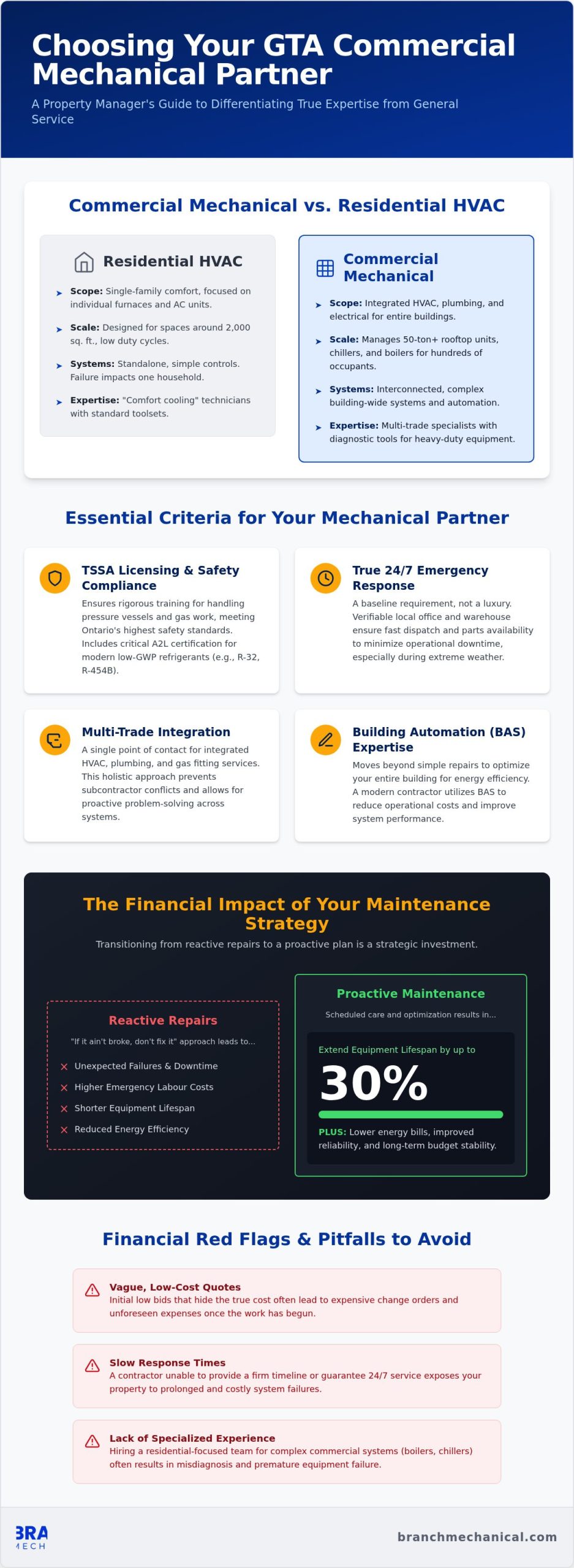
A mechanical contractor isn’t just a repair service. They’re multi-trade experts managing the complex intersection of Heating, ventilation, and air conditioning (HVAC), plumbing, and electrical systems. While a residential shop focuses on single-family comfort, a commercial HVAC contractor Toronto manages the infrastructure that keeps entire businesses and high-rise communities operational. They handle the heavy lifting of building systems that residential technicians rarely encounter.
The scale of these systems is vastly different. A residential furnace might heat a 2,000-square-foot home, but a commercial chiller or rooftop unit (RTU) manages ten times that load while balancing humidity and air quality for hundreds of occupants. Multi-residential properties require specific technical certifications because their systems are interconnected; a failure in one unit can affect the entire building’s pressure and efficiency. A dedicated commercial HVAC contractor Toronto must understand building-wide systems to ensure that individual components don’t work against the central plant’s logic.
Why Residential Solutions Fail in Commercial Environments
Residential equipment isn’t designed for the high duty cycles of a commercial setting. Commercial units run almost constantly, requiring heavy-duty replacement parts and specialized diagnostic tools that most residential shops don’t carry. Using under-equipped providers for condo HVAC systems often leads to premature compressor failure and inadequate climate control. These systems demand a level of precision that “comfort cooling” technicians aren’t trained to provide. It’s about more than just fixing a leak; it’s about maintaining the integrity of the building’s mechanical design.
The Multi-Trade Advantage for GTA Property Managers
Managing a building is easier when your gas fitting, plumbing, and HVAC services are integrated. When you have one point of contact for mechanical failures, you reduce administrative friction and eliminate the “blame game” between different subcontractors. This holistic view allows a contractor to spot how a plumbing leak might be affecting your HVAC’s electrical components before a total shutdown occurs. It’s a pro-active approach that ensures better system performance and long-term stability for your property.
Essential Criteria for Evaluating GTA Mechanical Partners
Selecting a commercial HVAC contractor Toronto involves looking far beyond the bottom line of a project quote. You need a partner with the infrastructure to support your building when systems fail. A 24/7 emergency response is not a luxury; it’s a baseline requirement for GTA businesses that cannot afford operational downtime. Ensure your contractor maintains a physical office and a local warehouse. This presence guarantees parts availability and faster dispatch times when every minute counts. You should also verify that a contractor has specific experience with your building type, whether you manage a sprawling industrial warehouse or a complex multi-residential high-rise.
TSSA Licensing and Ontario Safety Standards
In Ontario, TSSA licensing is the gold standard for anyone handling pressure vessels and complex gas work. It ensures the technician has the rigorous training required to keep your facility safe and compliant with 2026 safety standards. This includes specific A2L safety training required to handle newer, low-GWP refrigerants like R-32 or R-454B. WSIB compliance and robust commercial insurance are equally critical, as they protect property owners from liability during high-risk installations. Professional contractors also implement specific safety protocols for active environments, such as commercial kitchens or industrial sites, where gas lines and ventilation systems are critical to daily safety.
Technological Capability: BAS and Energy Management
A modern commercial HVAC contractor Toronto helps you organize and realize significant energy savings through Building Automation Systems (BAS). There is a vast difference between a standard “fix-it” shop and a partner that optimizes commercial HVAC systems for peak performance. By utilizing Energy-efficient commercial HVAC equipment and smart controls, you can reduce waste and lower utility costs. Remote monitoring is essential in 2026 for minimizing tenant complaints by identifying issues before they impact building comfort. If you want a team that balances technical skill with advanced energy management, you can learn more about our integrated mechanical services.
Red Flags and Common Pitfalls in the Toronto Market
Identifying a reliable commercial HVAC contractor Toronto requires a keen eye for what isn’t in the contract. “Low-ball” quotes are a common trap in the GTA market. These initial estimates often exclude essential components, leading to a cycle of constant change orders that eventually exceed the cost of a professional bid. Another major red flag is a contractor who relies exclusively on unvetted subcontractors. This practice dilutes accountability and makes it nearly impossible to maintain consistent quality across your facility. Always ask for references from similar-sized commercial properties in Mississauga or Etobicoke to ensure the contractor has the logistical capacity to handle your specific building scale.
A lack of documented service reports is a significant administrative warning sign. Without detailed records, you lose the ability to track system health or prove compliance during audits. Professional firms prioritize transparency by providing digital reports that summarize every repair and inspection. If a contractor can’t provide a clear history of what was fixed and why, they’re likely not managing your assets with a long-term strategy.
The Hidden Risks of Cut-Rate Repairs
Opting for the cheapest repair often leads to long-term financial damage. Poor installations frequently void manufacturer warranties, leaving you responsible for the full cost of a premature system failure. Beyond the financial risk, unqualified gas fitting or electrical work poses severe safety hazards to your tenants and staff. These “cheap” fixes are a primary cause of system cascades. For example, a faulty HVAC unit can place undue stress on other mechanicals, eventually requiring emergency commercial refrigeration repair Mississauga. Reliable contractors focus on doing the job right the first time to protect your total investment.
Communication Gaps and Response Time Realities
Response time is critical when a boiler fails in January. Contractors who don’t offer a guaranteed emergency response window leave your property vulnerable to frozen pipes and tenant lawsuits. Property managers need digital reporting for insurance and regulatory compliance, yet many shops still rely on vague paper receipts. Poor communication between trades also leads to extended system downtime. If your HVAC technician doesn’t coordinate with your plumber or electrician, simple repairs can stretch into multi-day projects. A professional contractor manages these overlaps internally to keep your building running smoothly.
Financial Strategy: Preventative Maintenance vs. Emergency Repair
Operating with a reactive mindset is one of the most expensive mistakes a property manager can make. When you wait for a system to fail before calling a commercial HVAC contractor Toronto, you aren’t just paying for a repair; you’re paying a premium for urgency. Proactive mechanical care shifts the financial burden from unpredictable emergency spikes to a managed, predictable budget. Investing in consistent commercial HVAC maintenance is documented to extend the operational life of your equipment by 25-30%, deferring the massive costs of premature replacement.
The true cost of a breakdown includes “soft costs” that rarely appear on a single invoice. Tenant turnover increases when climate control is inconsistent, and businesses lose revenue every hour a facility remains closed due to air quality or temperature issues. Regular mechanical audits provide the data necessary to plan for capital expenditures (CAPEX) years in advance, ensuring you’re never blindsided by a six-figure equipment failure during a peak season.
Calculating the ROI of Proactive Care
In the GTA, emergency premiums during a January deep freeze or a July heatwave can significantly inflate your operational costs. Beyond the call-out fees, poorly maintained systems often see monthly utility bills rise by up to 20% due to friction, clogged filters, and sensor drift. A commercial HVAC contractor Toronto focuses on calibrating these systems to their original design specifications, which directly impacts your bottom line. There is also a proven link between high-quality indoor air and tenant retention; a building that breathes well is a building that stays leased.
The Core Components of a Commercial Service Contract
A professional service contract should be more than a filter change. It should include a comprehensive quarterly or bi-annual mechanical audit that inspects heat exchangers, electrical connections, and refrigerant levels. Contract holders also benefit from prioritized scheduling, which is vital when every contractor in the city is booked during a record-breaking heatwave. This regular service ensures your building remains compliant with Ontario fire codes and TSSA regulations, protecting you from potential fines and liability. If you’re ready to stabilize your building’s performance and protect your mechanical assets, you can request a custom preventative maintenance quote from our team today.
Why Branch Mechanical is the Strategic Choice for GTA Property Managers
Branch Mechanical stands apart as a dedicated commercial HVAC contractor Toronto by focusing exclusively on the sectors that matter most to professional property managers: commercial and multi-residential facilities. We don’t split our focus with residential furnace repairs or single-family comfort cooling. Instead, we provide the specialized infrastructure and deep technical knowledge needed to maintain complex boiler plants, chiller systems, and multi-trade mechanical rooms. As a Canadian-owned contractor founded in 2012, we understand the stability our clients require. Our commitment to 24/7 emergency mechanical services ensures that when a critical failure occurs, our rapid GTA response team is already on the move to stabilize your building and protect your residents.
Our Integrated Mechanical Approach
Our integrated approach simplifies your daily operations by handling HVAC, plumbing, and electrical services under one roof. This “one-stop-shop” model removes the significant administrative burden of coordinating multiple vendors and ensures that every trade works in harmony rather than in isolation. We have extensive experience with Toronto’s diverse building stock, ranging from the intricate piping of aging high-rises in the downtown core to the massive rooftop units of modern industrial warehouses. Our technicians receive specialized training for high-performance commercial HVAC installation, ensuring that every new system meets the rigorous TSSA and efficiency standards required in 2026. This holistic view allows us to identify how a plumbing issue might impact your HVAC electrical, solving problems before they cause a shutdown.
The Branch Mechanical Guarantee
Transparency is the foundation of our partnership. We provide detailed, digital reporting that helps property managers justify maintenance costs to boards and stakeholders with concrete data. Our pro-active strategy identifies minor component wear or sensor drift before it escalates into a major system failure, protecting your budget from the high costs of reactive repairs. Beyond immediate reliability, we are committed to reducing your facility’s carbon footprint through advanced energy management and Building Automation Systems (BAS). By optimizing your mechanical logic, we help you realize lower utility bills while maintaining a high standard of indoor air quality. If you’re looking for a partner to optimize your mechanical assets, we invite you to consult with our mechanical contractors for a comprehensive facility audit. Getting started with a customized preventative maintenance plan today is the most effective way to ensure long-term stability for your property.
Securing Your Building’s Future with Professional Mechanical Care
Choosing the right commercial HVAC contractor Toronto is a strategic decision that affects your building’s operational stability and long-term financial health. We’ve explored the critical differences between general residential shops and full-scale mechanical experts; highlighting how specialized knowledge in TSSA regulations and Building Automation Systems (BAS) protects your assets. Shifting from a reactive repair cycle to a proactive maintenance strategy doesn’t just lower utility bills. It ensures your facility remains a reliable, high-performing environment for every tenant.
Branch Mechanical provides the stability property managers need through our TSSA-licensed expertise and a dedicated 24/7 emergency response team. We’re committed to helping you realize better energy management while reducing the administrative friction of managing multiple trades. If you’re ready to move beyond vague quotes and slow response times, we invite you to Request a Mechanical System Audit for Your Toronto Property. Taking this step today ensures your mechanical systems are prepared for the challenges of the coming years. We look forward to helping you build a more resilient and efficient property.
Frequently Asked Questions
What should I look for in a commercial HVAC contractor in Toronto?
Focus on TSSA licensing, multi-trade capability, and a physical local presence. A reliable commercial HVAC contractor Toronto should offer 24/7 emergency response and have a proven track record with complex building systems rather than just residential units. Look for contractors who provide digital, transparent reporting to help you justify maintenance costs to your board or stakeholders while ensuring your facility stays compliant with Ontario safety standards.
Are HVAC contractors in Ontario required to be TSSA licensed?
Yes, any contractor working on gas-fired equipment, boilers, or pressure vessels in Ontario must be TSSA licensed. This certification ensures the technician has met rigorous safety standards for high-pressure systems. Working with an unlicensed provider can void manufacturer warranties and lead to significant safety liabilities for property owners. Branch Mechanical is fully TSSA licensed and insured to handle these complex commercial requirements safely and professionally.
How often should a commercial HVAC system be serviced in the GTA?
Most commercial and multi-residential buildings in the GTA require a minimum of quarterly maintenance to handle Toronto’s extreme seasonal shifts. This schedule allows for filter changes, belt inspections, and sensor calibrations before the peak winter and summer seasons. Frequent servicing is especially critical for high-use systems like rooftop units (RTUs) and boiler plants to prevent unexpected failures during -20°C deep freezes or record-breaking summer heatwaves.
What is the difference between a residential and a commercial HVAC contractor?
The primary difference lies in the scale and complexity of the equipment. Residential contractors typically handle single-family furnaces and AC units, whereas a commercial HVAC contractor Toronto manages large-scale chillers, boilers, and building automation systems. Commercial work requires multi-trade expertise across plumbing, electrical, and gas fitting to ensure building-wide systems remain balanced. Commercial systems also operate on much higher duty cycles, requiring specialized heavy-duty parts and diagnostic tools.
Do you provide 24/7 emergency HVAC repair in Mississauga and Etobicoke?
We provide full 24/7 emergency mechanical services throughout Mississauga, Etobicoke, and the broader Greater Toronto Area. Our rapid response team is equipped to handle critical failures in HVAC, refrigeration, and electrical systems at any hour of the day. We understand that a boiler or chiller failure can lead to business closures or tenant displacement, so we prioritize emergency calls for our contract holders to ensure long-term building continuity.
Can a mechanical contractor help reduce my building’s energy costs?
A specialized mechanical contractor reduces energy costs by optimizing Building Automation Systems (BAS) and performing regular system audits. By calibrating sensors and ensuring that heating and cooling cycles don’t overlap, we can often lower utility bills by up to 20%. Our focus on energy management helps property managers reduce their building’s carbon footprint while extending the operational life of their mechanical assets through precise, data-driven adjustments and proactive maintenance.
What is included in a preventative maintenance contract for a condo building?
A standard preventative maintenance contract for a condo includes quarterly inspections of central plants, make-up air units, and common area HVAC. We perform tasks such as cleaning condenser coils, testing safety controls, and lubricating bearings. These steps ensure compliance with Ontario fire codes and prevent small leaks from becoming major floods. We also check electrical connections and gas lines to ensure every component of your mechanical room is operating at peak efficiency.
How do I choose between repairing or replacing my rooftop HVAC unit?
The decision usually depends on the age of the unit and the frequency of repairs. If a rooftop unit (RTU) is over 15 years old or requires a repair that costs more than 50% of its value, replacement is often more cost-effective. Modern units offer significantly better energy efficiency and comply with 2026 refrigerant regulations. We provide detailed audits to help property managers evaluate the return on investment for a new high-performance installation.