

Why does your Mississauga condo feel like a sauna in May, even when you’ve already switched your thermostat to “cool”? It’s a common frustration for GTA residents caught between a building’s central schedule and the actual weather outside. You likely feel that managing condo hvac systems shouldn’t require a degree in mechanical engineering or a constant battle with a noisy fan coil. Between rising energy costs and the confusion of the 2024 Ontario Building Code updates, staying comfortable in a high-rise can feel like a full-time job.
We understand that you want a home that stays at the right temperature without the mystery of high utility bills or uncertain repair responsibilities. This guide will help you identify exactly which system type you have and provide basic troubleshooting steps to keep things running smoothly. You’ll learn how to optimize your settings for efficiency and realize exactly when it’s time to call in a professional. We’re going to break down the technical side of your heating and cooling so you can enjoy total peace of mind in your living space.
Key Takeaways
- Learn how to identify your specific unit and understand how it regulates humidity and air quality within Mississauga high-rises.
- Discover the functional differences between centralized 2-pipe or 4-pipe systems and decentralized heat pumps to better manage your indoor comfort.
- Master the essential maintenance steps for condo hvac systems, including the critical schedule for filter replacements to prevent coil freezing.
- Recognize the early warning signs that your equipment is nearing the end of its lifespan and how modern upgrades can lower your monthly energy bills.
Understanding the Basics of Condo HVAC Systems
Condo hvac systems function as a critical bridge between your personal comfort and the building’s central infrastructure. Unlike a detached house where a furnace and air conditioner operate independently, a condominium unit is part of a massive, integrated network. These systems do more than just blow warm or cool air. In dense Mississauga high-rises, they are responsible for regulating humidity and maintaining high indoor air quality by filtering out urban pollutants like traffic exhaust and construction dust.
Your comfort relies on a “handshake” between two distinct parts of the building. The building plant consists of massive boilers and chillers, usually located on the roof or in the mechanical penthouse, which produce the raw heating or cooling energy. Your in-suite unit, often a Fan Coil Unit or a heat pump, takes that energy and distributes it through your living space. It’s a sophisticated exchange that requires both the building and the individual owner to play their part in maintenance.
Why Condo Systems Differ from Detached Homes
The most obvious difference is the lack of a dedicated outdoor condenser. You won’t find a noisy metal box sitting on your balcony. Instead, most units rely on shared infrastructure like cooling towers or fluid coolers to reject heat. This reliance on a central loop means your system’s performance is often tied to the building’s seasonal switchover dates. Energy costs are also handled differently. In many GTA buildings, the electricity for the fan is metered to your unit, while the thermal energy from the boilers or chillers is part of your shared maintenance fees. This creates a unique scenario where your neighbors’ habits can indirectly influence the building’s overall efficiency.
The Role of Ventilation in Modern Condos
Fresh air is a challenge in airtight high-rises. Modern buildings use Energy Recovery Ventilators (ERVs) to bring in fresh outdoor air while recovering heat or cooling from the air being exhausted. This process is essential for keeping your suite from feeling “stuffy” or humid. Another invisible but vital component is hallway pressurization. Building fans keep the hallways at a higher pressure than your suite, which prevents cooking smells or smoke from drifting between units. You should never block your vents or modify your ductwork. Doing so disrupts this delicate pressure balance and can lead to poor air quality or even moisture damage within your walls.
How to Identify Your Condo’s Heating and Cooling Unit
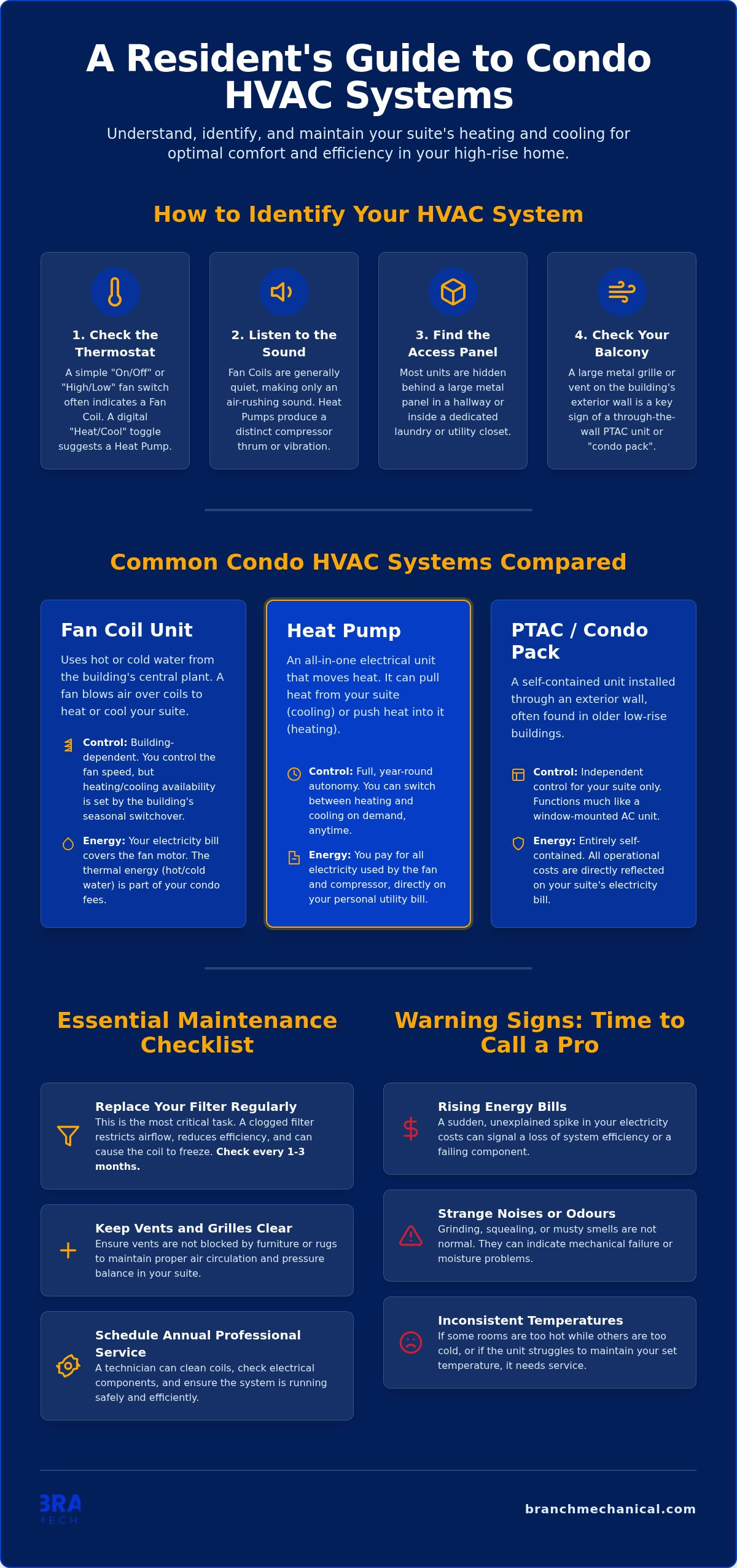
Identifying your specific setup is the first step toward effective maintenance. Most condo hvac systems are tucked away behind a metal panel in a hallway or inside a dedicated laundry room closet. You can gain clarity on your unit by following these simple steps:
- Locate the access panel: Find the large metal plate or the closet door that houses your mechanical equipment.
- Check the thermostat: A simple “On/Off” or “High/Low” fan switch often points to a building-controlled fan coil, while a digital interface with a “Heat/Cool” toggle usually suggests a heat pump.
- Listen to the operation: Fan coils are generally quiet, producing only the sound of rushing air. Heat pumps feature a distinct compressor thrum or vibration when they kick in.
- Inspect the exterior: Step onto your balcony to see if there is a large metal grille or vent on the building’s face, which is common for through-the-wall units.
Understanding these different condo hvac systems helps you troubleshoot issues before they become emergencies. If you’re unsure about your unit’s health, a quick inspection from the experts at Branch Mechanical can provide the clarity you need.
Common System Types Found in Mississauga and Etobicoke
In Mississauga’s newer high-rise towers, fan coil units are the standard. They operate by blowing air over coils filled with hot or cold water supplied by the building’s central plant. This is a primary component of modern Heating, ventilation, and air conditioning (HVAC) design. In contrast, many Etobicoke developments use heat pumps. These units use electricity and an internal compressor to move heat in or out of your suite, giving you year-round autonomy to switch between heating and cooling. Older low-rise buildings in the area might utilize PTAC units or “condo packs,” which are easily identified by their through-the-wall installation and individual external vents on the balcony.
Visual Cues and Model Numbers
Every unit has a data plate, usually located on the inside of the cabinet door or near the blower motor. This plate lists the manufacturer, model number, and serial number. This information is vital when you need commercial HVAC maintenance because it ensures your technician brings the correct filters or replacement parts. You might see names like “Magic Pak” on these plates, which refers to a specific type of all-in-one system common in mid-rise buildings. If your vents are unusually small, about two inches in diameter, you likely have a high-velocity air handler. Keeping a photo of this data plate on your phone is a simple way to stay prepared for future service calls and ensures you get the right support when you need it most.
Comparing Centralized vs. Decentralized Condo HVAC Configurations
The layout of your building’s mechanical pipes determines exactly how much control you have over your thermostat. Not all condo hvac systems are designed with the same level of flexibility. Centralized configurations rely on the building’s main plant to do the heavy lifting. In these setups, the thermal energy comes from massive boilers and chillers shared by every resident. While this often results in a quieter suite because there is no compressor vibrating behind your walls, it also means you are tied to a collective schedule.
Decentralized systems, primarily individual heat pumps, offer a different experience. Each suite contains its own compressor, allowing you to switch from heating to cooling whenever you wish. This autonomy is a significant advantage in the GTA, where spring and fall temperatures are notoriously unpredictable. However, that independence comes with the trade-off of higher maintenance requirements for the owner and a slightly louder operational noise within the suite.
The “shoulder season” is where the limits of centralized systems become most apparent. Residents in two-pipe buildings often find themselves sweltering during a surprise May heatwave because the building is still in “heating mode.” Since Toronto’s indoor temperature standards mandate cooling only from June 1 to September 30, property managers must carefully time the switchover to avoid legal and comfort issues. This seasonal struggle is the primary reason many new developments are moving toward more flexible configurations.
The Two-Pipe vs. Four-Pipe Debate
In a two-pipe system, the building has one supply pipe and one return pipe. This means the entire tower must be either in heating mode or cooling mode. There is no middle ground. A four-pipe system is the premium alternative. It features dedicated pipes for both hot and cold water, allowing one neighbour to heat their bedroom while another cools their sun-drenched living room. Professional mechanical contractors are essential during the complex seasonal transitions required for these systems to ensure the building plant isn’t stressed by sudden changes in demand.
Energy Management and BAS Integration
Modern high-rises in Mississauga and Etobicoke increasingly use Building Automation Systems (BAS) to manage these condo hvac systems. A BAS acts as the “brain” of the building, monitoring energy use and identifying leaks before they cause property damage. For property managers, this centralized monitoring is a vital tool for preventative maintenance. It allows for real-time adjustments to water temperatures based on outdoor conditions, which significantly lowers the building’s overall carbon footprint and keeps monthly maintenance fees more predictable for owners.
How to Maintain Your System for Peak Performance and Air Quality
Consistent maintenance is the only way to ensure your unit survives the humid Ontario summers. Neglecting your condo hvac systems often leads to preventable breakdowns at the worst possible times. The most important rule is to change your air filters every three to four months. A clogged filter restricts airflow, which causes the cooling coil to drop below freezing and eventually turn into a block of ice. This doesn’t just stop the cooling; it can lead to significant water damage when that ice eventually melts.
Beyond the filter, you should open the access panel twice a year to vacuum the cabinet. Dust buildup on the blower motor causes it to run hotter and fail prematurely. While you’re in there, look at the condensate drain pan. It should be dry or have very little water. If you see standing water or a jelly-like slime, the drain line is likely blocked. This is a leading cause of suite floods in Mississauga high-rises. Finally, check your thermostat. If it uses batteries, replace them annually to prevent your system from shutting down unexpectedly during a cold snap.
Seasonal Maintenance Checklist for Residents
Your maintenance routine should follow the GTA’s changing seasons. In the spring, focus on clearing out the dust that settled during the winter before you engage the cooling mode. In the fall, inspect the heating coil and ensure your humidistat is set correctly to prevent window condensation. While residents can handle basic cleaning, professional commercial HVAC systems service is required for deep coil cleaning. A technician uses specialized vacuums and chemicals to remove deep-seated grime that a household vacuum cannot reach.
Troubleshooting Common Condo HVAC Issues
Water pooling at the base of your unit is a red flag. It usually means your condensate line is backed up or your coil has frozen. If your fan is blowing but the air isn’t cold, your building might not have switched to “chiller mode” yet, or your internal components might have failed. Neglecting the specific needs of condo hvac systems can also lead to “dirty sock syndrome,” where bacteria growth on the coils creates a musty odour. If you notice these symptoms, it’s time to act. You can book a professional inspection with Branch Mechanical to resolve these issues before they escalate into costly repairs. For commercial property owners in the building, a cooling failure in any refrigerated storage areas carries the same urgency — the same principles that apply to emergency commercial refrigeration repair in Mississauga apply whenever a cooling system fails without warning and inventory or comfort is at stake.
Planning for Upgrades and Professional Service in the GTA
Most condo hvac systems reach their operational limit after 15 to 20 years of service. If your Mississauga suite is original to a tower built in the early 2000s, you are likely noticing a decline in performance. Frequent repairs, rising utility costs, and increased noise are clear indicators that a replacement is necessary. Modernizing your system is a long term investment in both your property value and your daily comfort.
One of the most significant benefits of a new installation is the switch to high-efficiency ECM motors. These motors operate with a variable speed, which means they don’t just blast air at 100% capacity every time the thermostat calls for heat. They ramp up slowly, providing a much quieter environment and reducing energy consumption by up to 30% compared to older models. This technology is particularly valuable in the dense living environments of Etobicoke, where mechanical noise can easily disrupt your sleep.
Navigating a unit replacement requires more than technical skill; it requires administrative expertise. You must obtain condo board approval before any major work begins. Boards typically demand specific documentation, including liability insurance and proof of WSIB coverage. Selecting an experienced commercial HVAC installation partner ensures that all technical specifications meet the building’s bylaws. This avoids costly delays and ensures the new unit integrates perfectly with the existing water loops or electrical circuits.
Modernizing Controls and Automation
Integrating smart thermostats into older fan coil units is one of the fastest ways to improve efficiency. These controls allow you to monitor your home remotely and set precise schedules that align with your lifestyle. Branch Mechanical helps building owners and property managers realize significant energy savings through the implementation of Building Automation Systems (BAS). We are also tracking the growth of geothermal retrofits in Mississauga condos. These projects replace traditional boilers with sustainable earth-energy systems, drastically reducing a building’s carbon footprint. Property managers looking to build a comprehensive strategy around these upgrades can find detailed guidance in our commercial HVAC maintenance guide for GTA facility managers.
Finding Reliable Mechanical Support in Mississauga and Etobicoke
Property managers need a partner who understands the high stakes of multi-residential mechanical systems. We provide 24/7 emergency support because a mechanical failure or a failed chiller can affect hundreds of residents in minutes. Preventative maintenance contracts serve as your best insurance against flood damage and catastrophic system failure. Our team has provided these specialized services since 2012, ensuring that your building’s infrastructure remains a source of comfort rather than a liability. Mixed-use buildings with ground-floor restaurants or retail tenants should also be aware that a chiller failure can simultaneously trigger the need for emergency commercial refrigeration repair in Mississauga for any on-site food storage systems. Contact Branch Mechanical for expert condo HVAC solutions today.
Secure Your Long-Term Comfort and Efficiency
Understanding the internal workings of your suite is the first step toward a stress-free living experience. Whether you manage a fan coil unit or an independent heat pump, consistent maintenance remains your best defence against unexpected failures and high utility bills. By identifying your system type and sticking to a strict filter replacement schedule, you protect your home from moisture damage and ensure your indoor air quality remains high throughout the year.
Branch Mechanical has been a trusted partner for Mississauga and Etobicoke residents since 2012. As specialists in multi-residential mechanical contracting, we understand the complex handshake between your suite and the building’s central plant. We provide 24/7 emergency mechanical services to handle critical failures whenever they occur, giving you the stability you need. If you’re ready to optimize your condo hvac systems for peak performance, Get a Professional Assessment for Your Condo HVAC System today. Investing in your mechanical health now ensures your home remains a sanctuary in every season.
Frequently Asked Questions
Who is responsible for HVAC repairs in my condo unit?
Responsibility usually falls on the unit owner for anything inside the walls of the suite. This includes the fan coil or heat pump unit itself. The condo corporation typically maintains the common elements, which are the shared boilers, chillers, and main vertical piping. You should always review your specific building’s declaration or bylaws, as some older Mississauga buildings have unique arrangements regarding mechanical maintenance.
Why does my condo only have heat and no air conditioning in the spring?
This is a common issue in buildings with two-pipe condo hvac systems. These buildings can only provide either heating or cooling at any given time. Property managers typically wait for a sustained period of warm weather before switching the central chiller on for the summer. Under Toronto’s indoor temperature bylaws, buildings that provide air conditioning must operate it from June 1 to September 30 to keep suites below 26°C.
How often should I change the filter in my condo fan coil unit?
You should replace your filter every three to four months at a minimum. If you have pets or live near a construction site in Etobicoke, you might need to change it every two months. Regular changes prevent dust from insulating the coils, which can lead to the system freezing up. Clean filters also ensure that urban pollutants are properly removed from your indoor air, protecting your respiratory health.
What is the average lifespan of a condo HVAC system in Toronto?
The average lifespan for these units is between 15 and 20 years. While some well-maintained systems in the GTA can last longer, efficiency usually drops significantly after the two-decade mark. Components like the blower motor or the internal valves begin to fail more frequently as the unit ages. If your system was installed before 2006, it’s likely time to start planning for a high-efficiency replacement.
Why is my condo HVAC unit so loud when it starts up?
Excessive noise often indicates a problem with the blower motor or a loose internal component. In heat pumps, a loud thump or vibration usually comes from the compressor starting its cycle. Older fan coils may have worn-out bearings in the motor. Upgrading to a unit with an ECM motor can solve this, as these motors ramp up speed gradually and operate much more quietly than traditional motors.
Can I install a Nest or Ecobee thermostat in my condo?
Installation depends on your unit’s voltage. Many condo hvac systems use high-voltage (120V or 240V) thermostats, while Nest and Ecobee are designed for low-voltage (24V) systems. You may need a transformer or a specific interface kit to make them compatible. It’s best to have a professional technician verify your wiring before purchasing a smart thermostat to ensure you don’t damage the unit’s control board.
What should I do if my HVAC unit starts leaking water?
Turn the unit off immediately at the thermostat to stop the production of more condensate. Water leaks are typically caused by a clogged drain line or a cracked condensate pan. If left unaddressed, this water can quickly seep into your flooring or your neighbour’s ceiling below. Once the unit is off, clear any visible standing water and call a mechanical contractor to clear the blockage and inspect the system.
Does the condo corporation pay for my HVAC electricity usage?
In most modern GTA developments, you are responsible for the electricity used by the fan and compressor inside your suite. This usage is captured by your unit’s individual hydro meter. However, the energy used to heat or cool the water circulating through the building is generally covered by your monthly maintenance fees. This is why your hydro bill might spike during a particularly humid Mississauga summer when the compressor runs constantly.