

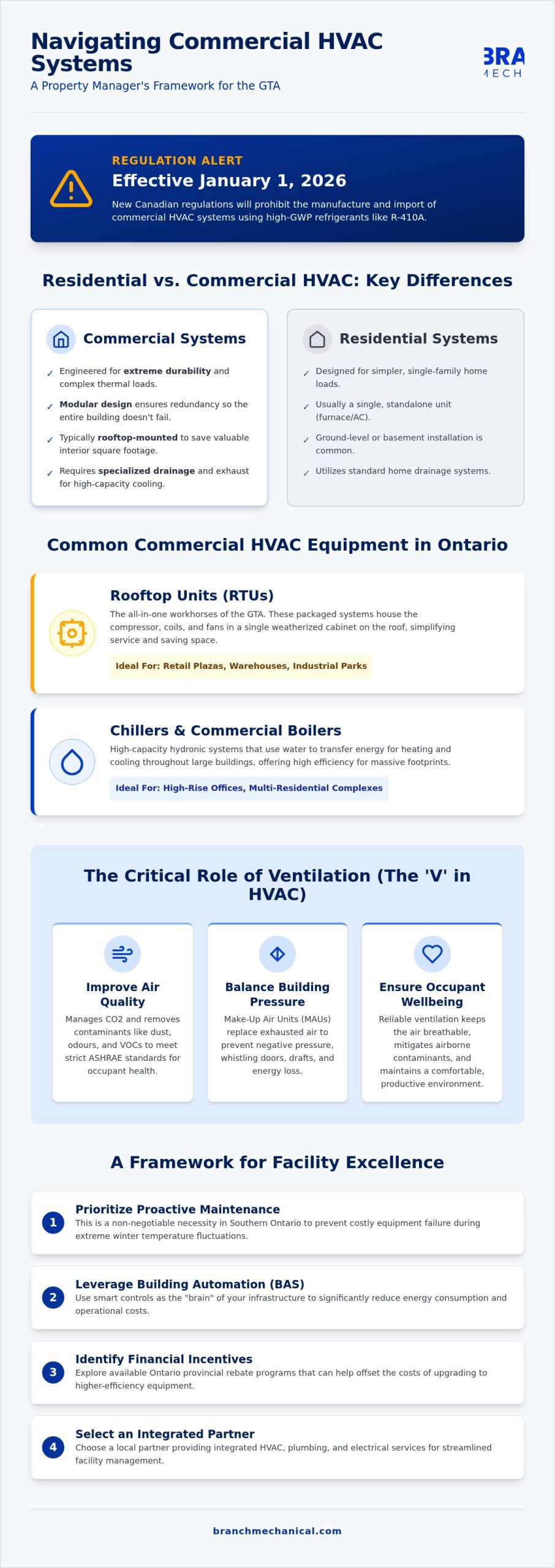
What if the hardware keeping your building comfortable was about to become obsolete? On January 1, 2026, new Canadian regulations will prohibit the manufacture and import of commercial hvac systems using high-GWP refrigerants like R-410A. For property managers in the GTA, this shift adds another layer of complexity to an already demanding job. You’re likely already juggling high energy bills and the constant fear of a catastrophic system failure during a peak Toronto winter.
It’s frustrating to manage aging equipment that triggers frequent tenant complaints and unpredictable repair costs. You deserve a mechanical ecosystem that operates quietly in the background so you can focus on your broader management goals. This guide provides the clarity you need to ensure your facility operates at peak performance throughout the year.
We’ll explore the essential types of systems, from boilers to building automation, and provide a clear framework for deciding when to repair or replace equipment. You’ll also learn how to navigate new efficiency standards and provincial incentive programs to lower your operational costs and maintain reliable, 24/7 climate control for your occupants.
Key Takeaways
- Understand the fundamental differences between residential units and the high-durability commercial hvac systems required to handle the complex thermal loads of GTA facilities.
- Discover how Building Automation Systems (BAS) and smart controls act as the brain of your mechanical infrastructure to significantly reduce energy consumption and operational costs.
- Learn why proactive maintenance is a non-negotiable necessity in Southern Ontario to prevent equipment failure during extreme winter temperature fluctuations.
- Identify the financial incentives and provincial rebate programs currently available in Ontario that can help offset the costs of upgrading to higher-efficiency equipment.
- Gain a clear framework for selecting a local mechanical partner who provides integrated HVAC, plumbing, and electrical services for streamlined facility management.
Understanding Commercial HVAC Systems: More Than Just Temperature Control
At its core, Heating, ventilation, and air conditioning (HVAC) is the mechanical heart of your facility. It’s an integrated system designed to maintain precise thermal comfort and ensure high indoor air quality for everyone inside. Unlike smaller setups, commercial hvac systems are engineered for extreme durability. They must withstand the constant stress of large-scale operations while managing the diverse needs of multiple tenants or industrial processes. Every system relies on three pillars: heating, cooling, and ventilation. If one component is sized incorrectly, the entire ecosystem suffers. An oversized unit will short-cycle, leading to premature wear and inflated energy bills. Conversely, an undersized system will run perpetually, failing to reach the set temperature during a humid Mississauga summer or a freezing Toronto night.
Residential vs. Commercial HVAC: Key Differences for Building Owners
Commercial systems are fundamentally modular. While a residential furnace is usually a single standalone unit, commercial setups often use multiple modules that work in tandem. This redundancy ensures that if one part fails, the entire building doesn’t lose climate control. Most commercial hvac systems are rooftop-mounted. This saves valuable interior square footage and keeps mechanical noise away from tenants. These large-scale facilities also require specialized drainage and exhaust systems to handle the significant amounts of condensate and waste heat generated by high-capacity cooling. Proper management of these fluids is vital to prevent structural water damage or mould growth.
The Critical Role of Ventilation in Modern Facilities
The “V” in HVAC is often the most overlooked component, yet it’s essential for occupant health. Ventilation manages CO2 levels and removes airborne contaminants like dust, odours, and volatile organic compounds. Modern facilities must adhere to strict ASHRAE standards to ensure adequate fresh air intake and filtration. In environments like commercial kitchens or large warehouses, standard ventilation isn’t enough. These spaces require make-up air units (MAUs) to replace the air that’s exhausted by heavy-duty hoods or industrial fans. Without a balanced make-up air system, your building can develop negative pressure. This leads to whistling doors, drafts, and poor energy efficiency as the system struggles to stabilize the internal environment. Reliable ventilation keeps the air breathable and the building’s pressure balanced.
Common Types of Commercial HVAC Equipment in Ontario
Selecting the right mechanical configuration is a balance between building scale and tenant requirements. In Mississauga and Etobicoke, commercial hvac systems generally fall into two categories: centralized or decentralized. Centralized systems, often found in high-rise towers, use a single plant to distribute climate control throughout the building. Decentralized systems use multiple independent units, such as rooftop packages, to serve specific zones. While centralized setups offer high efficiency for massive footprints, decentralized options provide modular flexibility and easier billing for multi-tenant retail spaces.
Rooftop Units (RTUs) and Packaged Systems
RTUs are the undisputed workhorses of GTA retail plazas, industrial parks, and warehouses. These all-in-one cabinets house the compressor, coils, and fans in a single weatherized housing. Because they sit on the roof, they save valuable interior square footage and keep mechanical noise away from occupants. Their placement also simplifies service. Technicians can perform routine maintenance or emergency repairs without entering tenant spaces or disrupting daily business operations. For low-rise commercial buildings, they remain the most cost-effective and reliable choice.
Chillers and Commercial Boiler Systems
For high-rise offices and multi-residential complexes, water is the primary medium for energy transfer. Chillers provide cooling by removing heat from liquid, which is then circulated through the building. On the heating side, commercial boilers drive hydronic systems that offer consistent, comfortable warmth. These systems rely on complex networks of pumps, valves, and insulated piping. While the initial setup is more intricate than a packaged unit, the longevity and efficiency of a well-maintained hydronic system are unmatched for large-scale facility management.
VRF and Split Systems for Zoned Comfort
Variable Refrigerant Flow (VRF) technology has become a preferred option for modern GTA office buildings that require precise, zoned comfort. VRF systems can provide simultaneous heating and cooling to different areas of the same building. This is ideal for facilities where one side of the floor catches the morning sun while the other remains in the shade. For smaller commercial footprints, split systems offer a flexible alternative. They separate the noisy condenser unit from the indoor air handler, allowing for a quiet environment in professional clinics or boutique shops. Choosing the right partner for commercial mechanical contracting ensures these complex commercial hvac systems are integrated correctly to meet your specific building’s demands.
Maximizing Efficiency: Energy Management and Building Automation
Even the most expensive commercial hvac systems will underperform if they’re managed by outdated controls. Efficiency isn’t just about the SEER rating of the condenser or the AFUE of the boiler; it’s about how the system responds to real-time building demand. A high-efficiency unit that runs at full capacity in an empty building is still wasting money. This is where Building Automation Systems (BAS) become essential. These systems act as a centralized “brain” that coordinates HVAC, lighting, and safety systems into one cohesive network. By integrating smart sensors, a BAS can identify unoccupied zones and reduce mechanical output automatically. This prevents the significant energy waste associated with cooling empty boardrooms or heating industrial warehouses during off-hours.
Remote monitoring adds another layer of reliability for property managers. Instead of waiting for a tenant to call about a cold office, modern sensors detect performance drifts as they happen. It’s a proactive approach that turns potential emergencies into scheduled maintenance, preserving both your budget and your peace of mind. When you can see a failing motor or a clogged filter on a dashboard before it triggers a total system shutdown, you’re no longer managing by crisis.
How BAS Reduces Operational Costs
Lowering utility bills starts with intelligent “setback” scheduling. This involves programming the system to relax temperature targets during nights and weekends when the building is vacant. Another powerful tool is demand-controlled ventilation (DCV). These systems use CO2 sensors to adjust fresh air intake based on actual occupancy rather than a fixed, arbitrary timer. This saves significant fan energy and reduces the load on your heating and cooling equipment without compromising indoor air quality. These small, automated adjustments lead to substantial cumulative savings over the fiscal year.
Energy Management for GTA Multi-Residential Buildings
Property managers of multi-unit facilities face the unique challenge of balancing comfort across hundreds of individual suites. It’s a high-stakes environment where a single boiler failure can affect thousands of residents. Upgrading to modern controls is often the most cost-effective way to achieve this balance while reducing mechanical stress. In Ontario, these upgrades frequently qualify for financial incentives. Programs like the IESO Save on Energy Retrofit Program can cover up to 50% of project costs for eligible equipment and controls. Integrating your HVAC with building automation systems ensures long-term operational health and simplifies the management of complex mechanical infrastructure in high-density environments. For individual unit owners in these buildings, understanding how condo hvac systems interact with the central plant is equally important for managing comfort and utility costs.
Navigating the GTA Climate: Seasonal Demands on Your System
Southern Ontario’s climate is notoriously unforgiving. Property managers in Mississauga and Etobicoke must prepare for a temperature swing that often exceeds 60 degrees Celsius over a single year. This volatility puts immense mechanical stress on commercial hvac systems. Metal components expand and contract constantly, which can lead to loosened electrical connections, material fatigue, and refrigerant leaks. Preventative maintenance is not a luxury in this environment; it is a fundamental necessity for building survival. Neglecting your equipment during the mild “shoulder seasons” of Spring and Fall is a common mistake. These transition periods are the ideal time to identify minor wear before it turns into a mid-winter crisis. A structured commercial hvac maintenance strategy that accounts for the 2026 refrigerant transition and Ontario Building Code standards is now an essential part of responsible facility management.
Humidity control is just as vital as temperature for occupant health and structural integrity. High summer humidity makes the air feel much warmer than it is, forcing your cooling system to work overtime. Conversely, the bone-dry air of a Toronto winter can cause respiratory issues for tenants and damage wood finishes or sensitive electronics. A properly calibrated system manages moisture levels to maintain a stable, comfortable environment regardless of the weather outside. Balancing these variables requires a sophisticated approach to mechanical management.
Winter Readiness: Boiler and Heating Reliability
Your heating system must be ready before the first frost arrives in November. Professional gas fitting and boiler inspections are critical to ensure safe, efficient operation throughout the season. During a deep freeze, a single cracked heat exchanger or a frozen pipe can lead to thousands of dollars in water damage and lost productivity. These failures rarely happen during business hours. You need a mechanical partner who provides 24/7 emergency mechanical services to keep your facility operational when the temperature drops. Regular winter prep ensures your burners are clean and your pumps are primed for the heavy lifting ahead.
Summer Peaks: Preventing AC Failures During Heatwaves
When July heatwaves hit the GTA, your cooling system fights a dual battle against temperature and humidity. Condenser coils that are clogged with dust or debris act like an insulating blanket. This traps heat inside the system and forces the compressor to run at dangerously high pressures. Over time, this leads to total compressor burnout. Checking refrigerant levels and cleaning coils in late Spring is the best way to maintain heat rejection efficiency. This proactive step prevents your commercial hvac systems from tripping breakers or failing entirely during the most humid days of the year.
Selecting a Commercial HVAC Partner in Mississauga
Choosing a partner for commercial hvac systems isn’t just about finding someone who can turn a wrench. In Mississauga and the surrounding GTA, you need a contractor who understands the specific mechanical stresses of our local climate. Large-scale facilities require more than a “fix-it” mentality; they need a methodical partner who prioritizes long-term health over quick patches. When a system fails at 2:00 AM on a Saturday, a global network of technicians won’t help you as much as a local team with 24/7 emergency availability. You need a partner who takes responsibility for the entire mechanical ecosystem, ensuring your facility remains operational regardless of the weather outside.
Reliability in commercial property management is built on trust and response times. A local expert knows the common failure points of buildings in Etobicoke and Mississauga, from aging boiler plants to high-traffic retail RTUs. This localized knowledge allows for faster diagnostics and more accurate part sourcing. Instead of waiting days for a specialized component, a well-connected local partner can often restore climate control within hours. This speed is essential for high-stakes environments like warehouses or multi-residential complexes where temperature fluctuations can lead to significant financial or legal liabilities.
The Value of Integrated Mechanical Contracting
Integrated contracting is the most efficient path for modern property managers. HVAC components are deeply intertwined with other building systems. A cooling failure might actually be a tripped electrical breaker or a plumbing leak in the chiller’s supply line. By choosing a partner like Branch Mechanical, you gain access to a team that manages HVAC, plumbing, and electrical services under one roof. This integrated approach eliminates the finger-pointing that often happens between separate vendors. It streamlines communication and ensures that every repair is handled with a complete understanding of your facility’s complex infrastructure.
What to Look for in a Service Contract
A preventative maintenance contract is the single best investment you can make for your building. These agreements move you away from “emergency-only” management and toward a predictable operational model. A proactive contract should include priority emergency response, detailed digital inspection reports, and preferred labour rates. Regular service extends the lifespan of expensive assets like rooftop units and commercial boilers by identifying minor issues, such as worn belts or clogged filters, before they cause a total shutdown. Secure your facility’s future with a customized preventative maintenance plan. This ensures your commercial hvac systems remain a reliable asset rather than a constant source of tenant complaints and budget overruns.
Securing the Future of Your Facility’s Mechanical Health
Managing commercial hvac systems in the GTA requires a shift from reactive repairs toward a strategy of long-term stability. By integrating modern building automation with proactive maintenance, you can lower operational costs while ensuring 24/7 tenant comfort. The extreme seasonal shifts in Mississauga and Etobicoke demand a partner who understands the unique stresses placed on your infrastructure. Since 2012, Branch Mechanical has provided comprehensive HVAC, plumbing, and electrical integration to help property managers streamline their operations.
Whether you’re dealing with a complex boiler plant or a fleet of rooftop units, having a single point of contact for all mechanical needs provides the peace of mind you deserve. Our team is ready to support your facility with 24/7 emergency mechanical services whenever a crisis arises. Request a Professional Mechanical Assessment for Your GTA Facility to identify efficiency gaps and protect your investment. Your building’s reliability is the foundation of your success; let’s ensure it stays strong for years to come.
Frequently Asked Questions
What is the average lifespan of a commercial HVAC system in Ontario?
A typical commercial HVAC system in Ontario lasts between 15 and 20 years. However, the extreme temperature swings in Mississauga and Etobicoke can accelerate wear on mechanical components. Regular maintenance is the only way to reach the upper end of this range. If your equipment is older than 15 years and requires frequent emergency repairs, it’s often more cost-effective to plan for a full system replacement before a catastrophic failure occurs.
How often should commercial HVAC filters be changed in a warehouse environment?
In a warehouse environment, filters should be inspected monthly and typically changed every 1 to 3 months. High-traffic facilities or those involved in manufacturing generate more airborne debris, which clogs filters faster. Clogged filters restrict airflow and force commercial hvac systems to work harder, leading to higher energy bills and premature motor failure. Keeping a strict schedule ensures your air remains clean and your equipment stays efficient during peak seasons.
Does my building need a Building Automation System (BAS) to be efficient?
While a small retail space might manage with programmable thermostats, larger GTA facilities definitely benefit from a Building Automation System (BAS). A BAS provides the centralized control needed to coordinate heating, cooling, and ventilation across multiple zones. It prevents energy waste in unoccupied areas and allows for remote monitoring of system health. For property managers, this technology is the most effective way to realize significant long-term savings on operational costs.
What are the signs that my commercial rooftop unit (RTU) needs to be replaced?
Several clear indicators suggest your rooftop unit (RTU) is reaching the end of its life. If you notice a steady increase in utility costs or if the unit can no longer maintain a consistent temperature during a Toronto heatwave, it’s likely failing. Frequent service calls for compressor issues or cracked heat exchangers are also red flags. Replacing an aging RTU often pays for itself through improved energy efficiency and reduced tenant complaints.
How does indoor air quality (IAQ) affect employee productivity in an office?
Poor indoor air quality (IAQ) directly impacts employee focus and health. High levels of CO2 and airborne pollutants in an office can cause headaches, fatigue, and “sick building syndrome.” By ensuring your ventilation system meets modern ASHRAE standards, you provide a fresh, oxygen-rich environment that boosts cognitive performance. Reliable air filtration and moisture control also reduce the spread of seasonal illnesses, leading to fewer sick days and a more productive workforce.
Can I use a residential HVAC contractor for my commercial property?
It’s not recommended to use a residential contractor for commercial properties. Commercial units are fundamentally different, often involving modular rooftop placements, complex drainage requirements, and integrated building controls. A specialized commercial contractor has the specific training and heavy-duty equipment needed to service these high-capacity systems. Branch Mechanical has focused on commercial and multi-residential mechanical contracting since 2012, ensuring we have the expertise required for complex GTA facilities.
What is the most energy-efficient HVAC system for a large multi-residential building?
For large multi-residential buildings, hydronic heating powered by high-efficiency commercial boilers is often the most effective solution. These systems provide consistent, comfortable warmth that is easier to manage across hundreds of individual units. Modern VRF (Variable Refrigerant Flow) systems are also excellent for efficiency because they allow for precise, zoned control. Choosing the right configuration depends on your building’s specific footprint and the existing piping infrastructure in your Mississauga or Etobicoke property. Residents in these buildings can also benefit from understanding how their condo hvac systems function at the unit level to better manage personal comfort and energy usage.
What happens during a commercial HVAC preventative maintenance visit?
A professional maintenance visit involves a comprehensive inspection of all mechanical and electrical components. Technicians check refrigerant levels, clean condenser coils, and inspect belts and pulleys for wear. We also clear condensate drains to prevent water damage and calibrate thermostats for accuracy. Documented inspections are a core part of our commercial hvac maintenance service contracts, providing property managers with a clear record of equipment health and any potential issues that need attention.