
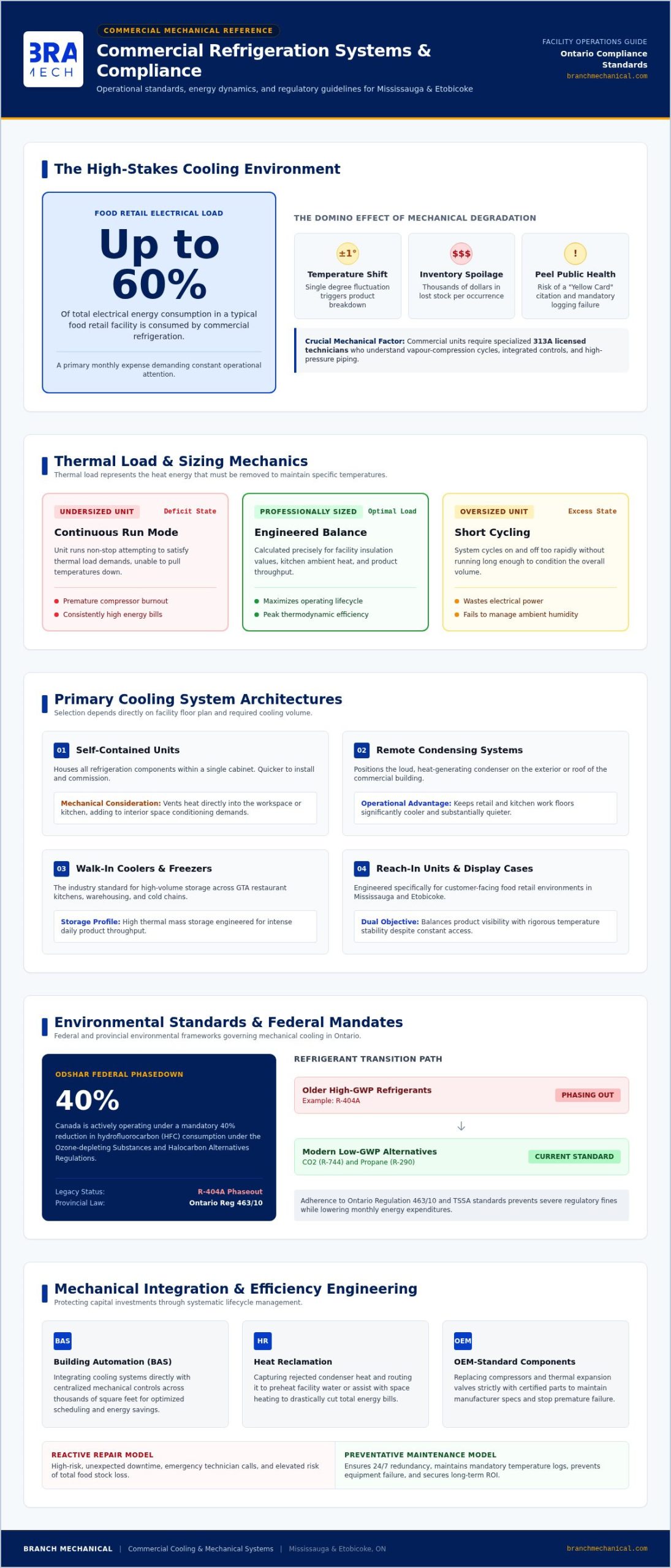
Did you know that commercial refrigeration accounts for up to 60% of the total electrical energy consumption in a typical food retail facility? For business owners in Mississauga and Etobicoke, this isn’t just a statistic; it’s a significant monthly expense that demands constant attention. You likely realize that a single degree of temperature fluctuation or a slow technician response can lead to thousands of dollars in spoiled inventory and a “yellow card” from Peel Public Health. It’s a high-stakes environment where the reliability of your mechanical systems defines your operational success.
This guide provides a comprehensive reference to help you optimize cooling performance, maintain strict compliance with Ontario’s safety regulations, and eliminate the threat of unplanned downtime. We’ll explore the critical role of preventative maintenance, the impact of federal HFC phasedowns on your equipment, and how integrated commercial refrigeration services can protect your bottom line. By the end of this article, you’ll have a clear roadmap to lower energy costs and the peace of mind that comes with a professional, well-maintained system.
Key Takeaways
- Learn how specialized commercial refrigeration services provide the 24/7 redundancy required to protect high-value inventory and ensure business continuity.
- Understand the specific TSSA and Ontario food safety regulations that govern cooling compliance and mandatory temperature logging in Mississauga and Etobicoke.
- Discover how transitioning from reactive repairs to a preventative maintenance model can significantly reduce long-term operational costs and prevent equipment failure.
- Explore the advantages of integrating your cooling systems with Building Automation (BAS) to realize greater energy efficiency and centralized mechanical control.
Understanding Commercial Refrigeration Systems in the GTA
Commercial refrigeration is far more than a simple appliance. It’s a high-stakes mechanical pillar that keeps your operations running. Unlike residential units, commercial refrigeration systems require specialized 313A licensed technicians who understand the complexities of vapour-compression cycles and integrated controls. In Mississauga and Etobicoke, these systems support a diverse range of industries. We see them in busy restaurant kitchens, pharmaceutical cold-chain facilities, large-scale warehousing, and multi-residential buildings. Reliable commercial refrigeration services ensure these sectors avoid the catastrophic inventory loss that comes with a system failure.
Choosing the right system requires a deep understanding of thermal load. This is the amount of heat energy that must be removed from a space to maintain a specific temperature. For Etobicoke facilities, professional sizing is vital. If a unit is undersized, it’ll run constantly, leading to premature compressor burnout and high energy bills. Conversely, oversized units cycle too frequently, which wastes power and fails to manage humidity. There’s a sharp distinction between light commercial units and industrial-grade racks. Industrial systems often integrate with building automation to manage massive cooling demands across thousands of square feet.
Primary System Configurations for Ontario Businesses
Selecting the right configuration depends on your floor plan and cooling volume. Self-contained units house all components in one cabinet. They’re easier to install but vent heat directly into your workspace. Remote condensing systems place the loud, heat-generating condenser outside or on the roof. This keeps your kitchen or retail floor cooler and quieter. For high-volume storage, walk-in coolers and freezers are the standard. Retail environments in the GTA often rely on specialized reach-in units and display cases designed for both visibility and temperature stability.
The Role of Refrigerants and Environmental Impact
The landscape of cooling chemicals is changing rapidly. Under the Ozone-depleting Substances and Halocarbon Alternatives Regulations (ODSHAR), Canada is currently operating under a 40% reduction in hydrofluorocarbon (HFC) consumption. This means older refrigerants like R-404A are being phased out in favour of eco-friendly alternatives. Modern commercial refrigeration services now focus on lower-GWP (Global Warming Potential) options, including CO2 (R-744) and propane (R-290). Proper system design doesn’t just meet Ontario Regulation 463/10 compliance; it actively reduces your carbon footprint and lowers your monthly energy bills by ensuring the system operates at peak thermodynamic efficiency.
Essential Commercial Refrigeration Services: Installation to 24/7 Repair
A commercial refrigeration system represents a major capital investment for any facility. Its lifecycle starts with precision engineering and ends with environmentally responsible decommissioning. Effective commercial refrigeration services manage every stage of this journey to maximize the return on your investment. In Mississauga and Etobicoke, professional care is the only way to ensure your equipment lasts for its intended lifespan. This work requires more than a standard appliance technician. Commercial systems use complex 313A-grade mechanics that demand specialized knowledge of high-pressure piping and advanced electrical controls.
Longevity also depends on the quality of the components used. We prioritize high-quality, OEM-standard parts because generic alternatives often lead to premature failure or reduced efficiency. When a compressor or thermal expansion valve is replaced with a certified part, it maintains the manufacturer’s original performance specifications. This commitment to quality, combined with adherence to Ontario refrigerant compliance standards, protects your facility from both mechanical breakdowns and regulatory fines.
Precision Installation and System Design
Successful cooling starts with an accurate load calculation. For new Mississauga installations, we assess variables like insulation values, ambient heat from kitchen equipment, and product throughput. This ensures your system is perfectly sized for your specific needs. We also focus on integrating refrigeration with your existing HVAC and ventilation systems. Capturing rejected heat from condensers to preheat water or assist with space heating is an effective way to lower total facility energy costs. Every installation concludes with a rigorous commissioning process to verify that pressures and temperatures meet design targets.
24/7 Emergency Repair and Troubleshooting
Mechanical failures don’t follow a schedule. When a walk-in freezer fails at 2:00 AM, the response time is the only thing standing between a minor inconvenience and a total inventory loss. Common signs of trouble include unusual compressor noises, excessive ice buildup on evaporator coils, or subtle temperature fluctuations. Our diagnostic process quickly identifies whether the root cause is a refrigerant leak, an electrical fault, or a mechanical failure. If you’re experiencing a cooling crisis, you can find more detailed answers in our commercial fridge repair FAQ. Proactive troubleshooting is always better than a reactive panic. If you need to restore stability to your facility, contacting a team that specializes in 24/7 emergency mechanical services is the fastest way to resolve the issue.
The ROI of Preventative Maintenance for Commercial Cooling
Choosing between a reactive and a preventative model for your cooling infrastructure is the difference between constant crisis management and predictable operational costs. Many facility managers in Etobicoke only call for commercial refrigeration services when a system has already failed. This reactive approach is the most expensive way to run a business. It involves emergency labour rates, rushed shipping for parts, and the high cost of spoiled inventory. In contrast, a preventative model identifies minor wear before it triggers a total shutdown, effectively extending the lifespan of your compressors and evaporators by several years.
Energy efficiency is another primary driver of ROI. Systems that meet ENERGY STAR commercial refrigeration standards perform best when their components are kept in peak condition. Dirty condenser coils or degraded door gaskets force the compressor to work harder, consuming significantly more electricity. Industry data indicates that regular maintenance can reduce refrigeration energy consumption by 10% to 25% while cutting emergency failures by up to 50%. For property managers overseeing multi-unit sites in Mississauga, this proactive approach offers essential peace of mind. You won’t have to worry about tenant complaints or emergency calls in the middle of the night.
What a Comprehensive Maintenance Contract Includes
A professional agreement ensures that no part of the system is overlooked. This isn’t a superficial check; it’s a deep mechanical audit. Our technicians focus on the following areas during a scheduled visit:
- Scheduled cleaning of condenser and evaporator coils to ensure optimal heat transfer.
- Testing refrigerant levels and identifying leaks early to prevent compressor burnout.
- Inspecting door gaskets, hinges, and hardware to maintain airtight seals.
- Calibration of thermostats and digital monitoring systems to ensure regulatory temperature compliance.
Reducing Long-Term Operational Costs
The long-term value of maintenance lies in risk mitigation. A small refrigerant leak, which can account for a 15% to 20% annual loss of total charge when unmonitored, eventually leads to a catastrophic compressor failure. Replacing a compressor is a major capital expense that can often be avoided through simple, scheduled inspections. Documenting these visits is also essential for insurance claims and health safety audits. Our specialized commercial refrigeration services include detailed reporting that satisfies both internal stakeholders and external inspectors. When working with experienced mechanical contractors in Mississauga, you gain a partner who understands the specific environmental and regulatory pressures of the GTA. This proactive care provides the stability your business needs to grow without the fear of sudden, expensive mechanical setbacks.
Compliance and Safety Standards for Ontario Businesses
Compliance is the legal backbone of any professional cooling operation. In Ontario, the Technical Standards and Safety Authority (TSSA) oversees the mechanical integrity of pressure systems to protect the public and your employees. Hiring licensed commercial refrigeration services ensures your facility adheres to the Technical Standards and Safety Act, 2000. Under these regulations, any refrigeration system with a compressor capacity exceeding 22 kW (approximately 30 HP) must be registered with the TSSA. Technicians performing this work must hold a valid 313A Refrigeration and Air Conditioning Systems Mechanic license. Using a technician with only a residential 313D license for commercial racks or process chillers is a violation of provincial law and can void your insurance coverage.
Environmental protocols are equally strict. Under Ontario Regulation 463/10, it’s illegal to discharge or vent refrigerants into the atmosphere. Technicians must hold a valid Ozone Depletion Prevention (ODP) certification to handle, test, or decommission equipment. This certification ensures that halocarbons are recovered and recycled according to federal and provincial standards. Maintaining these high bars for safety and environmental stewardship isn’t just about avoiding fines. It’s about ensuring your facility operates reliably without the risk of legal or mechanical failure.
Meeting TSSA and Provincial Regulations
Safety relief valves and pressure vessel inspections are mandatory components of a compliant mechanical room. In Etobicoke commercial buildings, these systems must follow the CSA B52:23 Mechanical Refrigeration Code. This standard governs everything from mechanical room ventilation to the specific leak detection protocols required for mildly flammable A2L refrigerants. Our team ensures that every installation and repair meets these rigorous criteria. We maintain detailed documentation for every pressure test and safety check, providing you with a clear audit trail for TSSA inspectors.
Food Safety and Inventory Protection
For food service and retail businesses, compliance also means meeting the requirements of O. Reg. 493/17 under the Health Protection and Promotion Act. Potentially hazardous foods must be maintained at an internal temperature of 4°C or colder, while frozen goods must stay at -18°C. Peel Public Health in Mississauga and Toronto Public Health in Etobicoke conduct regular inspections to verify these levels. Integrated building automation (BAS) provides automated temperature logging, which replaces manual logs and ensures 100% accuracy for health audits. A complete approach to kitchen safety also means addressing ventilation risks; grease buildup in exhaust systems is a leading fire hazard, and understanding the warning signs is covered in our guide to commercial kitchen exhaust fan repair. If you want to ensure your facility meets every provincial safety and health mandate, contact us for professional mechanical services to schedule a compliance audit.
Choosing Branch Mechanical for Integrated Refrigeration Solutions
Modern buildings are complex environments where mechanical systems are deeply interconnected. A failure in your cooling rack can often be traced back to an electrical surge or a ventilation imbalance. This is why choosing a single-source contractor for HVAC, electrical, and commercial refrigeration services is a strategic advantage for GTA businesses. We provide a unified approach that simplifies facility management and ensures every component of your mechanical room works in harmony. Our team has been Canadian owned and operated since 2012, focusing specifically on the unique needs of property managers in Mississauga and Etobicoke.
Our commitment to 24/7 emergency support across the region provides the stability you need to run your business without interruption. We don’t just offer generic repairs; we build long-term partnerships based on trust and technical excellence. By custom-tailoring our preventative maintenance plans, we ensure that your specific operational requirements are met, whether you’re cooling a pharmaceutical lab or a high-volume commercial kitchen. This local expertise is backed by a professional infrastructure designed to handle the most complex mechanical challenges.
The Branch Mechanical Difference: Integrated Expertise
Our multi-trade background allows for more accurate system diagnostics. We don’t just look at the compressor in isolation; we evaluate the entire mechanical ecosystem. By leveraging Building Automation Systems (BAS), we can implement smart monitoring that tracks temperature trends and energy spikes. This proactive data collection is essential for preventing the inventory losses discussed earlier in this guide. If you’re looking to upgrade your entire facility, you can explore our commercial HVAC installation guide for more technical insights.
Getting Started: Your Local Service Partner
A reliable partnership starts with transparency. We begin every new relationship with a comprehensive system audit to establish a baseline for your equipment’s health. Following this inspection, we provide detailed reporting and a maintenance quote that reflects the specific thermal loads and usage patterns of your site. We’re committed to 24/7 emergency support, ensuring that our local experts are never more than a phone call away. Whether you’re managing a restaurant, a warehouse, or a multi-unit residential building, we have the expertise to keep your systems running at peak performance. To secure your facility’s future, contact Branch Mechanical for a consultation and discover the peace of mind that comes with professional mechanical care.
Protecting Your Operational Stability through Expert Cooling
Managing a facility in the GTA requires a proactive approach to mechanical health. We’ve explored how commercial refrigeration services bridge the gap between high energy costs and streamlined, efficient operations. By prioritizing precision installation and adhering to strict TSSA and provincial health standards, you protect your inventory and your reputation. The shift from reactive repairs to a structured preventative maintenance model isn’t just a technical upgrade; it’s a strategic business decision that pays for itself through lower utility bills and extended equipment life.
Since 2012, we’ve served the Mississauga and Etobicoke communities with a focus on long-term reliability. Our team understands that cooling failures don’t wait for business hours, which is why we provide 24/7 emergency mechanical support and comprehensive preventative maintenance plans. We’re here to ensure your systems remain a silent, dependable partner in your success. If you’re ready to optimize your facility’s performance and achieve total peace of mind, Contact Branch Mechanical for Expert Refrigeration Services in the GTA. Let’s build a more resilient infrastructure together.
Frequently Asked Questions
What is included in a standard commercial refrigeration maintenance contract?
A standard maintenance contract includes scheduled cleaning of condenser and evaporator coils to ensure efficient heat transfer. Our technicians also check refrigerant levels, inspect door gaskets for airtight seals, and calibrate thermostats. We examine electrical connections and mechanical components like fan motors and compressors. These comprehensive commercial refrigeration services help identify minor wear before it causes a system failure, ensuring your facility remains compliant with Ontario safety regulations.
How quickly can you respond to a refrigeration emergency in Mississauga?
We provide 24/7 emergency mechanical services across Mississauga and Etobicoke to minimize your downtime. Since we’re locally based, our technicians can typically arrive on-site within hours of your call. Our priority is protecting your perishable inventory and restoring operational stability. We’ve served the region since 2012, so we understand the local highway networks and can navigate to your facility quickly during a critical cooling crisis.
Why is my commercial freezer leaking water or building up excess ice?
Excess ice buildup or water leaks often indicate a failure in the defrost cycle or a clogged condensate drain line. If the defrost heater or timer fails, ice accumulates on the evaporator coils, restricting airflow. Damaged door gaskets also allow warm, humid air to enter the unit, causing rapid frost formation. Addressing these issues early prevents water damage and ensures your freezer maintains the -18°C temperature required by Ontario food safety regulations.
Do you service all brands of commercial refrigeration equipment?
Yes, our licensed 313A technicians have the expertise to service all major brands and configurations of commercial refrigeration equipment. We work with self-contained units, remote condensing systems, and large-scale industrial racks. Because we prioritize high-quality OEM-standard parts, we ensure that repairs maintain the original manufacturer’s performance specifications. Our team stays current with the latest technical standards for both traditional and newer low-GWP refrigerant systems used in Ontario.
What are the most common causes of commercial compressor failure?
The most common causes of compressor failure include dirty condenser coils, refrigerant leaks, and electrical faults. When coils are clogged with dust, the compressor must work harder to reject heat, leading to overheating and mechanical wear. Low refrigerant levels cause the system to run constantly, while electrical surges can damage internal windings. Regular commercial refrigeration services are essential to catch these issues early and avoid the high cost of a total compressor replacement.
Can building automation systems (BAS) help monitor my refrigeration units?
Building Automation Systems (BAS) provide a significant advantage by offering 24/7 remote monitoring and automated temperature logging. These systems track compressor vibration, pressure levels, and temperature fluctuations in real-time. If a unit deviates from its set point, the BAS triggers an alert before your inventory is at risk. This technology simplifies compliance with Peel Public Health mandates and allows our technicians to perform predictive diagnostics, often resolving issues before a total failure occurs.
How often should commercial condenser coils be cleaned?
Commercial condenser coils should be cleaned at least once every three months to maintain peak efficiency. In high-traffic environments or restaurant kitchens with significant grease and dust, monthly cleanings may be necessary. Clogged coils increase energy consumption by 10% to 25% and are a leading cause of premature compressor failure. Keeping these components clear ensures your system can reject heat effectively, lowering your monthly utility bills and extending equipment lifespan.
What should I do immediately if my walk-in cooler stops reaching temperature?
If your walk-in cooler stops reaching temperature, first verify that the power supply and breakers are functional. Keep the doors closed as much as possible to retain the existing cold air and protect your inventory. Check for obvious obstructions around the condenser unit or ice buildup on the evaporator. Once these basics are checked, contact us for 24/7 emergency mechanical services. Our technicians will perform a professional diagnostic to identify and resolve the root cause quickly.