
Imagine it’s a humid Friday evening in Mississauga, and your kitchen is at peak capacity. Suddenly, you notice the digital display on your reach-in cooler is climbing past 4°C. For a GTA business owner, this isn’t just a technical glitch; it’s a high-stakes race against the two-hour window before health regulations mandate you discard your entire inventory. The fear of massive spoilage and unexpected costs is enough to keep any operator awake at night.
We understand that your refrigeration system is the heart of your operation. This guide provides the essential answers you need regarding commercial fridge repair, helping you distinguish between a simple maintenance task and a critical system failure. You’ll learn how to troubleshoot common issues, implement preventative maintenance to extend equipment life, and identify when it’s time to call a professional 24/7 technician. From protecting your bottom line to ensuring compliance with Peel Public Health standards, we’ve organized everything you need to maintain business continuity and peace of mind.
Key Takeaways
- Identify early warning signs like frost buildup and fluctuating temperatures to prevent inventory loss before a total system failure occurs.
- Understand why specialized commercial fridge repair requires 313A licensed technicians who are equipped to handle the high-volume demands of a professional kitchen.
- Learn the immediate emergency protocols to protect your stock and ensure compliance with Ontario’s strict 4°C food safety threshold.
- Discover how routine maintenance and building automation (BAS) integration can significantly reduce energy costs and prevent premature compressor burnout.
- Gain peace of mind by knowing how to secure reliable 24/7 mechanical support tailored for businesses in Mississauga and Etobicoke.
Recognizing the Signs: When Do You Need Commercial Fridge Repair?
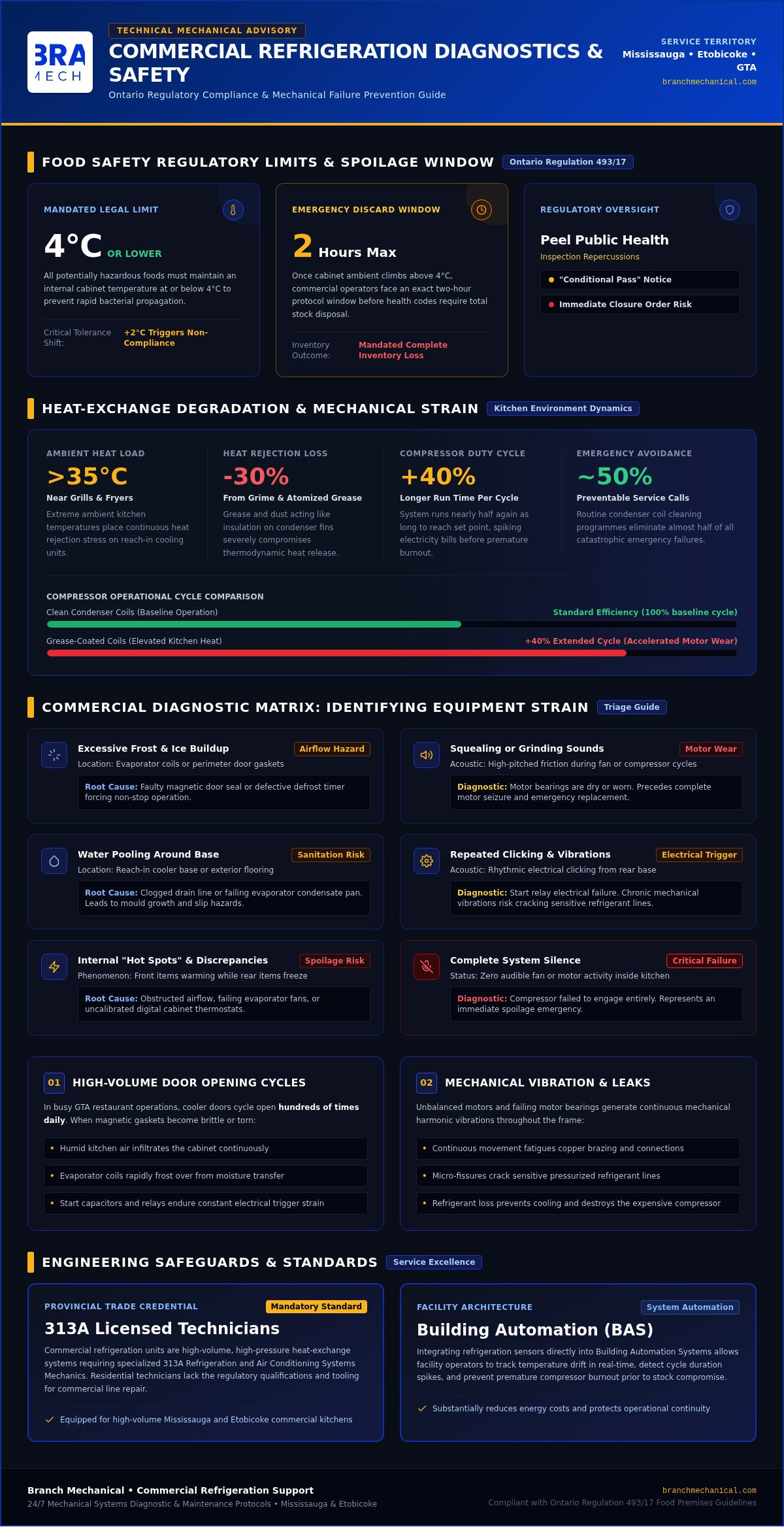
Catching a mechanical issue before it becomes a catastrophe is the hallmark of a well-managed kitchen. A commercial refrigerator rarely fails without warning; it usually provides subtle signals that the internal components are struggling to maintain equilibrium. Understanding the basic principles of refrigeration systems helps operators realize that these units are complex heat-exchange machines, not just cold boxes. When one part of the cycle fails, the entire system works harder to compensate, leading to a spike in energy bills and eventual total failure.
Excessive frost buildup is one of the most common early warnings. If you see ice forming on the evaporator coils or around the door gaskets, the unit is likely struggling with a faulty seal or a broken defrost timer. Similarly, visible water pooling around the base of a reach-in unit is never normal. While it might seem like a minor nuisance, it often indicates a clogged drain line or a failing evaporator pan. In the high-pressure environments of Mississauga and Etobicoke kitchens, these leaks quickly become safety hazards for your staff and can lead to mould growth if left unaddressed. Scheduling a commercial fridge repair at this stage is significantly more cost-effective than replacing a burnt-out compressor later.
Temperature Inconsistency and Spoilage Risks
In Ontario, food safety is governed by strict legal thresholds. Under O. Reg. 493/17, all potentially hazardous foods must be kept at an internal temperature of 4°C or lower. Even a 2-degree upward shift can put your business at risk of a “Conditional Pass” or a closure order from Peel Public Health inspectors. You might notice “hot spots” where items at the back are freezing while items near the door are warming. This inconsistency often stems from poor airflow, failing evaporator fans, or a thermostat that requires professional recalibration to ensure the digital display accurately reflects the cabinet’s climate.
Unusual Noises and Mechanical Vibrations
Your kitchen is naturally loud, but you should still be able to distinguish between a normal fan cycle and the rhythmic thumping of a failing motor. Squealing or grinding sounds often indicate that motor bearings are dry or worn. Conversely, a completely silent fridge is often a bigger emergency than a loud one, as it suggests the compressor isn’t engaging at all. If you hear a repeated “clicking” sound coming from the back of the unit, it’s a common sign of an electrical failure in the start relay. Addressing these mechanical vibrations promptly through commercial fridge repair prevents the movement from cracking sensitive refrigerant lines and causing a costly leak.
Common Causes of Refrigeration Failure in Commercial Kitchens
Commercial kitchens are high-stress environments where heat, airborne grease, and constant activity put immense pressure on mechanical systems. Unlike residential units, these systems operate under extreme ambient temperatures, often exceeding 35°C near grills and fryers. When a unit fails, it’s rarely a random event. Most breakdowns stem from a few specific, preventable issues that compromise the system’s ability to reject heat and maintain the cold chain. Recognizing these root causes helps you decide when to call for commercial fridge repair before a minor part failure destroys an expensive compressor.
Beyond the primary mechanical components, simple wear and tear on door gaskets and seals often goes unnoticed. In a busy GTA restaurant, doors might open hundreds of times daily. If the magnetic seal is brittle or torn, cold air escapes while warm, humid kitchen air enters. This creates a cycle where the evaporator coils frost over, forcing the unit to run continuously. Over time, this constant operation leads to the failure of electrical components like start capacitors and relays, which act as the “heartbeat” that triggers the cooling cycle. It’s also worth noting that poor ventilation compounds these issues significantly; a kitchen with inadequate airflow traps heat and grease, accelerating wear on all mechanical systems, which is why commercial kitchen exhaust fan repair is often just as critical to your refrigeration’s longevity as the fridge service itself.
The Impact of Grease and Dust on Condenser Coils
The condenser coil is responsible for releasing the heat collected from inside the cabinet. In a professional kitchen, these coils act like a magnet for dust and atomized cooking grease. When a layer of grime coats the fins, it reduces heat rejection capacity by up to 30%. This forces the compressor to run up to 40% longer per cycle to reach the desired temperature. It’s an invisible drain on your finances; you’ll see higher electricity bills long before the unit actually breaks. Establishing a routine cleaning schedule can prevent nearly half of all emergency service calls. If your system is already struggling to keep up, a professional preventative maintenance audit can restore its efficiency.
Refrigerant Leaks and Environmental Compliance
Refrigerant doesn’t “wear out” or get used up; if the levels are low, there’s a leak. These leaks often occur at vibration points or due to age-related corrosion in the copper lines. You can sometimes spot a leak by looking for an oily residue near joints or on the floor of the mechanical compartment. Adhering to Ontario Food Premises Regulation requirements is mandatory for food safety, but environmental laws are just as strict. In Canada, “topping up” a leaking system without fixing the source is illegal and unprofessional. Technicians must hold valid Ozone Depletion Prevention (ODP) cards to handle these chemicals, ensuring that commercial fridge repair is performed according to federal and provincial environmental standards.
Commercial Fridge vs. Residential Repair: Why Specialization Matters
A common mistake for new business owners is assuming that a general appliance technician can handle a walk-in cooler or a commercial reach-in. The reality is that commercial units operate on a completely different scale. While a residential fridge might open twenty times a day, a commercial unit in a busy Mississauga restaurant handles that volume in a single lunch rush. This constant influx of warm air requires a compressor designed for a 100% duty cycle, meaning it can run continuously without overheating. Using a technician who doesn’t specialize in commercial fridge repair often leads to misdiagnosis and the installation of parts that simply cannot handle the industrial load.
The mechanical complexity also extends to the system architecture. Many commercial setups use remote condensers located on rooftops or in separate mechanical rooms to keep heat out of the kitchen. Navigating these systems requires specialized manifold gauges, high-capacity recovery machines, and a deep understanding of commercial refrigeration leak repair standards. Attempting a repair with residential-grade parts is a recipe for premature failure. Residential components aren’t rated for the high BTU (British Thermal Unit) loads required to pull down temperatures quickly after a heavy delivery or during a frantic service window.
Higher Mechanical Demands and Load Factors
Commercial compressors are the workhorses of your kitchen. They’re engineered to maintain precise temperatures even when the ambient kitchen heat climbs. When selecting a service provider, it’s vital to ensure they understand the specific BTU ratings of your equipment. A residential fan motor might fit the bracket, but it won’t move the volume of air necessary to prevent evaporator freeze-ups in a commercial cabinet. Professional contractors prioritize OEM parts that are specifically tested for the rigorous demands of the food service industry, ensuring your equipment stays within its designed operating parameters.
Regulatory Standards for GTA Businesses
In the GTA, compliance isn’t optional. Toronto Public Health and Peel Region inspectors look for more than just cold food; they check for professional maintenance logs and evidence of proper system care. If an inspector sees a residential technician working on a commercial system, it can trigger immediate red flags regarding your facility’s safety standards. Licensed mechanical contractors ensure your equipment meets the Ontario Building Code and TSSA requirements. Keeping detailed service records isn’t just for health audits; it’s often a mandatory requirement for insurance claims if a catastrophic failure leads to significant inventory loss in Mississauga or Etobicoke. Partnering with a provider that offers comprehensive commercial refrigeration services in Mississauga and Etobicoke ensures your documentation, compliance, and equipment performance are all managed under one professional umbrella.
Emergency Repair Protocol: Minimizing Downtime in Mississauga
When a walk-in cooler or reach-in unit fails, the clock starts immediately. In Mississauga and Etobicoke, where food hubs are densely packed, a breakdown can cost thousands in lost revenue and wasted stock. You need a protocol that bridges the gap between discovering the failure and the arrival of a technician. This isn’t just about calling for commercial fridge repair; it’s about active crisis management to protect your bottom line. Reliable 24/7 availability is a necessity for GTA restaurant and warehouse operators who cannot afford a single night of downtime.
First Response: Protecting Your Inventory
Your immediate priority is maintaining the cold chain. The most critical rule is to keep the doors shut. A well-insulated commercial unit can maintain safe temperatures for several hours if the thermal mass remains undisturbed. If the breakdown occurs during a humid Ontario summer or near high-heat kitchen equipment, consider using dry ice as a temporary measure. Document the cabinet temperature every thirty minutes. These logs are vital for insurance claims and proving compliance to Peel Public Health inspectors. If repair times look extended, move high-value, potentially hazardous foods to backup cooling or a partner facility immediately.
What to Expect During an Emergency Service Call
Reliability in a crisis depends on speed and technical readiness. Technicians arrive equipped with specialized diagnostic tools to pinpoint the failure, whether it’s a seized fan motor or a blown start capacitor. Because we understand the local logistics of the Highway 401 and 403 corridors, we prioritize rapid response for critical commercial fridge repair calls. Many common issues can be resolved in a single visit because professional mobile units carry universal parts like pressure controls and food-grade refrigerants. If a specialized OEM component like a specific digital controller is required, we provide clear lead times so you can adjust your operations accordingly.
Clear communication with your contractor is essential. Be prepared to provide the make, model, and current temperature of the unit over the phone. This helps the dispatcher send the right technician with the right tools. If you are facing a total cooling failure right now, don’t wait for the situation to worsen. Contact our 24/7 emergency mechanical services to get an expert onsite before your inventory reaches the danger zone.
Beyond the Fix: Preventative Maintenance for Long-Term Reliability
The most cost-effective way to manage your refrigeration is to move from a reactive mindset to a proactive one. While we’re always ready for an emergency commercial fridge repair, our goal is to help you avoid that stress entirely. A well-maintained system doesn’t just last longer; it operates with a level of stability that protects your inventory and your reputation. By the time a compressor fails, it has often spent months struggling against preventable issues. Regular service ensures that small mechanical stresses don’t snowball into a total system collapse during your busiest shift.
Customized maintenance contracts are particularly valuable for businesses in Etobicoke and Mississauga. These agreements allow you to budget for maintenance rather than facing the shock of an unexpected four-figure repair bill. The return on investment is clear when you consider that preventing a single emergency service call can save more than the cost of an entire year’s worth of preventative visits. Beyond the immediate savings, a tuned system consumes less electricity, directly lowering your monthly overhead.
The Maintenance Checklist: What a Professional Service Includes
A professional maintenance visit is much more than a quick visual inspection. It’s a methodical audit of the unit’s mechanical and electrical health. Our technicians focus on the components that are most likely to trigger a commercial fridge repair if neglected. A typical service includes:
- Deep cleaning of condenser and evaporator coils: Removing the grease and dust that force your compressor to work overtime.
- Electrical audit: Tightening connections and testing start capacitors to prevent electrical fires or component burnout.
- Mechanical lubrication: Ensuring fan motors spin freely to maintain consistent airflow and prevent ice buildup.
- System calibration: Testing defrost cycles and verifying that thermostats accurately trigger the cooling process.
- Refrigerant verification: Checking for the oily residue of leaks and ensuring the system is charged to OEM specifications.
Integrating Refrigeration into Building Automation
Modern commercial kitchens are increasingly moving toward integrated energy management. By connecting your refrigeration units to a Building Automation System (BAS), you gain a powerful layer of protection. These systems monitor energy spikes that often signal mechanical distress before the temperature even begins to rise. If a motor starts drawing more amperage than usual, the BAS can trigger an alert, allowing you to schedule a service call on your own terms. Working with Expert Mechanical Contractors in Mississauga and the GTA ensures that your refrigeration is part of a cohesive, efficient building strategy that prioritizes long-term reliability over temporary fixes.
Securing Your Business Continuity and Food Safety
Maintaining a reliable refrigeration system is more than a technical requirement; it’s the foundation of your business’s reputation in the GTA. You’ve learned that recognizing early warning signs and understanding the strict regulatory landscape in Ontario are critical steps in preventing massive inventory loss. Professional service requires the expertise of licensed technicians who understand the industrial load factors and mechanical complexity of professional kitchen equipment. Don’t wait for a total breakdown.
Since 2012, Branch Mechanical has served as a reliable partner for Mississauga and Etobicoke business owners. Our team of licensed HVAC, electrical, and refrigeration specialists focuses on preventative maintenance to optimize your system’s lifespan and prevent the stress of sudden failures. Whether you’re looking to integrate your units into a broader building automation system or need immediate assistance, we provide the professional infrastructure to keep your operations running smoothly. Contact Branch Mechanical for 24/7 Emergency Commercial Fridge Repair to protect your investment today. Your peace of mind is our priority, and we’re here to ensure your kitchen never misses a beat.
Frequently Asked Questions
How much does a commercial fridge repair typically cost in the GTA?
Costs vary based on the component failure and the system’s size. While replacing minor electrical parts like capacitors or relays is relatively straightforward, major repairs such as compressor replacements require a larger investment in both specialized parts and labour. GTA business owners should always request a detailed quote after a professional diagnostic to understand the specific requirements for their unit’s horsepower and the type of refrigerant used.
How long should a commercial refrigerator last before needing replacement?
A high-quality commercial refrigerator typically lasts between 10 and 15 years in a professional kitchen environment. This lifespan depends heavily on the consistency of preventative maintenance and the ambient conditions of your facility. Units located near high-heat equipment or those with neglected condenser coils often fail closer to the 10-year mark. Modern Energy Star models may offer better long-term ROI through reduced electricity consumption compared to aging units.
Can I perform any commercial fridge repairs myself to save money?
Most repairs must be handled by a professional due to strict Ontario trade regulations. Under the Building Opportunities in the Skilled Trades Act, 2021, commercial refrigeration is a compulsory trade requiring a 313A certification. Business owners can safely handle basic tasks like cleaning door gaskets or clearing floor drains. However, any work involving electrical components or sealed refrigerant systems requires a technician with valid Ozone Depletion Prevention credentials.
Why is my commercial freezer leaking water onto the floor?
Water leaks usually indicate a blockage in the defrost drainage system or a cracked drain pan. In a commercial freezer, the defrost cycle melts ice from the evaporator coils, and this water should flow through a heated drain line to a pan for evaporation. If the line freezes or becomes clogged with debris, the water overflows onto your floor. This creates immediate slip hazards and can lead to structural damage if not addressed promptly.
What is the fastest way to get an emergency refrigeration technician in Etobicoke?
The most efficient way to secure assistance is to contact a contractor that maintains a local dispatch presence near the Highway 401 and 427 corridors. Branch Mechanical provides 24/7 emergency mechanical services specifically for Mississauga and Etobicoke businesses. Having your unit’s make and model number ready when you call allows the dispatcher to send a technician with the correct universal parts, significantly reducing the time required to restore your cooling.
Does a commercial fridge repair come with a warranty on parts and labour?
Reputable contractors generally provide warranties on both the replacement parts and the labour performed. Most OEM components come with a manufacturer’s warranty, while the service provider guarantees the quality of the installation. You should always confirm the specific duration of these warranties before the work begins. Clear documentation of the repair is essential for maintaining your equipment’s history and ensuring coverage for any future mechanical issues.
How often should I schedule preventative maintenance for my refrigeration system?
Most GTA kitchens should schedule professional preventative maintenance at least quarterly. High-volume environments with significant grease and dust may require monthly coil cleanings to maintain efficiency. Regular audits allow technicians to identify worn fan motors or brittle gaskets before they trigger a total system failure. This proactive approach is the most effective way to avoid the high costs and business downtime associated with an emergency commercial fridge repair. A comprehensive facility maintenance strategy should also include scheduled commercial kitchen exhaust fan repair and ventilation inspections, as grease-laden air from a failing exhaust system directly accelerates condenser coil fouling and refrigeration failures.
What are the signs that my compressor is about to fail?
A failing compressor often signals its distress through loud grinding noises or frequent short cycling, where the unit turns on and off too rapidly. You might also notice a clicking sound, which indicates the start relay is struggling to engage the motor. If your cabinet temperatures are rising despite the fans running, the compressor may no longer be effectively moving refrigerant. Addressing these symptoms early can prevent a catastrophic failure and inventory loss.