

Commercial plumbing isn’t an isolated utility; it’s a critical component of your building’s integrated mechanical health. When managing an industrial site or commercial property along Highway 27 or the QEW corridor, you can’t afford an unexpected sewer backup or a misdiagnosed booster pump that halts daily operations. Selecting the right commercial plumbing contractor Etobicoke facilities rely on means working with professionals who understand how domestic water, drainage, and hydronic loops connect directly to your broader HVAC and building automation systems.
You already know the frustration of delayed service responses, mismatched automation controls, and the constant pressure of keeping pace with the 2024 Ontario Building Code and Toronto Water bylaws. In this reference guide, you’ll master the essential technical requirements and contractor evaluation criteria needed to safeguard your facility, eliminate compliance risks, and establish dependable preventative maintenance. We’ll examine everything from local backflow regulations to integrated mechanical diagnostics, giving you a clear blueprint for long-term operational reliability.
Key Takeaways
- Understand why industrial facilities and high-occupancy residential properties demand engineered, mechanical-grade plumbing rather than basic domestic servicing.
- Discover how partnering with an integrated commercial plumbing contractor Etobicoke businesses trust aligns domestic water circuits with central boilers, HVAC loops, and Building Automation Systems.
- Review the strict compliance benchmarks under the 2024 Ontario Building Code and Toronto Municipal Code, including mandatory backflow testing and grease interceptor standards.
- Learn the primary trade credentials, insurance thresholds, and technical capabilities required to properly vet commercial mechanical contractors across the GTA.
- See how structured preventative maintenance contracts eliminate costly operational downtime and protect long-term equipment performance.
The Scope of Commercial Plumbing in Etobicoke Facilities
Commercial facilities across west Toronto operate under vastly different operating stresses than standard properties. A retail unit on The Queensway has little in common with a 200,000-square-foot distribution hub near Highway 27, yet generic service providers often treat them identically. Reliable operations demand a dedicated commercial plumbing contractor Etobicoke managers can trust for site-specific engineering. From the manufacturing plants in south Etobicoke dealing with legacy cast-iron lines to high-throughput commercial kitchens requiring complex grease interceptors, your plumbing infrastructure directly controls your facility uptime.
Industrial vs. Multi-Residential Requirements
High-density residential towers and logistics plants impose radically different loads on mechanical systems:
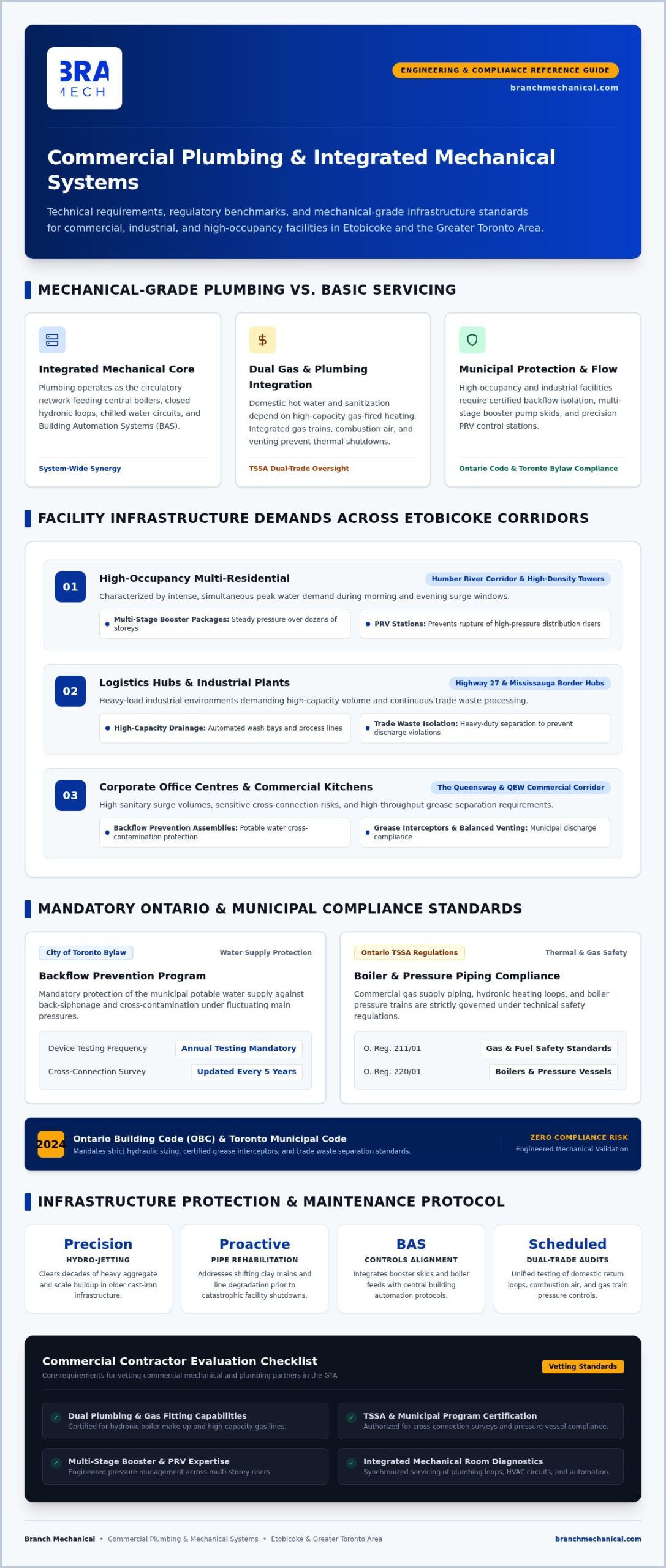
- High-Occupancy Multi-Residential: Condominium developments along the Humber River corridor generate intense, simultaneous peak water demands every morning and evening. These systems rely on multi-stage booster pump packages and pressure-reducing valve (PRV) stations to deliver steady pressure across dozens of storeys without rupturing distribution risers.
- Logistics and Industrial Hubs: Warehouses near the Mississauga border require specialized high-capacity drainage, automated wash bays, and heavy-duty trade waste isolation to keep operations continuous.
- Corporate Office Centres: High-density commercial buildings generate heavy sanitary surge loads, requiring balanced venting configurations and certified backflow prevention devices to protect the municipal potable water supply against cross-contamination under fluctuating main pressures.
Older commercial buildings throughout south Etobicoke present additional structural friction. Decades of heavy aggregate buildup, shifting clay mains, and outdated pipe sizing mean routine repairs won’t suffice. Keeping these facilities compliant requires ongoing mechanical evaluation, precision hydro-jetting, and proactive pipe rehabilitation before small failures escalate into catastrophic water shut-offs.
The Critical Nature of Gas Fitting Integration
Commercial plumbing rarely exists in a vacuum. High-demand facilities require continuous hot water for process sanitization, hydronic heating loops, and occupant health. This connects your plumbing distribution directly to high-capacity gas systems. Choosing a qualified commercial plumbing contractor in Etobicoke with dual plumbing and gas-fitting capabilities ensures your gas-fired storage tanks, central boilers, and high-efficiency water heaters operate with absolute safety.
Gas-fired equipment requires precise combustion air management, proper venting, and calibrated gas pressure regulation. In Ontario, all hydronic heating boilers and commercial gas lines fall strictly under Technical Standards and Safety Authority (TSSA) regulations (specifically O. Reg. 211/01 and O. Reg. 220/01). Our mechanical-first strategy guarantees that boiler feeds, gas piping trains, and domestic return loops are serviced in unison, ensuring full TSSA compliance while safeguarding your facility against unplanned thermal shutdowns.
Mechanical-Grade Plumbing: Beyond Standard Pipe Repairs
Mechanical-grade plumbing operates on an entirely different plane than basic pipe patching or clearing localized fixture clogs. In high-demand facilities, plumbing forms the structural circulatory system that feeds central HVAC equipment, chilled water loops, and hydronic heating infrastructure. Mechanical rooms house complex booster skids, variable frequency drives, expansion tanks, and backflow isolation assemblies. When these systems fail, the entire facility halts. Securing a skilled commercial plumbing contractor Etobicoke property teams can depend on ensures your water distribution functions in sync with your broader environmental controls. Facility managers must also keep mechanical room assemblies certified under the City of Toronto Backflow Prevention Program, which mandates annual testing and updated cross-connection surveys every five years to protect building systems and the municipal supply.
Commercial Boiler and Heating Synergy
Plumbing lines provide the critical make-up water that sustains closed-loop hydronic heating boilers. Raw, unconditioned water introduced into these closed circuits brings dissolved oxygen and calcium carbonate, causing scale buildup that destroys boiler heat exchangers from within. Facility teams working alongside expert mechanical contractors in Mississauga and the GTA gain an integrated approach. Plumbers and boiler technicians coordinate side-stream filtration, backflow isolation, and chemical treatment together, protecting costly capital assets from premature corrosion.
High-Performance Water Heating Solutions
Selecting water heating systems requires balancing footprint, demand surges, and operating efficiency:
- High-Efficiency Storage Systems: Ideal for properties with predictable, concentrated spikes, such as commercial laundries, athletic centres, and industrial processing shifts requiring significant buffer volume.
- Tankless Multi-Unit Arrays: Provide continuous hot water for hospitality facilities and multi-tenant commercial suites while reducing standby heat loss and mechanical footprint.
- Balancing Recirculation Loops: Multi-storey buildings demand precision-balanced return loops and thermostatic mixing valves. Without exact balancing, distant risers suffer long wait times, energy waste, and stagnant dead-legs that increase biological growth risks.
Every commercial water heater installation requires disciplined hydraulic calculations and routine checkups. If your building faces recurrent temperature swings or rising utility consumption, consulting with a dedicated mechanical partner like Branch Mechanical provides the diagnostic clarity needed to stabilize your mechanical room.
Evaluating Commercial Plumbing Contractors: Key Selection Criteria
Online consumer reviews cannot measure how a contractor performs when an industrial backflow assembly fails or a high-rise booster skid loses pressure. Facility managers need methodical, technical criteria to evaluate trade capability. A true commercial plumbing contractor Etobicoke facilities count on brings specialized credentials, documented safety protocols, and sufficient field capacity to manage complex installations. When an emergency strikes, your contractor’s physical location matters. A team dispatching from within the west GTA reaches sites near Rexdale, Kipling, or south Etobicoke within minutes, containing major distribution floods before they jeopardize operations.
Licensing and Safety Standards in the GTA
Commercial compliance in Ontario starts with compulsory trade licensing and verifiable workplace safeguards:
- Certificate of Qualification (C of Q): Under the Building Opportunities in the Skilled Trades Act, 2021, commercial plumbing is a compulsory trade (Trade Code 306A). Confirm that every technician on your site holds an active 306A license, Red Seal endorsement, or is a registered apprentice under verified supervision.
- Ontario Building Code Adherence: All piping alterations, drainage layouts, and fixture units must satisfy Part 7 of the Ontario Building Code, ensuring sanitary drainage systems operate safely without siphoning sewer gasses into your occupied tenant spaces.
- Insurance and Safety Clearances: Never allow an underinsured crew into your mechanical rooms. Demand an active Workplace Safety and Insurance Board (WSIB) clearance certificate and a minimum of $2,000,000 to $5,000,000 in Commercial General Liability (CGL) coverage to protect your facility from structural water liabilities.
Mechanical Contractor vs. Service Plumber
The gap between a reactive service plumber and a mechanical contractor centres on technical scope. Standard service outfits clear clogged sinks, swap damaged fixtures, and invoice by the hour. When underlying pressure fluctuations, boiler feed imbalances, or mechanical sensor errors cause those repeated failures, they rarely diagnose the root cause.
In contrast, a commercial mechanical contractor takes responsibility for the whole infrastructure through preventative maintenance agreements. They understand how hydronic balancing valves, circulation pumps, and cooling coils intersect with domestic feeds. By pairing plumbing diagnostics with high-performance commercial HVAC installation in the GTA, your facility avoids fragmented accountability. Having a single mechanical partner managing plumbing, gas fitting, and 24/7 emergency mechanical services keeps your equipment stable, compliant, and operational through every seasonal shift.
Compliance and Preventative Maintenance Standards
Staying ahead of building regulations protects your property from municipal enforcement actions and costly operational halts. Following the expiration of all transition periods on March 31, 2025, commercial plumbing retrofits and permit submissions across Toronto must adhere entirely to the 2024 Ontario Building Code Compendium. This harmonized code eliminated over 1,730 technical variations to match national plumbing benchmarks. Partnering with a proactive commercial plumbing contractor Etobicoke managers rely on ensures every drainage slope, venting balance, and pipe material change satisfies city inspectors during routine building audits.
The Role of BAS in Modern Plumbing
Modern commercial buildings no longer manage plumbing in isolation. Integrating mechanical sensors into a central building automation system turns passive piping into an intelligent utility network:
- Acoustic and Flow-Based Leak Detection: IoT inline sensors identify continuous micro-leaks within tenant walls or mechanical shafts, shutting automated isolation valves instantly before water cascades down multiple storeys.
- Remote Pressure and Thermal Tracking: Digital differential pressure monitors track booster pumps and domestic water heaters around the clock, catching pump head decay or scald risks without manual physical checks.
- Labour Reduction: Automated data collection delivers actionable diagnostic logs, eliminating routine visual meter walks and freeing maintenance staff for high-priority physical tasks.
Mandatory Backflow Prevention and Testing
Compliance under Toronto Municipal Code Chapter 851 (Water Supply) is mandatory for every commercial, industrial, and institutional site in Etobicoke. Water contamination risks carry severe consequences, with corporate penalties for severe infractions reaching up to $100,000. Under municipal rules, facilities must retain an active survey submitted at least every five years, with re-evaluations triggered within 30 days of operational modifications.
Every mechanical backflow assembly requires precision upkeep to maintain your connection to municipal mains:
- Mandatory Testing Frequencies: Assemblies must undergo testing at initial commissioning, within 72 hours of any repair or overhaul, and annually thereafter.
- Authorized Execution: Testing must be completed by an Ontario-certified Cross-Connection Control Specialist and uploaded directly to Toronto Water’s electronic reporting portal.
Relying on reactive emergency calls leaves your property vulnerable to severe municipal fines and disruptive water shut-offs. Protect your facility by establishing a preventative maintenance contract with Branch Mechanical to automate your testing, backflow reporting, and mechanical room servicing.
Integrated Mechanical Solutions for Etobicoke Businesses
Fragmented contractor communication remains a primary source of facility downtime. When a booster pump fails, a traditional plumber might blame the control wiring, while an electrician faults the pump motor. Facility managers end up trapped in the middle, coordinating multiple service calls while their buildings sit without adequate water pressure. Working with a truly unified commercial plumbing contractor Etobicoke facilities rely on removes that operational friction entirely. Founded in 2012, Branch Mechanical eliminates third-party finger-pointing by consolidating commercial plumbing, HVAC, gas fitting, and electrical services under one accountable team.
Consider a recent optimization project at a multi-residential complex near the Mississauga border. The property experienced recurrent low domestic water pressure during peak morning hours alongside continuous boiler cycling issues. Rather than treating these as unrelated problems, our mechanical-first assessment revealed an uncalibrated pressure booster skid that was triggering irregular make-up water feeds into the primary heating loop. By overhauling the booster controls, balancing the domestic recirculation loop, and recalibrating the boiler water feed system in a single coordinated service visit, we stabilized domestic water delivery and eliminated unnecessary thermal stress on the heating plant.
24/7 Emergency Support for Critical Infrastructure
Plumbing failures rarely follow convenient business hours. A burst domestic riser or failed interceptor pump overnight can flood electrical vaults, compromise finished inventory, and disrupt entire shifts. Branch Mechanical provides 24/7 emergency mechanical services throughout Etobicoke and Mississauga to protect critical business continuity.
Our dedicated mobile units arrive prepared for commercial-scale work. Equipped with specialized commercial valves, high-pressure diagnostic tooling, and industrial replacement components, our licensed technicians focus on immediate physical containment and fast mechanical restoration to keep building closures to an absolute minimum.
Customized Maintenance Contracts
Shifting your facility from costly reactive repairs to a structured preventative routine protects long-term operational budgets. Tailored preventative maintenance contracts deliver structured inspections scheduled around your facility’s operational rhythms:
- Targeted Facility Scheduling: Quarterly or semi-annual maintenance protocols customized for logistics centres, commercial office spaces, and multi-residential towers.
- Transparent Operational Reporting: Detailed mechanical service logs, calibration checks, and energy management recommendations delivered directly to building operators after every visit.
- Comprehensive Equipment Audits: Contact Branch Mechanical to schedule an on-site mechanical evaluation of your plumbing, heating, and automation infrastructure to safeguard your site against preventable disruption.
Secure Your Facility’s Mechanical Future
Managing commercial infrastructure across west Toronto requires moving past temporary fixes. Plumbing systems in large-scale properties demand precision engineering, strict code compliance, and direct alignment with central heating and automation controls. Partnering with a proven commercial plumbing contractor Etobicoke facility managers trust transforms unpredictable maintenance emergencies into steady operational reliability.
Locally owned and operated since 2012, Branch Mechanical specializes in multi-residential and commercial sites throughout Etobicoke and Mississauga. Our unified approach covers your entire mechanical footprint, from mandatory backflow testing to complex hydronic loops. When urgent disruptions strike, our licensed technicians deliver 24/7 emergency mechanical services to contain risks and keep your operations running smoothly. Take control of your building systems today. Contact Branch Mechanical for expert commercial plumbing in Etobicoke to schedule a comprehensive mechanical audit and build a lasting maintenance strategy.
Frequently Asked Questions
What is the difference between a residential and commercial plumbing contractor in Etobicoke?
Commercial contractors handle high-capacity, complex mechanical systems governed by stringent commercial codes, while residential plumbers focus on single-family home fixtures. A dedicated commercial plumbing contractor Etobicoke facility managers hire manages multi-stage booster pumps, hydronic loop make-up water, trade waste interceptors, and large-scale distribution risers. They also navigate commercial building permits and municipal industrial waste compliance across Toronto, which standard residential service providers aren’t structured or certified to handle.
How often should a commercial facility in the GTA have its plumbing inspected?
Most commercial facilities require comprehensive semi-annual or quarterly mechanical inspections alongside mandatory annual backflow testing. High-use environments like multi-residential buildings, commercial kitchens, and food processing plants need more frequent checks to clear grease interceptors and service booster systems. Regular preventative inspections catch valve degradation, pipe thinning, and pressure anomalies before they cause pipe bursts, water damage, or tenant downtime across your facility.
Does Branch Mechanical provide 24/7 emergency plumbing services in Etobicoke?
Yes, Branch Mechanical provides 24/7 emergency mechanical services across Etobicoke and Mississauga for urgent commercial and multi-residential failures. Our licensed technicians dispatch quickly to handle critical incidents like severed water mains, booster pump breakdowns, and boiler feed failures. Because our service vehicles carry commercial-grade diagnostic tools and heavy-duty replacement hardware, we focus on rapid physical containment and immediate system restoration to protect your facility from prolonged downtime.
What are the most common commercial plumbing issues in older Etobicoke buildings?
Facilities throughout south Etobicoke commonly experience interior corrosion in aging cast-iron drainage lines, severe mineral scaling, and failing domestic water PRVs. Over time, shifting foundations and heavy industrial use create sewer line bellies or tree root intrusions that disrupt flow. In addition, outdated mechanical layouts often feature uninsulated lines and abandoned dead-legs that cause inconsistent water temperatures, poor booster pressure, and increased water-quality liabilities.
Is backflow prevention testing mandatory for businesses in Toronto?
Yes, backflow prevention testing is mandatory under Toronto Municipal Code Chapter 851 for all industrial, commercial, and institutional properties. Devices must be tested upon installation, following any repairs, and annually by an authorized Cross-Connection Control Specialist. Property managers must also submit an updated cross-connection survey to Toronto Water at least every five years. Failing to test or report can lead to water service termination and severe corporate fines.
Can commercial plumbing be integrated into my existing Building Automation System (BAS)?
Yes, modern commercial plumbing systems can be directly integrated into your building automation platform. By installing networked flow meters, pressure transducers, and digital temperature sensors, facility operators track water consumption and monitor pump performance in real time. BAS integration allows building operators to receive automated alerts for abnormal pressure drops or continuous flow patterns, enabling fast diagnostic intervention before minor leaks turn into structural disasters.
What should I do if my commercial water heater fails after hours?
First, isolate the system by closing the domestic cold-water intake valve and shut off the dedicated fuel or electrical supply to prevent overheating. Next, contact Branch Mechanical’s 24/7 emergency mechanical line. Our technicians respond swiftly to diagnose the failure, clear diagnostic error codes on commercial condensing units, or source replacement heat exchangers. We focus on restoring hot water safely so your property remains operational for the morning shift. For a detailed breakdown of how to identify root causes and determine whether repair or replacement is the right call, review our guide on commercial water heater repair Toronto facility managers rely on.
Does Branch Mechanical handle gas fitting alongside plumbing services?
Yes, Branch Mechanical holds full certification for commercial gas fitting alongside our mechanical plumbing operations. Because high-capacity water heater installation projects, hydronic heating boilers, and make-up air units rely on high-volume natural gas trains, dual trade capabilities are essential. As an integrated commercial plumbing contractor Etobicoke teams rely on, our technicians service gas supplies, hydronic circulation systems, and commercial water heating equipment while ensuring strict compliance with TSSA technical safety standards.