

A building automation system that can’t communicate with your existing equipment may add complexity instead of control. For GTA facility managers, the key question isn’t simply whether to install building automation systems. It’s how to connect them with existing HVAC and electrical infrastructure so the whole building works more effectively.
High utility bills, disconnected mechanical systems across multiple floors or properties, and emergency repairs are familiar pressures. A well-planned BAS can bring key operations into one place, helping your team monitor conditions, adjust heating and cooling, and spot issues before they become urgent. The system must also work with the equipment you already have, not just look capable on paper.
This guide explains how modern BAS can support more consistent operations, help manage energy use, and protect the service life of mechanical assets. You’ll learn what systems can be integrated, what to consider when choosing a solution, and why sensors and controllers need ongoing attention. Branch Mechanical brings experience across both building automation and the mechanical systems it manages, including commercial HVAC and boilers. The result is a practical starting point for making informed decisions about your facility.
Key Takeaways
- Use building automation systems to bring key building operations into a more coordinated view and support informed facility decisions.
- Learn how sensors and controllers work together to monitor conditions and manage system responses.
- Assess whether open or proprietary protocols are a better fit for your existing equipment and future service needs.
- Prioritize automation through a facility audit, then consider a phased plan that fits your capital planning.
- Keep BAS sensors and controllers maintained so system information and automated responses remain dependable.
What is a Building Automation System (BAS) and Why Does Your Facility Need One?
A building automation system (BAS) links hardware and software to monitor and control building equipment from a central platform. Depending on the installation, it can coordinate HVAC and electrical systems, and connect with building security systems. The purpose is practical: give facility teams a clearer view of how equipment is operating and help them respond using real-time information. Building automation systems (BAS) are also known as building management or energy management systems.
Without that oversight, teams may rely on complaints, manual checks, or equipment failures to identify problems. A BAS can help shift that work from reactive response towards proactive management. For example, trend data may reveal that a system is running outside its schedule or that a mechanical asset needs attention. The system supports decision-making; it doesn’t replace qualified maintenance or correct equipment problems on its own.
Ontario’s regulatory context is also evolving, but 2026 shouldn’t be treated as a blanket BAS mandate. The 2024 Ontario Building Code came into force on January 1, 2025, and new permit applications have had to comply with it since April 1, 2025. Its updates include energy performance. Toronto’s Green Standard applies to development within the city, not every GTA property. Facility managers should confirm which current requirements apply to their building and project before planning upgrades.
The Core Objectives of Modern Automation
Effective automation balances operating costs with reliable building performance. Scheduling can reduce unnecessary heating or cooling when spaces aren’t in use, while occupancy sensors can help adjust operation to actual use. Monitoring temperature, humidity, and other conditions can also help teams investigate comfort and indoor air quality concerns. These controls matter only when they’re configured for the building and maintained correctly.
There’s an asset-life benefit, too. Better visibility into operating patterns can help identify unusual behaviour in boilers, rooftop units, and other mechanical equipment before it contributes to a disruptive failure. BAS data is most useful when maintenance teams review it and act on what it shows.
Why GTA Buildings Face Unique Automation Challenges
GTA facilities must manage heating demands in Ontario winters and cooling needs in summer. A schedule or control setting that suits one season may not suit the next, so systems need thoughtful configuration and ongoing adjustment. Older buildings in Mississauga and Etobicoke can add another layer: existing controls and mechanical equipment may come from different generations, making a site assessment essential before selecting an integration approach.
For multi-residential and mid-sized commercial properties, automation isn’t limited to large industrial facilities. A suitable system can help coordinate building operations while supporting comfort and energy goals. The right starting point is to understand existing equipment, operating priorities, and applicable local requirements, then identify where automation can provide useful oversight.
How a Building Automation System Works: The Architecture of Control
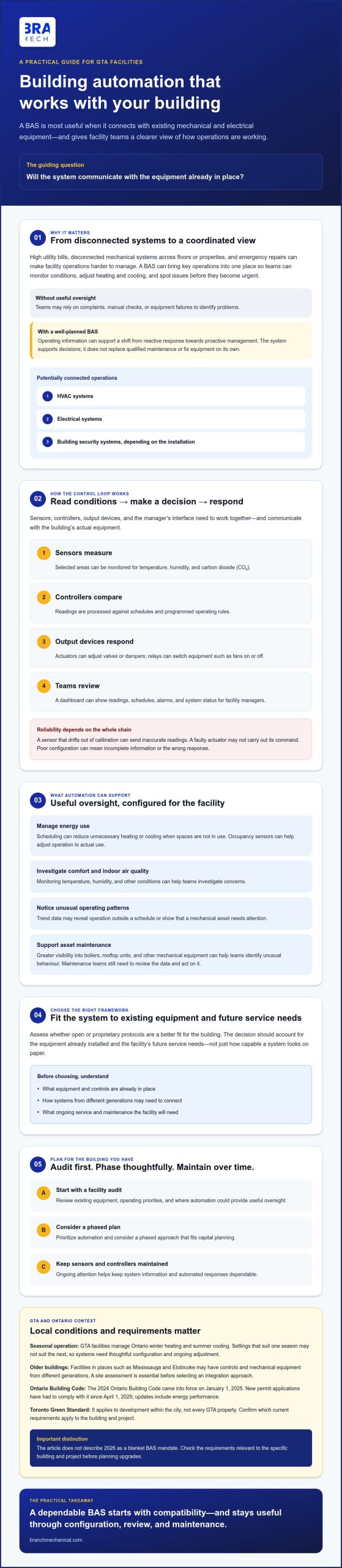
A BAS follows a simple loop: it gathers information, compares conditions with programmed settings, and signals equipment to respond. The details matter. Sensors, controllers, output devices, and the manager’s interface must work together and communicate with the building’s actual mechanical and electrical equipment. If any part is poorly configured, the system may provide incomplete information or trigger the wrong response.
From Sensor Reading to System Response
Sensors act as the system’s eyes and ears. They can measure conditions such as temperature, humidity, and carbon dioxide (CO₂) levels in selected areas. Controllers process those readings against schedules and operating rules, then send commands to output devices. Actuators can adjust valves or dampers, while relays can switch equipment such as fans on or off. Facility managers use a dashboard to review readings, schedules, alarms, and system status.
Reliable results depend on the whole chain. A sensor that drifts out of calibration can feed inaccurate readings to a controller, while a faulty actuator may not carry out its command. A building automation program also reflects the mix of technical knowledge involved, from controls and electronics to mechanical systems.
Connecting HVAC and Electrical Systems
Integration is where a BAS becomes more than a collection of separate controls. Connected to a commercial HVAC installation, the system can use operating schedules and available sensor data to coordinate equipment and airflow. Lighting schedules can also be aligned with HVAC operation, so unoccupied areas aren’t conditioned as though they’re in use. The exact controls depend on the building’s equipment and system design.
Electrical monitoring may help facility teams understand when and where loads occur. Depending on the utility’s rate structure and the BAS configuration, that information can support efforts to manage peak demand. It doesn’t automatically eliminate demand charges; managers need to review their applicable utility terms and decide which operating changes are practical. Understanding the full scope of your building’s electrical infrastructure is equally important — a guide to commercial electrical services in Mississauga and Etobicoke can help facility managers confirm which systems and work types a contractor covers before planning BAS-related electrical upgrades.
Following Data from the Mechanical Room
BAS data may stay on a local server, be made available through cloud-based monitoring, or use a combination of both. Cloud access can support remote review, but it isn’t automatically secure. Before choosing an arrangement, clarify who can access the system, how access is controlled, and what happens if the network connection is interrupted.
Alerts can flag conditions such as a boiler fault or a temperature moving beyond its set range, giving staff an opportunity to investigate before occupants report a problem. Historical trends add context: repeated alarms, longer run times, or recurring temperature swings can point to equipment or scheduling concerns. Newer analytics, including AI-enabled tools, may help identify unusual patterns, but findings still need qualified review and follow-up.
For GTA facilities, integration works best when controls and mechanical equipment are considered together. A team experienced in both can help assess how existing equipment fits into a BAS plan. Learn more about Branch Mechanical’s building automation services.
Open vs. Proprietary Protocols: Choosing the Right Framework
A BAS protocol is the communication framework that lets controllers and other devices exchange information. BACnet is a widely used open standard designed to support interoperability between equipment from different manufacturers. But “open” doesn’t mean every device will work together automatically. Compatibility depends on the equipment, supported functions, and how the system is configured.
Proprietary systems can provide a tightly integrated experience within one manufacturer’s ecosystem. The trade-off is potential dependence on that manufacturer for compatible upgrades, specialized support, or licensing. That can narrow future service options and affect ownership costs. Open protocols can give building owners more flexibility, but only when the selected equipment and integration work meet the facility’s needs.
LonWorks is another established protocol that may suit certain industrial or specialized installations, particularly where existing equipment already uses it. Rather than choosing by protocol name alone, check which devices and functions need to communicate, what the building already has, and what future changes are likely. The Climate Technology Centre & Network’s overview of Building Energy Management Systems provides further context on automation’s role in managing building energy use.
Assess the Full Cost of Ownership
Compare options across a 15-year building cycle, not just by the initial project scope. Include the costs and practical implications of:
- Software licences, system support, and future upgrades
- Adding or replacing equipment from different manufacturers
- Staff training and the effort required to manage multiple interfaces
- Service availability if you change contractors or the original vendor’s offering changes
These factors vary by building and system. Ask for a clear account of recurring fees, access to system documentation, and what work is needed to connect future devices. This makes it easier to compare proposals on more than initial cost.
Why Integration and Configuration Matter
For Mississauga facilities, an open protocol can make it easier to consider different mechanical contractors for future service and to add compatible technology as the building evolves. It may also reduce the need for staff to manage separate interfaces, though a unified dashboard depends on system design. Ask how proposed devices will exchange the specific data and commands your facility needs.
System integrators help verify that devices communicate as intended. A bridge device may connect legacy proprietary equipment to a newer BACnet system, but it can introduce limits on available functions, so confirm exactly what will remain accessible. Open protocols don’t guarantee cybersecurity either. Review network access, user permissions, updates, and the separation of building controls from other networks as part of the design.
Because BAS connects mechanical equipment with control technology, ask prospective providers how their experience spans both sides. A discussion with Branch Mechanical’s building automation team can help you frame those integration questions around your facility’s existing systems.
Planning and Maintaining Your Building Automation System
Start with the building, not the technology. A facility audit helps identify where automation could address real operating concerns and whether existing equipment can support the proposed controls. Document mechanical assets, current control systems, operating schedules, recurring comfort complaints, and maintenance history. In the GTA, review how equipment performs through both heating and cooling seasons before setting priorities.
Use the audit to build a phased plan. A facility might begin with HVAC monitoring and control, then consider adding lighting or other systems as needs and capital budgets allow. Define what each phase should improve, what existing equipment must connect, and how staff will assess results. This makes capital expenditure easier to plan and reduces the risk of investing in features the building doesn’t need.
Retrofitting vs. New Construction BAS
New construction can incorporate controls into the design from the outset. Retrofitting requires a closer look at what’s already installed. In older Etobicoke buildings, thick concrete construction may affect wireless sensor signals, so confirm coverage at intended locations before committing to a wireless approach. Existing wiring, controls, and access constraints can also shape the design.
Automated leak detection is another potential retrofit priority. For commercial plumbing systems, compare the proposed system’s installation and ongoing requirements with the building’s exposure to leaks, the areas it can monitor, and the potential disruption a leak could cause. Ask what the system detects, how it alerts staff, and what response procedures are needed. The value depends on the facility, not just the technology.
Make Maintenance Part of the BAS Plan
A BAS needs upkeep to provide dependable information. Sensors that drift out of calibration can report incorrect temperatures or other conditions, prompting controls to overheat, overcool, or run equipment unnecessarily. Actuators that respond slowly may also prevent valves or dampers from reaching the intended position. Both issues can undermine comfort, energy performance, and equipment operation.
Use BAS trends and alarms to inform preventative maintenance, alongside scheduled inspections and technicians’ findings. A pattern of repeated faults or unusual run times can help teams decide what to investigate. Predictive maintenance uses system and equipment data to anticipate likely failures and schedule attention before a breakdown occurs.
Include staff training in each implementation phase. Show operators how to read dashboards, acknowledge alarms, adjust approved schedules, and escalate faults; document procedures so knowledge doesn’t sit with one person. Building automation systems deliver more value when people know how to use their information and when sensors and controllers are checked regularly.
For support with planning BAS maintenance around your building’s mechanical equipment, contact Branch Mechanical about automation and preventative maintenance.
Partnering with Branch Mechanical for Integrated Automation Solutions
A building automation system connects controls with the equipment they’re meant to manage. For that connection to work well, the design needs to account for both the BAS and the building’s existing mechanical and electrical systems. Branch Mechanical works across building automation, commercial HVAC, boilers, and commercial electrical services, bringing the “brains” and “brawn” of building operations into the same conversation.
That combined perspective matters in the GTA, where a facility may need to manage heating through cold winters and cooling during summer heat. Automation strategies should reflect how the building is occupied, how its equipment operates, and how seasonal changes affect comfort and energy use. The aim is a practical control approach based on the facility, not a one-size-fits-all setup.
Coordinating Mechanical and Automation Work
When the BAS provider and mechanical contractor work in isolation, it can be difficult to determine whether an issue comes from the controls, equipment, or how they interact. Coordination between mechanical and electrical expertise helps teams assess the full system, plan integration, and clarify responsibilities during installation and service. Branch Mechanical has specialized in commercial and multi-residential mechanical contracting since 2012, with experience across both electrical and mechanical systems.
This doesn’t mean every issue has a single cause or that coordination removes the need for other specialists. It does mean the building’s equipment and automation can be considered together, rather than treating software and hardware as separate projects. For facilities in Mississauga, Etobicoke, and the wider GTA, local mechanical service can also help keep system decisions grounded in the property’s actual operating conditions.
Plan for Long-Term Performance
A properly selected, integrated, and maintained BAS can support better oversight of energy use and mechanical assets. The return depends on the building, existing equipment, system configuration, and ongoing maintenance, so set clear objectives and review performance over time instead of assuming savings will happen automatically.
Ongoing care is part of that plan. Preventative maintenance helps keep BAS sensors and controllers calibrated, while mechanical inspections can address the equipment the controls depend on. Branch Mechanical provides preventative maintenance contracts and 24/7 emergency mechanical services, including emergency support for automated systems in the GTA.
If you’re considering an upgrade, start by reviewing your existing controls, equipment, operating concerns, and priorities with a qualified mechanical and automation team. That facility assessment can help identify a sensible scope and the questions to resolve before work begins. Contact Branch Mechanical about building automation to discuss your facility’s needs.
Make Your Next BAS Decision with Confidence
A well-planned BAS is more than a control interface. It’s a way to make building operations easier to oversee, align automation with the equipment already in place, and use system data to guide maintenance. The long-term value depends on thoughtful integration and continued care, including keeping sensors and controllers calibrated.
Branch Mechanical brings commercial mechanical experience dating back to 2012, with expertise across HVAC, electrical systems, and BAS integration. Based in Mississauga and serving the GTA, the team also provides 24/7 emergency mechanical support. That combination can help facility managers assess both the controls and the equipment they depend on.
Ready to explore how building automation systems could support your facility’s priorities? Contact Branch Mechanical to discuss a BAS consultation and identify practical next steps. With a clear plan and the right expertise, you can move towards more informed, reliable building operations.
Frequently Asked Questions
What is the typical ROI for a building automation system in a commercial setting?
There’s no single ROI that applies to every commercial building. Results depend on the facility’s current energy use, equipment condition, operating schedules, system design, and ongoing maintenance. Start by establishing a baseline for utility use, comfort issues, and maintenance needs. Then compare those measures over time with the costs of installation, software, and service. This helps you assess whether the system is delivering value without relying on a guaranteed savings figure.
Can a BAS be installed in an older building with legacy mechanical systems?
Yes, a BAS can often be adapted to an older building, but compatibility needs to be assessed first. Review existing equipment, controls, wiring, and communication protocols to identify what can connect directly and where an interface or replacement may be needed. In older Mississauga and Etobicoke properties, building construction and access can also affect sensor placement. A facility audit helps define a workable scope before selecting equipment or planning installation.
How much does a building automation system cost per square foot in the GTA?
There isn’t a reliable per-square-foot figure to apply to every GTA facility. Cost depends on the building’s size and condition, the equipment being integrated, the project scope, and ongoing software or service requirements. Since BAS installation is a service Branch Mechanical provides, it’s more useful to request a project-specific assessment than to rely on a general price range. Ask for the proposed scope, exclusions, recurring costs, and factors that could affect the final project cost.
What is the difference between a BAS and a Building Management System (BMS)?
BAS and BMS are often used to describe systems that monitor and control building equipment, including HVAC and electrical systems. Usage varies by organization and supplier. Some use BMS as a broad term for building controls, while BAS may refer specifically to automation and control functions. Energy-focused platforms may also be called Building Energy Management Systems. Rather than relying on the label, confirm which equipment, data, alarms, and control functions the proposed system includes.
Do I need to hire a full-time operator for my building automation system?
Not necessarily. Staffing needs depend on the building’s size, system complexity, operating hours, and the skills of the existing facility team. Some facilities assign BAS monitoring to staff who already manage building operations, supported by clear procedures and appropriate training. Operators should know how to review trends, respond to alarms, and escalate mechanical issues. Regular maintenance remains important, since automation doesn’t replace inspections or qualified service for building equipment.
How does a BAS help with LEED certification or other green building standards?
A BAS may support sustainability work by recording operating data, helping manage schedules, and giving facility teams visibility into energy-related system performance. That information can assist with monitoring and documentation, but installing a BAS doesn’t automatically earn LEED certification or meet every green building requirement. Confirm the current criteria for the specific standard and project, then check that the system can provide the required data in a useful, reviewable format.
Is a building automation system secure from hacking and cyber threats?
No connected system should be assumed to be completely secure. Reduce risk by controlling user access, using strong authentication, keeping software and devices updated, and limiting connections between BAS networks and other networks. Ask who can access the system remotely, how access is monitored, and what procedures apply if a suspected incident occurs. Include cybersecurity responsibilities in system planning and maintenance, and confirm that the approach suits your organization’s IT policies.
Can I monitor my building’s automation system from my smartphone?
Often, yes, if the BAS supports remote access and has been configured for it. Smartphone monitoring may let authorized users review system status, readings, or alerts, but available functions depend on the platform and setup. Before enabling access, confirm how accounts are protected, who can view or change settings, and what happens if internet service is interrupted. Facility managers in Mississauga and Etobicoke should also ensure remote access fits their organization’s security procedures.