
Uneven comfort or doors that are harder to open can point to a ventilation imbalance, not just a heating problem. In commercial buildings, a make-up air unit works with exhaust fans to bring outdoor air inside and help maintain balanced building pressure. If the unit or a connected system isn’t operating as intended, occupants may notice changes in comfort or airflow. Commercial makeup air unit service assesses the equipment in the context of the building’s wider mechanical system.
Ventilation problems can affect staff, customers, and day-to-day operations. A focused service plan considers the unit alongside heating, exhaust, and building automation equipment. Branch Mechanical provides commercial HVAC service and preventative maintenance for buildings in Mississauga and Etobicoke.
This article explains how a make-up air unit supports commercial ventilation, what operating changes to document, and how planned maintenance can support reliable building operations. It also covers why service decisions should account for connected systems, rather than treating the unit in isolation.
Key Takeaways
- See how make-up air supports ventilation and building pressure in commercial spaces.
- Understand how airflow, heating, and controls work together, and why system setups differ by facility.
- Learn how maintenance, repair, retrofit, and replacement address different equipment needs.
- Prepare for commercial makeup air unit service by recording symptoms, affected areas, and operating conditions.
- Explore how planned maintenance and building automation can support coordinated facility care in Mississauga and Etobicoke.
What a Commercial Make-Up Air Unit Does for Your Building
A commercial make-up air unit supplies outdoor air to replace air removed through exhaust or mechanical ventilation. Bringing replacement air into the space helps the ventilation system operate as intended and supports balanced building pressure. Depending on the equipment and building design, the unit may also heat incoming air.
A make-up air unit replaces air removed by ventilation, helping support airflow and pressure balance without taking the place of the building’s broader HVAC system.
Commercial kitchens commonly use exhaust hoods to remove cooking fumes, heat, and odours. Warehouses and other ventilated facilities may also exhaust air as part of their operations. If replacement air isn’t coordinated with that exhaust, airflow and building pressure can be affected. The right setup depends on the site, so commercial makeup air unit service should account for the unit’s connections to other mechanical equipment.
How make-up air and exhaust ventilation work together
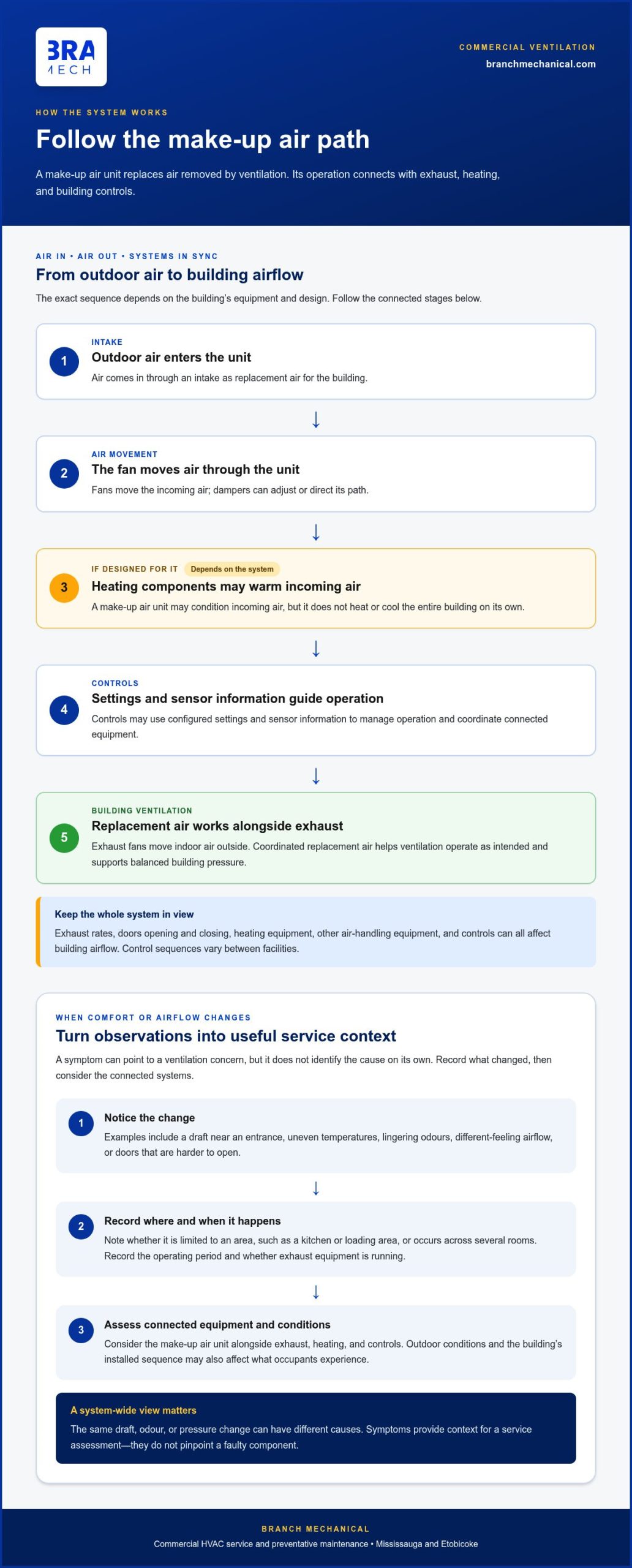
Exhaust fans move indoor air outside, while a make-up air unit supplies outdoor air to help replace it. If exhaust removes more air than the building brings in, indoor pressure can drop relative to outdoors. The building may then draw air through unintended gaps, and doors can become harder to open. Kitchen hoods and make-up air systems are often coordinated, but equipment and control sequences vary between buildings.
For general background, Wikipedia’s overview of the air handler describes air-handling equipment and its role in moving and conditioning air. In a commercial facility, the practical question is how the make-up air unit, exhaust equipment, and controls work together. A change in one part of that arrangement can affect the others.
Why facility teams notice comfort and airflow changes
Staff may first notice a concern through everyday changes: a draft near an entrance, uneven temperatures, lingering odours, or airflow that feels different from usual. These observations can indicate a ventilation issue, but they don’t pinpoint the cause. Outdoor conditions, exhaust operation, heating equipment, and building controls may also affect what occupants experience.
Record where and when the change occurs. Is it limited to the kitchen, near a loading area, or present across several rooms? Does it happen during a particular operating period or when exhaust equipment is running? These details give a service assessment useful context and help distinguish a possible make-up air concern from an issue elsewhere in the HVAC system.
Make-up air supports the building’s ventilation strategy, but the result depends on the facility and its systems. A thorough assessment considers the unit alongside related exhaust, heating, and control equipment. This system-wide view helps facility teams make service decisions without assuming that every draft, odour, or pressure change has the same cause.
How a Commercial Make-Up Air Unit Works With Heating and Controls
A make-up air unit works as part of a sequence, not as an isolated fan. Outdoor air enters through an intake, and a fan moves it through the unit and into the building. Depending on the system, heating components may warm the incoming air, while controls use configured settings and sensor information to manage operation. The sequence depends on the building’s equipment and design.
A make-up air unit supplies and may condition incoming outdoor air; it doesn’t heat or cool the entire building on its own. The broader HVAC system manages overall space conditions, while the make-up air system supplies replacement air for ventilation. For general context on HVAC guidance, consult ASHRAE standards and guidelines.
Fans, dampers, heating components, and sensors
Each component has a distinct role. The fan moves air; dampers adjust or direct its path; heating components warm incoming air when the system is designed to do so; and sensors provide information, such as temperature or operating conditions, to the controls. If a fan isn’t moving air as intended, or a damper or control isn’t responding properly, airflow or temperature may change. Symptoms alone don’t identify the faulty component.
How the sequence responds to building conditions
Air movement in a facility depends on more than the make-up air unit. Exhaust rates, doors opening and closing, and other air-handling equipment all affect the relationship between air entering and leaving the building. For example, one control sequence may coordinate the make-up air unit with exhaust operation, while another system may follow a different schedule. Commercial makeup air unit service should account for the installed arrangement instead of assuming one sequence fits every site.
Constant airflow, variable airflow, and building automation
A constant-volume system is designed to move air at a relatively steady rate during operation. A variable-air-volume system can adjust airflow in response to system demand or control signals. Neither description alone tells you how a particular building should operate. Equipment, sensors, settings, and connections to exhaust or heating systems all shape its performance.
Building automation can coordinate equipment according to the facility’s configured sequence. Sensor readings or operating schedules may inform when connected systems run and how they respond, depending on the controls in place. Facility teams looking at those connections can learn more from this building automation guide for GTA facility managers.
For a clear service plan, assess the make-up air unit alongside related heating, exhaust, and control equipment. Branch Mechanical provides commercial HVAC service as part of coordinated mechanical care for facilities in Mississauga, Etobicoke, and the GTA.
Repair, Maintenance, or Replacement: Assessing Make-Up Air Problems
A comfort complaint doesn’t automatically mean the make-up air unit needs replacing. A draft, temperature change, or interruption can have several causes, including a control issue or a problem elsewhere in connected equipment. Commercial makeup air unit service should begin with an on-site assessment of equipment condition, system operation, and facility requirements. This helps match the response to the issue instead of jumping to a larger project.
These options address different needs:
| Service decision | What it generally addresses |
|---|---|
| Maintenance | Planned attention to the unit’s operating condition and service needs. |
| Repair | An identified fault in equipment or controls that affects operation. |
| Retrofit | Targeted changes to existing equipment or controls to address project needs. |
| Replacement | A new unit when its condition, performance needs, or project scope make replacement the appropriate option. |
Signs that justify a service assessment
Watch for changes in how the system operates. Record what you observe rather than assuming the cause. Useful clues include:
- Airflow: Airflow feels inconsistent or differs from its usual pattern.
- Temperature: New or recurring temperature complaints arise in areas served by the system.
- Sound: The unit or related equipment makes unusual noise.
- Control response: Operation doesn’t appear to follow the usual schedule or response.
- Interruptions: The system stops repeatedly or has other operating disruptions.
Note when the issue occurs, which areas are affected, and whether related exhaust equipment is running. A single symptom can have several possible causes across connected building systems. These observations help guide an assessment without attempting a remote diagnosis.
When maintenance, repair, or replacement may fit
Maintenance is planned care that reviews operating condition and identifies service needs. Repair is appropriate when an assessment identifies a fault that can be addressed. A retrofit may suit a project that calls for targeted changes to existing equipment or controls. Replacement decisions depend on the unit’s condition, the facility’s performance needs, and the wider project scope.
The right choice depends on the evidence, not one complaint in isolation. An assessment can consider the unit alongside related systems and the building’s operating requirements. That gives facility teams a clearer basis for planning the next step and coordinating work with day-to-day operations.
Planning Make-Up Air Unit Service for Mississauga and Etobicoke Facilities
Good preparation helps make a service visit more focused and connects an equipment concern with how the facility operates. For commercial makeup air unit service, gather practical observations, note what else is running, and plan access before the visit.
Prepare useful information before a service visit
Use this sequence to organize details for the service team:
- Document the symptoms. Record when the issue began and whether it comes and goes or persists. Include what staff have noticed, such as unusual sounds, changes in airflow, or temperature complaints, without trying to diagnose the cause.
- Identify affected areas. Note the rooms, work areas, or entrances where the change is most noticeable. Indicate whether the concern affects one zone or several parts of the facility.
- Note operating conditions. Record the time of day, occupancy or activity, and whether kitchen exhaust or other connected equipment was operating. Include recent changes to exhaust schedules, controls, building use, or occupancy.
- Plan equipment access. Arrange access to the unit and relevant mechanical-room areas, and share site procedures that affect entry or work planning.
These details provide a useful picture of the operating context. A symptom that appears only during a busy kitchen period, for example, gives different context from one reported throughout the day. Observations help guide the assessment, but the equipment and connected systems still need to be evaluated on site.
Coordinate maintenance with the rest of the mechanical system
Plan make-up air service alongside the equipment it works with. Kitchen exhaust, heating operation, occupancy patterns, and building controls can all affect when the unit runs and what conditions it serves. Schedule maintenance around the facility’s use and operating needs, not just a calendar date.
Seasonal planning matters in the GTA. Before facilities in Mississauga and Etobicoke enter cold-weather operation, consider how the make-up air unit’s heating function fits into the building’s seasonal schedule. Timing and work depend on the system and site. Where practical, coordinate planned attention with other heating and ventilation work, especially when equipment access or operations overlap.
If a facility is considering a broader system change rather than routine service, the project scope may need to include related HVAC equipment and controls. For context on that type of project, see the guide to commercial HVAC installation in the GTA.
A prepared visit supports clearer service decisions and practical coordination with facility operations. Arrange commercial HVAC maintenance for your facility with Branch Mechanical.
Commercial Make-Up Air Unit Service With Branch Mechanical
Make-up air equipment is part of a wider mechanical system. Branch Mechanical is a Canadian-owned commercial and multi-residential mechanical contractor serving Mississauga, Etobicoke, and the GTA. We provide commercial makeup air unit service and commercial HVAC service, considering the unit in relation to the facility’s heating, ventilation, exhaust, and building controls.
A coordinated assessment is useful when a concern affects more than one area or appears alongside changes in heating or exhaust operation. Reviewing the equipment and its role in the building helps distinguish an isolated fault from a broader system issue. The right scope depends on the system and the facility’s operating requirements.
A coordinated approach to commercial mechanical systems
Commercial HVAC service considers make-up air alongside related heating and ventilation equipment. Planned maintenance gives facility teams a way to organize attention around system condition and operating needs, rather than waiting for an interruption to prompt a decision. Building automation may also be relevant when controls connect ventilation equipment with other building systems. Learn more about Branch Mechanical’s work as expert mechanical contractors in Mississauga and the GTA.
Preventative maintenance helps facility teams plan service around operations and coordinate attention across mechanical equipment. The scope and timing should reflect how the building is used, which systems interact, and what the team has observed. This is especially useful when ventilation and heating needs shift with occupancy or operating schedules.
Arrange commercial make-up air service
To make the service discussion more focused, share the building type, the equipment concern, and its effect on operations. Notes about when the issue occurs, which areas are affected, and how related equipment is operating can add useful context. Branch Mechanical tailors service to the system and project requirements, with commercial HVAC service and preventative maintenance as part of coordinated facility care.
For urgent mechanical needs, Branch Mechanical provides 24/7 emergency mechanical services. For planned maintenance or an operational concern, a clear description of the facility and issue helps establish the next steps.
For commercial makeup air unit service in Mississauga, Etobicoke, or the GTA, contact Branch Mechanical about commercial HVAC service and share your facility’s needs.
Set Up Your Next Service Decision With Confidence
Turn an equipment concern into a practical next step by recording what staff notice, when it occurs, and how it affects operations. This gives the service discussion a useful starting point. Your facility team can then weigh immediate needs against upcoming operating demands and plan maintenance around the building.
For commercial makeup air unit service, the goal is to understand the equipment’s condition and identify options that suit the facility. The right scope depends on how the unit interacts with other mechanical systems and what work is planned for the building. A focused discussion brings these details together before decisions are made.
Branch Mechanical works with commercial and multi-residential facilities on mechanical service needs. Share your building type, the concern, and its operational impact to discuss a suitable path forward.
Contact Branch Mechanical to discuss commercial make-up air unit service for your facility in Mississauga or Etobicoke.
Frequently Asked Questions
What does commercial make-up air unit service include?
Commercial make-up air unit service can include assessing the unit’s condition, airflow, heating operation, and controls, then addressing maintenance or repair needs identified during the assessment. The scope depends on the equipment and reported concern. For example, a review may consider whether a change in operation coincides with kitchen exhaust use or a control schedule. Sharing symptoms and operating details helps focus the service visit.
How is a make-up air unit different from an air handler?
A make-up air unit is designed to supply outdoor air, often to replace air removed by exhaust. An air handler is a broader term for equipment that moves and may condition air; some make-up air units are a type of air handler. Depending on its design, an air handler may circulate return air or combine it with outdoor air. The equipment’s name alone doesn’t describe its full configuration.
Is a make-up air unit required for every commercial kitchen?
Not necessarily as a separate, dedicated unit in every kitchen. The ventilation design, exhaust equipment, building layout, and applicable requirements affect how replacement air is supplied. A kitchen with a large exhaust hood has different operating demands from one with limited exhaust. Consider the building’s mechanical design as a whole rather than assuming every commercial kitchen needs the same equipment arrangement.
Can a make-up air unit cause cold drafts in winter?
It can contribute to cold drafts if incoming air is too cool for the space or airflow reaches occupied areas in an uncomfortable way. Heating operation, air distribution, controls, and other HVAC equipment may also be involved. Note where the draft occurs and whether it changes when the unit or exhaust equipment operates. These details can help an on-site assessment identify what needs attention.
What can cause a commercial make-up air unit to freeze?
Freezing can have several possible causes, depending on the unit’s design. Restricted airflow, inadequate heating, a control issue, or a problem with water circulation in a hydronic heating coil may contribute during cold conditions. These are possibilities, not a remote diagnosis. If ice is visible, record when it appears and how the system is operating, then arrange an assessment rather than trying to remove ice from equipment yourself.
What happens if an exhaust fan runs without enough replacement air?
The building can become negatively pressurized, which may make doors harder to open or draw air through unintended openings. In some buildings, a pressure imbalance may also affect the operation of fuel-burning appliances or their venting. The level of risk depends on the facility and connected equipment. If exhaust is running while replacement air is unavailable or reduced, have the system assessed as a coordinated setup.
How can building automation affect make-up air unit operation?
Building automation can influence when the unit runs and how it responds to schedules, sensor readings, or signals from connected equipment. A schedule that doesn’t match operating hours, for example, may affect ventilation timing. If controls are involved, note any displayed alerts and record when the unit starts or stops. Where available, control-system logs can help compare operation with occupancy or exhaust use.