
A cooler that starts warming during a dinner rush can put food inventory, service, and staff decisions under pressure at once. A practical restaurant refrigeration maintenance routine helps catch warning signs before they become a disruption. The key is knowing what staff can check, what to record, and when a technician should step in.
Consistent care goes beyond cleaning equipment. It includes monitoring readings, keeping units clear, following approved cleaning procedures, recognizing performance changes, and recording what was found and done. A clear routine gives your team a reliable process while keeping technical work with qualified service professionals.
This 2026 guide covers daily and weekly checks, scheduled professional maintenance, and useful equipment records. You’ll also learn when a developing problem calls for service. Branch Mechanical provides commercial refrigeration service and preventative maintenance for restaurants and other businesses across the Greater Toronto Area, including Mississauga and Etobicoke.
Key Takeaways
- Build a practical restaurant refrigeration maintenance routine around staff observations, approved cleaning, and scheduled professional care.
- Use equipment manuals, workplace procedures, and food-safety protocols to guide checks and clarify when technical service is needed.
- Organize checks around opening or closing, regular team reviews, and planned maintenance, adapting the schedule to equipment guidance and service needs.
- Record equipment IDs, locations, readings, alarms, symptoms, actions, and follow-up status to spot recurring issues and keep maintenance organized.
- Branch Mechanical provides commercial refrigeration service, preventative maintenance contracts, and 24/7 emergency mechanical services for businesses in the GTA, including Mississauga and Etobicoke.
Why restaurant refrigeration maintenance matters to GTA kitchens
A refrigeration issue can affect more than one appliance. If a unit can’t maintain suitable conditions, food inventory may be at risk, prep plans can change, and staff may need to respond during service. Restaurant refrigeration maintenance is the planned care, observation, and cleaning that help equipment operate reliably and make developing concerns easier to spot. Repair addresses a fault or breakdown that has already occurred.
For a GTA restaurant, dependable refrigeration supports the flow of receiving deliveries, storing ingredients, preparing dishes, and serving customers. A walk-in cooler that struggles after a busy delivery can complicate storage. A reach-in unit that is unavailable during peak service may force staff to adjust their station workflow. Planned attention helps teams notice changes and organize a response before they add pressure to a shift.
Which restaurant refrigeration systems need routine attention?
Include every unit used to store or display chilled or frozen food in your equipment overview. That may include walk-in coolers, walk-in freezers, reach-in units, and refrigerated display equipment. Maintenance needs vary with equipment type, age, workload, installation conditions, and manufacturer guidance. A display case used throughout service may face different demands from a walk-in used mainly for bulk storage, so a single schedule may not suit every unit.
Keep manufacturer instructions accessible and make sure staff know which equipment serves each area. Clear identifiers help the team report a concern precisely, such as “walk-in cooler beside receiving,” rather than “the fridge by prep.”
How missed maintenance affects restaurant operations
Performance changes can develop gradually. A unit may run longer than usual, make a new sound, show a recurring alarm, or take longer to recover after its door is opened. One unusual reading or brief change doesn’t automatically mean equipment failure. It is a reason to follow workplace procedures, see whether the condition continues, and record what happened. A repeated or worsening change deserves attention, particularly if food storage conditions may be affected.
Without a clear routine, warning signs can get overlooked amid prep, customer service, deliveries, and closing tasks. A developing issue may become an urgent repair need at a difficult time. Staff may then need to protect or relocate inventory while keeping service moving. A consistent record of what the team notices helps managers determine whether a symptom is new, recurring, or changing.
Preventative maintenance is planned care intended to identify equipment issues before they lead to failure. It complements, but doesn’t replace, repairs when a unit has a fault. Food-safety duties depend on current Ontario requirements and local public-health direction. Confirm applicable requirements through current official guidance, and ensure restaurant procedures reflect them. Equipment care is one part of the broader responsibility to handle and store food safely.
What restaurant staff can check, and what refrigeration technicians should handle
Staff play an important role in restaurant refrigeration maintenance, but their role is observation and approved routine care, not mechanical troubleshooting. Follow each equipment manual, workplace procedures, and food-safety protocols. These instructions clarify what staff can safely clean or inspect and what should be left to a refrigeration technician.
Routine checks restaurant teams can record
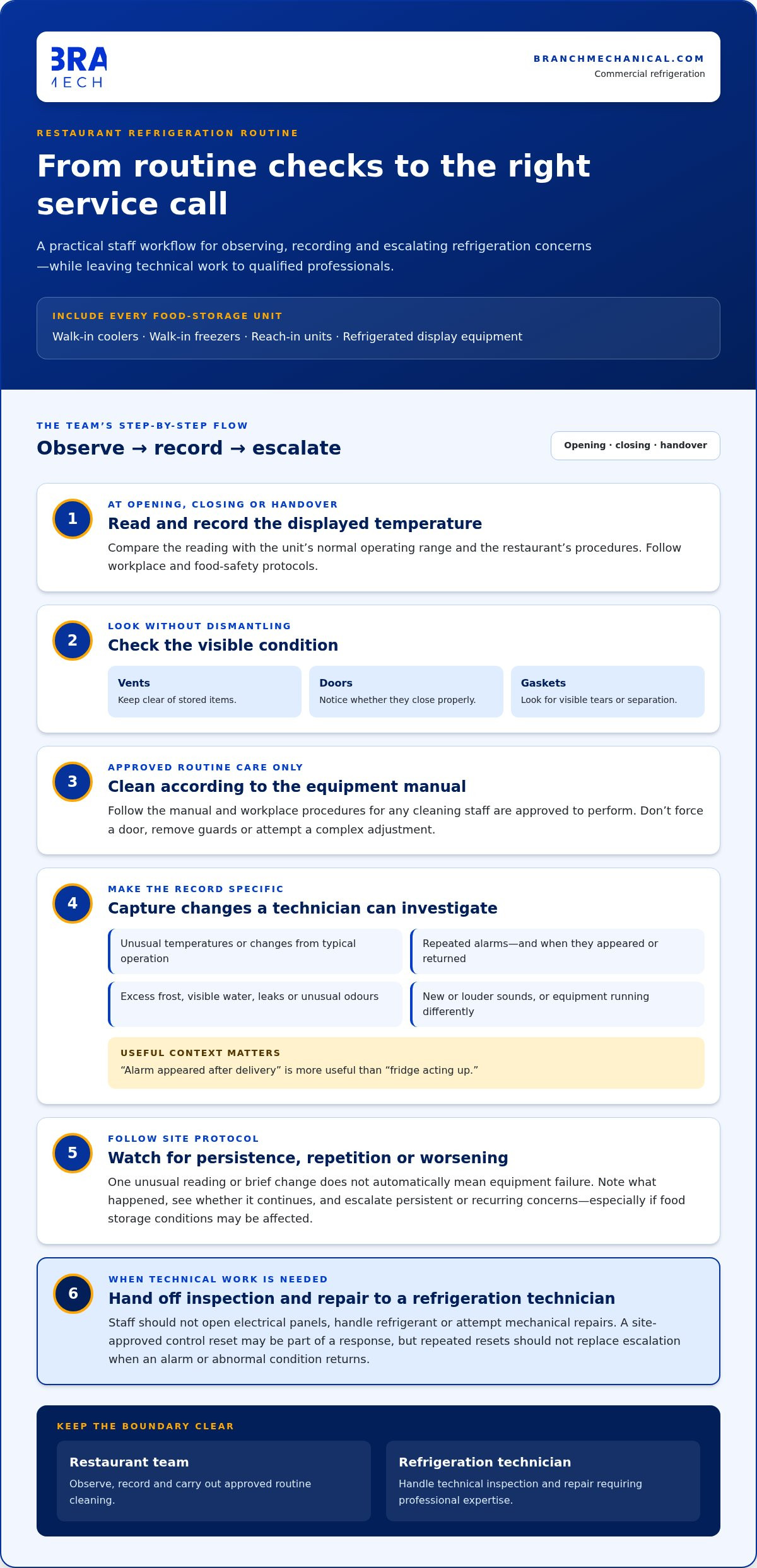
Build checks into an existing opening, closing, or handover routine. Staff can record displayed readings and compare them with the unit’s normal operating range and the restaurant’s procedures. A single unusual reading may have a straightforward explanation, but one that persists or returns should be recorded and escalated under site protocol.
Team members can look for visible changes without dismantling equipment. Keep vents clear of stored items, check that doors close properly, and look for visible tears or separation in door gaskets. Follow the manual for any routine cleaning staff are approved to perform. Don’t force a door, remove guards, or attempt a complex adjustment to change how a unit closes or runs.
Record signs that may help a technician understand what’s happening:
- Unusual temperatures or changes from the unit’s typical operation
- Repeated alarms, including when they appeared and whether they returned
- Excess frost, visible water, leaks, or unusual odours
- New or louder operating sounds, or equipment that seems to run differently
Be specific. “Alarm appeared after delivery” gives a manager more useful context than “fridge acting up.”
When to stop troubleshooting and request professional service
Staff should stop at observation and approved cleaning. They shouldn’t open electrical panels, handle refrigerant, or attempt mechanical repairs. Technical inspection and repair require appropriate professional expertise. Resetting a control may be part of a site-approved response, but repeated resets shouldn’t replace escalation when an alarm or abnormal condition returns.
Repeated abnormal operation deserves documented attention, not repeated resets. Escalate recurring alarms, unexplained temperature changes, visible leaks, or a unit that can’t maintain its normal operation. If food may be affected, follow the restaurant’s established food-protection procedures and applicable public-health guidance. Don’t assume food is safe based only on a display reading or on the fact that a unit is still running.
Clear roles help the team respond calmly. The person who notices a change can record the equipment, time, reading or symptom, and action taken, then alert the designated manager. The manager can determine the next step under workplace procedures and arrange service where needed. Branch Mechanical provides commercial refrigeration service for restaurants and businesses in the Greater Toronto Area, including Mississauga and Etobicoke.
Build a restaurant refrigeration maintenance schedule that fits service
A useful schedule makes checks predictable without treating every unit the same. Start with manufacturer guidance, then adapt tasks to each appliance’s workload, condition, and service history. A busy reach-in opened throughout a lunch rush may need closer observation than equipment used less often. Restaurant procedures should also identify which units hold high-volume or higher-risk inventory, so staff know where to focus when time is limited.
Treat the schedule as a framework, not a universal rulebook. Keep it visible with shift procedures or in the equipment record, and assign responsibility by role. Checks are less likely to be missed when they don’t depend on one person remembering. A clear handoff also helps carry unresolved concerns from one shift to the next.
A practical daily and weekly routine
At opening or closing, have the assigned team member record displayed readings and check doors, alarms, visible leaks, and unusual changes in operation. Follow site procedures for readings outside the expected range. During a weekly team review, look for patterns in the logs, confirm vents remain unobstructed, and identify accessible surfaces that need attention under approved cleaning procedures.
Build in a handoff. If a concern remains unresolved at the end of a shift, record the unit, what was observed, any action taken, and who has been notified. This prevents the next shift from treating an ongoing equipment issue as a new one.
Plan professional maintenance around equipment needs
Arrange professional service using manufacturer recommendations, operating conditions, and equipment history. A unit with repeated alarms or recurring performance changes may need attention sooner than one operating consistently. Don’t assign every system the same service interval by default. Equipment type, age, workload, and technician findings all help shape a sensible plan.
Before a planned visit, make the equipment list and recent observations available to the technician. Ask for a record of what was inspected, what work was completed, and any recommended follow-up. This gives you useful information for the next scheduling decision and connects each visit to the restaurant’s maintenance records.
A simple planning framework can help your team put the routine into practice:
- Opening or closing: Complete assigned readings and visual checks, following site procedures.
- Weekly review: Look for recurring symptoms, address approved cleaning needs, and carry open concerns forward.
- Planned professional care: Schedule work according to manufacturer guidance, observed condition, equipment history, and technician recommendations.
Revisit the schedule when you add equipment, change how a unit is used, or notice a pattern in its performance. A seasonal menu or busier delivery cycle, for example, may mean doors are opened more often and increase demands on a unit. Keep food-safety procedures and applicable public-health guidance in view as you organize checks. A well-maintained restaurant refrigeration maintenance schedule supports consistent attention while leaving technical decisions to qualified service professionals.
Use maintenance records and clear priorities to prevent avoidable disruption
A maintenance log turns individual observations into an equipment history. A single temperature change or alarm may be difficult to interpret on its own. Similar events recorded over time can reveal a recurring pattern and help a manager decide what needs follow-up. Consistent records also make shift handoffs clearer and give a responding technician useful context.
What to include in a refrigeration maintenance log
Keep the format brief enough for staff to complete during a busy shift. Use a shared paper log or digital record, and make sure the team knows where it is and who updates it. Give every unit a clear identifier and note its location, so entries aren’t confused between a walk-in and a reach-in.
Include the details that explain what happened and what the team did:
- Equipment identifier, location, date, and observed reading
- Alarm details, including whether an alert recurred
- Reported symptoms, such as unusual sounds, frost, or visible water
- Checks or approved cleaning completed, and the person responsible
- Actions taken, who was notified, and the status of any follow-up
Use plain, specific descriptions. “Alarm displayed after the lunch rush” is more useful than “unit problem,” especially if the next shift sees the same alert. Record relevant equipment observations, not customer details. Keep entries factual and consistent with workplace procedures and applicable guidance.
Choose a recordkeeping method staff can maintain
A paper sheet near the equipment can work well if staff can access it, write legibly, and pass open issues to the next shift. A shared digital log can make records easier to search and review across teams. Neither format helps if entries are incomplete or nobody reviews them. Choose the simplest method your team will use consistently, and establish who follows up on unresolved items.
Prioritize equipment and prepare for a failure
Not every unit has the same operational importance. Identify which equipment holds critical or high-volume inventory, then establish an internal response path for concerns involving those units. The plan should tell staff whom to notify, who coordinates next steps, and how to follow restaurant food-protection procedures if a unit can’t maintain normal operation. Keep these steps aligned with applicable public-health guidance.
Make equipment details and recent service history easy to find. A technician can use the unit identifier, location, recorded readings, alarm history, symptoms, and actions already taken to understand the situation. A concise, current record is more useful than a long account assembled after the issue escalates.
Branch Mechanical provides commercial refrigeration service and preventative maintenance contracts for businesses in the Greater Toronto Area, including Mississauga and Etobicoke. Arrange commercial refrigeration service to organize planned equipment care and maintenance follow-up.
Arrange restaurant refrigeration maintenance with Branch Mechanical in the GTA
A maintenance plan works best when routine team checks connect to professional commercial refrigeration support. Branch Mechanical provides commercial refrigeration service and preventative maintenance contracts for businesses across the Greater Toronto Area, including Mississauga and Etobicoke. Planned service can help organize equipment care around your restaurant’s operating needs. Branch Mechanical also provides 24/7 emergency mechanical services when urgent mechanical issues arise.
This support complements your team’s daily observations. Staff can report changes and follow site procedures, while professional service addresses work that calls for technical inspection or repair. Sharing equipment records and priorities gives the service team useful context.
What to prepare when arranging refrigeration service
Gather details that identify the unit and describe the concern. A walk-in cooler and a reach-in beside a prep station may have different operating demands, so clear information helps explain which equipment needs attention and why.
- Equipment make and model, unit identifier, and location
- Current displayed reading and the unit’s normal setpoint
- Relevant alarm history and symptoms, including when they began
- Recent maintenance or service, and any changes noticed since
- Site access details and the restaurant contact coordinating the visit
Describe what staff observed without attempting a diagnosis. For example, note that an alarm appeared more than once or that the unit’s reading changed after a busy service period. Accurate details give the service team a useful starting point and help connect the restaurant’s records to the work completed.
Make planned maintenance part of restaurant operations
Scheduled maintenance is easier to manage when it reflects equipment guidance, workload, operating condition, and previous service findings. Coordinate planned visits with restaurant operations and identify units that hold important inventory or support high-volume service. The goal is to organize access and priorities, not apply one fixed schedule to every refrigeration system.
After a visit, keep the technician’s observations, completed work, and recommended follow-up with the equipment history. Use that information to update the maintenance plan and prepare the team for next steps. If refrigeration is part of a wider building operations plan, Branch Mechanical’s mechanical contractors guide offers a broader look at mechanical contracting in Mississauga and the GTA.
To plan restaurant refrigeration maintenance around your equipment and priorities, discuss commercial refrigeration service with Branch Mechanical.
Put your maintenance plan into motion
Start by assigning someone to review the equipment records, confirm the team’s routine fits current operations, and identify units that need planned attention. Regular reviews help keep restaurant refrigeration maintenance aligned with changes in workload, equipment condition, and restaurant priorities.
Turn those observations into an ongoing plan. Keep the process manageable, give staff a clear way to pass concerns forward, and adjust the approach as you learn how each unit performs. The aim isn’t to eliminate every unexpected issue. It’s to make equipment care a considered part of running the restaurant.
With a clear plan and the right support, your team can approach refrigeration care with greater confidence and keep its attention on serving guests.
Frequently Asked Questions
How often should restaurant refrigeration equipment be maintained?
There’s no single service interval for every unit. Equipment type, manufacturer guidance, workload, and operating conditions all affect the schedule. Include staff observations in daily routines, review logs regularly, and plan professional maintenance using documented service recommendations. A unit working harder during a busy season may need closer attention. Revisit the restaurant refrigeration maintenance plan if issues recur or the way a unit is used changes.
Can restaurant staff clean commercial refrigerator coils?
Staff should clean coils only if the equipment manual and workplace procedures approve the task and they’ve been trained to do it. Coil access and equipment designs vary, and nearby electrical components can present hazards. Don’t remove panels or work near energized components. If the coils are difficult to reach, or the approved cleaning steps aren’t clear, leave the task to qualified service personnel.
What happens if a restaurant refrigerator keeps alarming?
Record the alarm, displayed reading, time, and any change in operation, then follow the restaurant’s food-protection and escalation procedures. An alarm alone doesn’t establish the cause, and a reset that clears it temporarily doesn’t show that the underlying issue is resolved. If the alert returns or normal operation is affected, report the pattern and arrange professional assessment. Include whether the alarm appeared during a particular shift or operating condition.
Is preventative maintenance required for restaurant refrigeration in Ontario?
Whether a specific maintenance task is legally required depends on applicable rules and circumstances, so don’t assume one blanket requirement applies to every system. Ontario food-premises and public-health requirements may affect restaurant operations. Check current Ontario requirements and guidance from your local public-health unit for authoritative food-safety obligations. A maintenance programme helps organize equipment care, but it doesn’t replace the restaurant’s responsibility to meet applicable requirements.
What should I do if a walk-in cooler stops holding temperature?
Follow your restaurant’s food-protection procedure, note the displayed reading and time, and report the issue through the established escalation path. Don’t repeatedly reset the unit or attempt repairs beyond your training. Record any alarm, unusual sound, leak, or frost, since those details may help explain the change. If normal operation doesn’t return, arrange qualified service and follow applicable public-health guidance for decisions about stored food.
Does preventative maintenance guarantee that restaurant refrigeration will not break down?
No. Planned maintenance can’t eliminate every failure, and a component may stop working unexpectedly. Regular attention can help document equipment condition and bring developing concerns to notice, but reliability also depends on factors such as age, workload, and operating conditions. A practical approach combines staff observations with professional maintenance and clear response procedures, so the restaurant has a consistent way to address issues if equipment performance changes.