

Most commercial water heater breakdowns don’t justify an immediate system replacement, despite how quickly rushed contractor quotes suggest it. When supply temperatures drop, securing dependable commercial water heater repair Toronto facility managers can rely on is about restoring service swiftly without discarding viable equipment. Tenant complaints mount by the minute, operational shutdowns threaten core business functions, and the risk of multi-storey water damage creates immediate pressure to act.
A methodical diagnostic approach protects your capital budget by separating simple component failures from genuine equipment end-of-life. This guide shows you how to pinpoint electrical and mechanical root causes, execute safe emergency containment while awaiting professional dispatch, and determine with confidence whether a targeted component repair or complete system upgrade makes the most practical sense for your facility.
Key Takeaways
- Recognize early operational warnings like temperature swings and sediment rumbling before they trigger catastrophic tank breaches or property damage.
- Identify mechanical and electrical failure points, from failed gas control valves to burnt heating elements, across commercial tank and tankless systems.
- Discover when targeted commercial water heater repair Toronto facilities require makes financial sense over capital replacement using the 50 percent rule.
- Follow orderly containment steps to de-energize circuits, isolate water lines, and protect multi-storey properties while waiting for dispatch.
- Understand how licensed mechanical contractors maintain Ontario Building Code and TSSA compliance to protect commercial building safety and warranties.
Recognizing Urgent Signs That Require Commercial Water Heater Repair in Toronto
Commercial hot water systems run under constant thermal stress. Unlike small domestic units, multi-residential and commercial assemblies supply dozens of fixtures simultaneously. When equipment falters, acting early prevents costly operational disruptions. Calling for targeted commercial water heater repair in Toronto at the first hint of mechanical trouble keeps minor part failures from turning into full facility shutdowns.
Temperature Inconsistencies and Insufficient Hot Water Volume
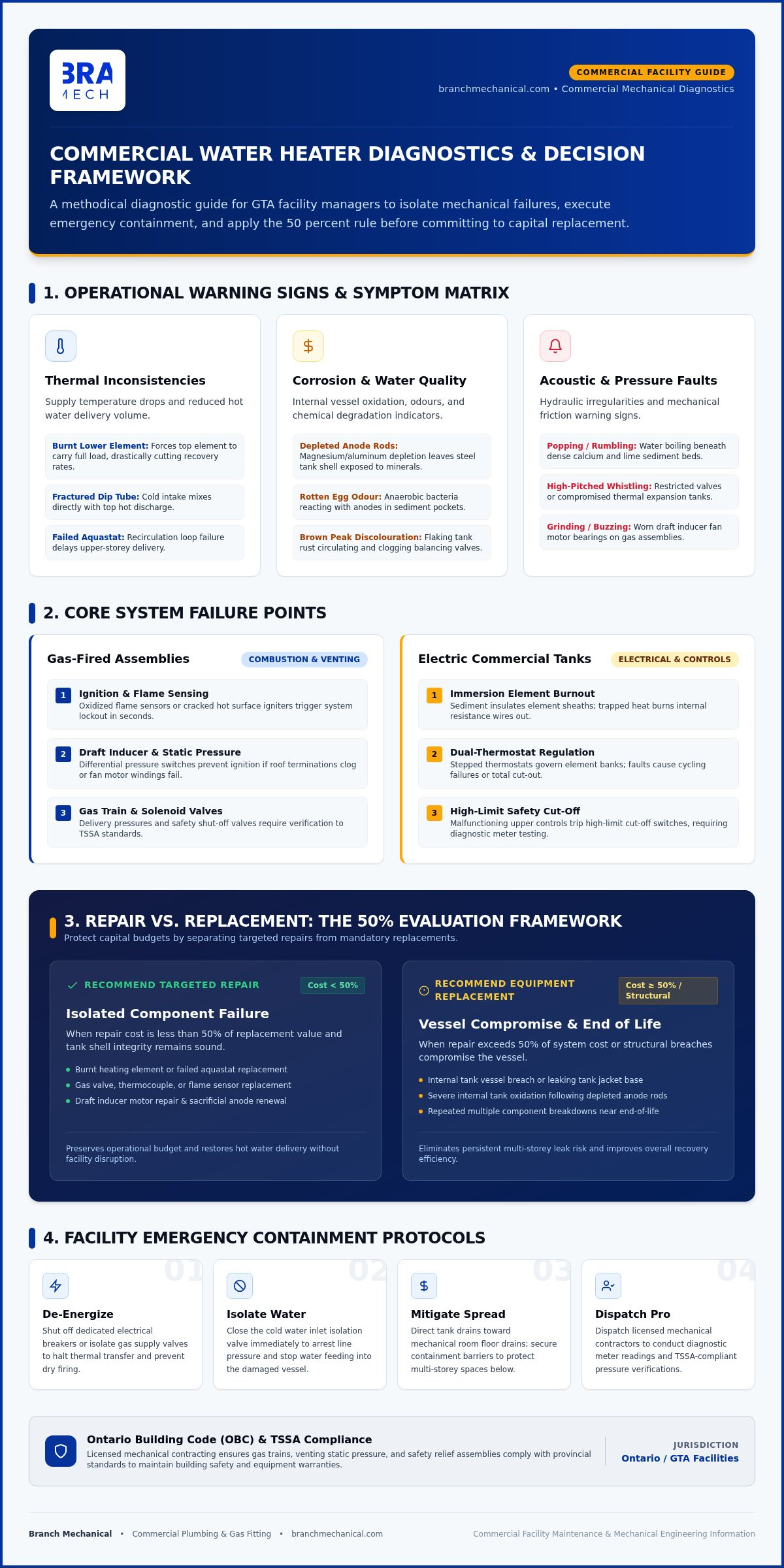
Sudden drops in supply temperature often signal internal component failure rather than increased building demand. In multi-element electric tanks, a burnt lower element forces the upper element to carry the entire heating load, cutting recovery rates dramatically. For high-volume properties utilizing conventional storage water heater technology, a fractured internal dip tube allows incoming cold water to mix directly with the heated water exiting the top. If upper storeys experience delayed delivery, the mechanical culprit is frequently a failed aquastat on the dedicated recirculation loop.
Corrosion Symptoms, Discolouration, and Unpleasant Odours
Water quality changes provide direct insight into internal tank health. If hot taps run rusty while cold fixtures stay clear, your mechanical vessel is oxidizing from the inside out. Watch for these distinct warning signs:
- Depleted sacrificial anode rods: Once these magnesium or aluminum rods fully corrode, aggressive minerals attack the steel tank shell directly.
- Rotten egg odours: Sulphur smells indicate anaerobic bacteria reacting with magnesium anodes inside accumulated sediment pockets.
- Brown tinting during peak draws: Rust flakes dislodge from thermal stress, circulating through building fixtures and clogging balancing valves.
Unusual Mechanical Noises and Pressure Irregularities
Heavy mechanical clatter should never be dismissed as normal operation. Deep rumbling or kettle-like popping indicates boiling water trapped beneath dense calcium and lime deposits at the tank base. High-pitched whistling usually reveals restricted domestic supply valves or failed thermal expansion tanks driving pressure past safe limits. On power-vented gas systems, harsh buzzing or grinding points directly to worn draft inducer motor bearings. When water begins pooling around the jacket base, schedule specialized commercial water heater repair Toronto technicians provide immediately to verify whether the leak stems from a replaceable fitting or internal vessel compromise.
Common Mechanical and Electrical Causes Behind Commercial Water Heater Failures
Commercial water heating assemblies endure far greater mechanical strain than residential units. They combine high-output burners or multi-stage electrical circuits with continuous municipal line pressures. When a system drops offline, methodical diagnostics reveal whether the fault lies in combustion controls, electrical distribution, or hydraulic pressure imbalances.
Gas Supply, Electronic Ignition, and Venting System Breakdowns
Gas-fired commercial systems rely on an exacting sequence of operation to ensure safe combustion. If a flame sensor oxidizes or a hot surface igniter cracks, the burner control module locks out within seconds. Mechanical venting components introduce additional failure points. Draft inducer fans must generate precise static pressure before differential pressure switches close to allow ignition. Blocked roof terminations or failing fan motor windings interrupt this sequence instantly. Licensed technicians verifying gas train operations also inspect safety shut-off solenoid valves to ensure delivery pressures align with TSSA standards. Facilities operating commercial kitchens should also review proper commercial kitchen gas line installation requirements to ensure fuel supply infrastructure supports all connected appliances safely.
Electric Heating Element Burnout and Dual-Thermostat Failures
High-capacity electric commercial tanks utilize banks of heavy-duty immersion elements governed by stepped thermostats. When sediment insulates an element sheath, the trapped heat burns the internal resistance wire out quickly. Technicians use digital multimeters to measure resistance and isolate dead elements without draining the vessel. In severe conditions, malfunctioning upper thermostats can trigger the high-limit safety cut-off switch. Addressing these electrical faults requires specialized commercial water heater repair Toronto properties need to prevent loose terminal connections and scorched wiring harnesses inside the panel.
Mineral Sediment Buildup and Relief Valve Complications
Water supplies across Southern Ontario carry dissolved minerals that precipitate rapidly at elevated commercial temperatures. This scale settles at the tank bottom, creating an insulating thermal barrier between the burner and the potable water. The steel vessel base overheats, accelerating metal fatigue. Scale also compromises hydraulic safety components:
- Weeping relief valves: Temperature and pressure (T&P) relief valves begin dripping continuously when scale obstructs the seat or when an internal thermal expansion tank bladder ruptures.
- Seized valve stems: Heavy calcification can freeze safety valves shut, eliminating critical pressure relief paths established by industry safety and design standards.
- Premature vessel cracking: Uneven heat distribution creates concentrated stress fractures along welded seams.
When pressure spikes or heat transfer drops threaten facility uptime, consulting commercial mechanical service specialists helps isolate damaged valves and restore balanced system operation before structural tank damage occurs.
Commercial Water Heater Repair vs. Replacement: Evaluation Framework for GTA Properties
Facility managers often face a tough choice when high-capacity hot water systems fail. Rushed proposals frequently push complete equipment replacement when a targeted repair could restore reliable service for years. Establishing an objective engineering framework helps property directors protect capital reserves while avoiding recurring mechanical downtime.
The 50% Rule and Equipment Age Benchmarks
A reliable industry standard is the 50 percent rule. If an estimate for commercial water heater repair Toronto technicians provide exceeds half the cost of a new system, and the asset has passed the midpoint of its operating lifespan, replacement is generally the wiser financial move. Commercial storage tanks typically deliver an operational lifespan of 8 to 12 years under standard Greater Toronto Area commercial usage. In contrast, commercial tankless assemblies can operate reliably for up to 20 years when scheduled descaling protects their copper and stainless steel heat exchangers from aggressive mineral deposits.
Repairable Component Failures vs. Terminal Vessel Breaches
Determining whether to service or decommission equipment depends on the physical boundary of the breakdown. External and mechanical components are fully serviceable. Technicians routinely replace ignition modules, draft inducers, gas valves, immersion elements, and external circulating pumps to return systems to peak performance. Terminal failure occurs when the internal pressure vessel is breached. Pinhole leaks along welded bottom seams or water sweating through the outer jacket insulation indicate structural metal fatigue. Never waste maintenance capital patching exterior jackets over failing pressure vessels, as catastrophic rupture remains an unavoidable safety risk.
Energy Efficiency Gains and Long-Term Operating Costs
Operating costs play a central role in long-term asset management. Aging atmospheric gas water heaters lose significant heat through standby thermal radiation and continuous venting drafts. Upgrading through a modern commercial water heater installation introduces condensing technology that captures latent heat from exhaust gases, lowering monthly operating overhead. When evaluating whether ongoing commercial water heater repair in Toronto aligns with your building lifecycle plan, consult a licensed commercial plumbing contractor in Etobicoke to run a comprehensive efficiency audit across your domestic water heating infrastructure.
Emergency Protocols Before a Mechanical Technician Arrives on Site
Sudden mechanical failure across multi-residential buildings or commercial facilities requires orderly containment. Waiting passively for a response team risks extensive structural flooding across lower floors and creates severe electrical hazards. Executing systematic isolation protocols immediately limits property damage while your contractor mobilizes for commercial water heater repair Toronto dispatch.
Step 1: Safely Cut Off Power or Gas Supplies
Eliminate energy sources feeding the damaged equipment before addressing water lines. For electric commercial systems, switch off the dedicated disconnect switch adjacent to the unit, or throw the corresponding two-pole breakers at the distribution panel. De-energizing the circuits prevents dry-firing, which instantly destroys immersion elements if the vessel drains. On gas-fired hardware, rotate the manual gas shut-off valve handle a quarter turn so it sits perpendicular to the black iron piping. If you smell distinct natural gas or the commercial carbon monoxide alarm sounds, evacuate the mechanical room immediately and call emergency services from outside the facility.
Step 2: Isolate the Domestic Water Supply
Stopping incoming municipal pressure prevents continuous water flow from compounding an active leak. Locate the dedicated cold-water inlet valve positioned on the supply pipe directly above the heater. Turn circular wheel handles clockwise until fully seated, or swing ball valve handles 90 degrees until perpendicular to the line. If these local equipment isolation valves seize or fail to hold, engage the main building domestic water shut-off valve to protect lower tenant suites from cascading water damage.
Step 3: Mitigate Flooding and Gather System Data
Once power, fuel, and water supplies are fully isolated, focus on stabilizing the mechanical room environment. Follow these practical containment measures:
- Clear primary drainage: Inspect mechanical floor drains and remove accumulated silt, debris, or maintenance materials to ensure unobstructed drainage paths.
- Connect gravity drain hoses: Thread a standard commercial wash-down hose onto the boiler drain valve at the base of the tank and direct the open end into a functional drain.
- Record unit specifications: Photograph the equipment rating plate to capture the complete model number, serial code, electrical requirements, and input firing rate.
Capturing accurate nameplate details ensures technicians arrive with exact OEM replacement parts and appropriate diagnostic equipment. If your property is facing an active mechanical failure, request 24/7 emergency mechanical services to dispatch certified technicians directly to your mechanical room.
Why Professional Mechanical Contracting Ensures Safe, Long-Term Operation
Maintaining high-capacity domestic hot water requires multi-trade technical competency. Commercial facilities rely on complex networks where gas lines, high-amperage electrical panels, and pressurized hydronic circuits intersect. Engaging certified mechanical contractors for commercial water heater repair in Toronto protects building occupants, preserves manufacturer equipment warranties, and ensures complete alignment with rigorous provincial safety standards.
Strict Compliance with Ontario Safety Codes and TSSA Regulations
Natural gas and propane systems operate under stringent Technical Standards and Safety Authority (TSSA) oversight in Ontario. Only licensed gas technicians possess the legal authority and training to calibrate gas trains, service burners, and certify draft performance. In multi-residential settings, the Ontario Building Code mandates storing water in electric storage-type heaters at a minimum of 60°C to halt Legionella bacteria growth, while keeping distributed water at fixtures below 49°C to eliminate scalding hazards. Technicians test, rebuild, and calibrate commercial master mixing valves to keep domestic supply strictly within these legal parameters.
Structured Preventative Maintenance for Multi-Unit Facilities
Emergency repairs are costly, disruptive, and frequently preventable. Setting up a structured preventative maintenance agreement safeguards capital assets against the aggressive municipal water conditions common across the Greater Toronto Area. Core mechanical service routines include:
- Routine sediment flushing and chemical descaling: Removing mineral accumulations restores heat transfer surfaces and prevents early vessel fatigue.
- Sacrificial anode rod monitoring: Inspecting core metal volume annually ensures internal galvanic protection remains active before rust damages tank steel.
- Recirculation loop balancing: Testing circulation pumps, check valves, and digital line aquastats prevents delivery lag to upper tenant suites.
Dedicated 24/7 Mechanical Support in Toronto, Mississauga, and Etobicoke
Hot water interruptions quickly turn into critical operational emergencies for commercial kitchens, hospitality centres, and multi-unit residences. When sudden equipment faults arise, facility managers require responsive commercial water heater repair Toronto building operators can trust around the clock. Contact Branch Mechanical to establish dependable preventative care or mobilize fully licensed mechanical specialists to resolve critical heating, plumbing, and gas issues across your GTA properties.
Restore Reliable Hot Water Performance Across Your GTA Facility
Maintaining uninterrupted hot water doesn’t require guessing between premature capital replacements and temporary patches. Methodical troubleshooting, timely system containment, and applying the 50 percent rule help you safeguard your building’s mechanical assets. Reliable commercial water heater repair Toronto facility managers count on focuses on precision diagnostics, isolating failed components before minor issues compromise the entire vessel.
Partnering with licensed mechanical contractors keeps your domestic hot water equipment aligned with Ontario Building Code and TSSA standards. Whether you operate a restaurant, a multi-residential complex, or a commercial centre across Toronto, Mississauga, or Etobicoke, proactive care stops sudden failures before they disrupt operations. When urgent breakdowns happen, swift technical dispatch protects your property from severe operational losses. Schedule commercial water heater repair with Branch Mechanical to access rapid 24/7 emergency service or establish a structured preventative maintenance agreement tailored to your facility.
Frequently Asked Questions
How do facility operators determine whether a commercial water heater requires repair or complete replacement?
Facility operators should evaluate the equipment age, vessel condition, and repair cost ratio. If a component repair quote exceeds 50 percent of the replacement value and the storage tank has served beyond eight years, capital replacement is generally the practical choice. If the internal vessel remains structurally sound and the failure involves serviceable controls, burners, or elements, commercial water heater repair Toronto technicians provide is the sensible path.
What causes an electric commercial water heater to stop producing hot water entirely?
Total loss of heating in an electric system usually points to a tripped high-limit switch, a failed magnetic contactor, or severed incoming supply power. When extreme internal temperatures trip the high-limit control, it opens the entire circuit as a critical safety measure. Technicians test incoming line voltage, inspect internal terminal blocks for heat damage, and verify element circuit continuity to pinpoint the exact failure point.
Why is water leaking from the bottom seam of our commercial water heater storage tank?
Water leaking from the bottom seam indicates a terminal failure of the internal steel pressure vessel. Internal corrosion gradually thins the bottom head and welded joints until municipal water pressure forces a breach through the metal shell. This structural damage cannot be welded or patched safely under Ontario safety standards, meaning the complete commercial water heater vessel must be decommissioned and replaced immediately.
Can a leaking temperature and pressure relief valve be repaired safely without replacing the heater?
Yes, a weeping or leaking temperature and pressure relief valve can be replaced easily as an isolated component without discarding the heater. Technicians first verify whether the valve is discharging because of mechanical seat failure, excessive line pressure from a failed expansion tank, or dangerous vessel overheating. Once the underlying pressure condition is resolved, installing a new, properly rated relief valve restores safe operating compliance.
How frequently should commercial and multi-residential water heating systems receive professional maintenance?
Commercial water heaters in Mississauga, Etobicoke, and Toronto require comprehensive preventative maintenance at least semi-annually. High-demand facilities, such as commercial kitchens and multi-storey residences, benefit from quarterly inspections to manage heavy regional sediment buildup. Routine service visits cover chemical descaling, anode rod volume checks, control calibration, and safety valve testing to stop unexpected operational shutdowns before they occur.
Is it legally permissible for in-house facility staff to repair commercial gas water heaters in Ontario?
No, Ontario law prohibits uncertified personnel from servicing commercial gas-fired water heaters. The Technical Standards and Safety Authority mandates that any installation, diagnostic work, or repair involving natural gas or propane systems must be performed exclusively by a licensed gas technician. Hiring qualified mechanical contractors ensures work meets mandatory provincial safety standards and keeps building insurance policies fully valid.
Why does hot water run out prematurely during peak operational hours in commercial buildings?
Premature hot water loss often points to depleted heating elements, broken dip tubes, or heavy mineral scale accumulation. When several inches of hardened lime settle across the tank bottom, it insulates potable water from the heat source and cuts thermal recovery rates drastically. In multi-element electric tanks, a single burnt element reduces total heating output, leaving the building short during peak draw periods. Operators of food service facilities should also ensure their commercial kitchen gas line installation is properly sized to sustain full appliance demand without starving water heating equipment during peak service hours.