
What if the most expensive part of your building’s mechanical room isn’t the fuel bill, but the hidden cost of waiting for a total system failure? For property managers, the first cold snap often triggers a predictable cycle of high tenant complaint volumes and emergency service calls that strain both your patience and your annual budget. It’s a stressful reality when you’re responsible for aging boilers and complex distribution networks that require more than just a standard furnace technician.
We understand that managing multi-residential heating repair in Mississauga requires a specialized approach tailored to our unique Great Lakes climate and strict Ontario safety codes. You deserve a mechanical system that operates with quiet reliability rather than constant crisis management. This resource is designed to help you identify early warning signs, manage large-scale mechanical repairs, and optimize your systems for long-term stability.
We’ll walk you through the essentials of commercial boiler maintenance, explain how to reduce system downtime, and show you how to transform your heating strategy from reactive repairs to predictable, professional management.
Key Takeaways
- Differentiate between centralized mechanical ecosystems and in-suite equipment to better manage your building’s long-term assets.
- Identify how Mississauga’s hard water impacts heat exchangers and why it is a leading cause for multi-residential heating repair Mississauga.
- Use the “Rule of 15” to evaluate boiler lifespans and decide when to transition from costly repairs to a full system replacement.
- Ensure compliance with TSSA requirements while protecting lakefront buildings from the unique “wind tunnel” effects of the local climate.
- Reduce emergency service costs by implementing preventative maintenance strategies like vibration analysis and thermal imaging to predict motor failures.
Understanding Multi-Residential Heating Systems in Mississauga
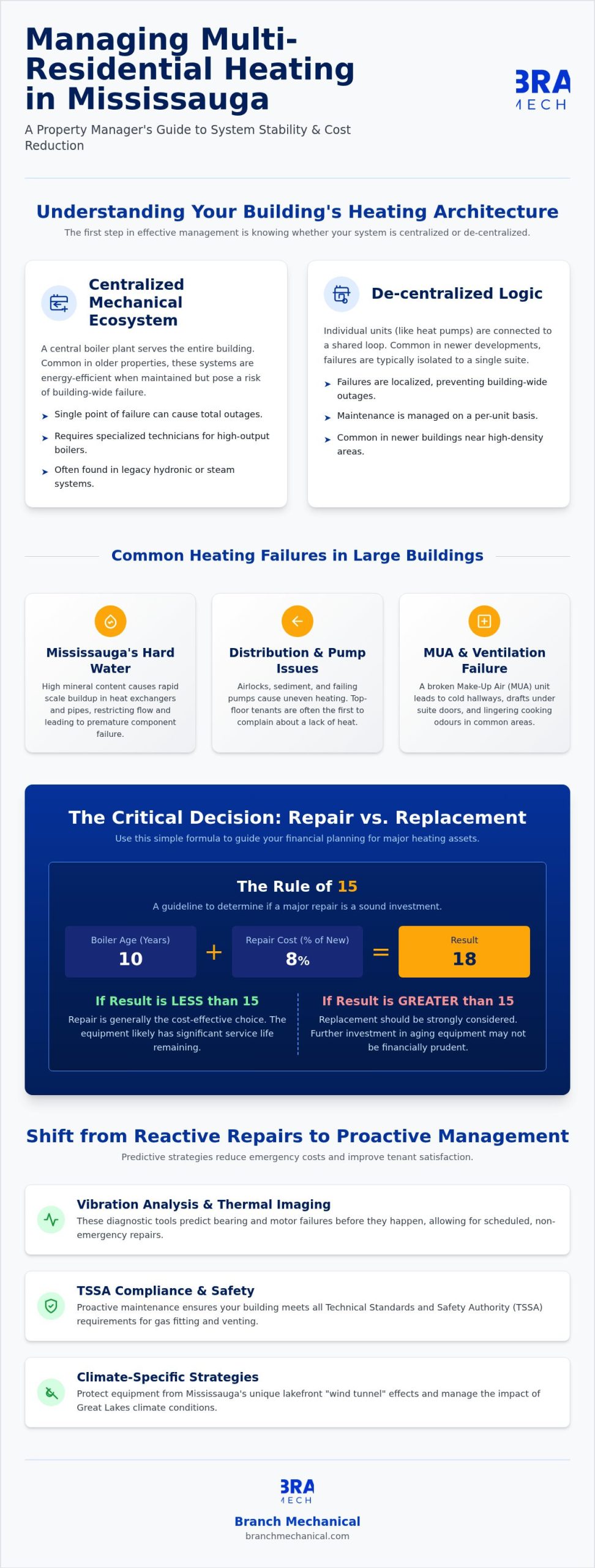
A multi-unit building operates as a centralized mechanical ecosystem. Unlike a single-family home where a furnace stands alone, these systems rely on a complex network of interconnected parts. Property managers often face confusion when distinguishing between in-suite equipment, like fan coils, and base-building mechanical assets. Success in multi-residential heating repair Mississauga depends on understanding that a problem in one unit often signals a broader imbalance in the central plant. Managing these assets requires a perspective that looks beyond the individual thermostat to the entire distribution network.
In older Mississauga neighbourhoods like Port Credit, many buildings still utilize hydronic heating or legacy steam systems. These setups require a deep understanding of pressure vessels and pipe expansion that a standard residential technician simply won’t possess. Searching for a general furnace repair service is often insufficient because they lack the specialized tools and licensing to work on high-output commercial boilers. When a system serves hundreds of people, the margin for error is non-existent.
The Core Components: Boilers, Pumps, and MUAs
High-efficiency commercial boilers serve as the heart of the building. They generate the massive thermal loads required to keep hundreds of residents warm. However, the heat only reaches those residents if the circulating pumps are balanced and operational. Another critical piece is the Make-Up Air (MUA) unit. These systems don’t just provide heat; they handle hallway pressurization. Without a functioning MUA, you’ll notice cold drafts under suite doors and lingering cooking odours in common areas. Maintaining this balance is essential for tenant comfort and building safety.
Centralized vs. De-centralized Heating Logic
Building age and location dictate your maintenance strategy. Newer developments near Square One often favour de-centralized logic, using individual unit heat pumps connected to a shared water loop. Older stock relies on massive central boiler plants. Centralized systems offer better energy efficiency when tuned correctly but create total building outages when they fail. Partnering with experienced mechanical contractors ensures your specific system logic is respected during every service call. This expertise is vital for multi-residential heating repair Mississauga because it prevents small component failures from cascading into expensive building-wide shutdowns.
Common Heating Failures in Large-Scale Buildings
Identifying the root cause of a “no heat” call in a high-rise is rarely as simple as checking a thermostat. In Mississauga, the local water supply poses a unique challenge. High mineral content leads to rapid scale buildup within heat exchangers and piping. This sediment restricts flow and forces boilers to work harder, eventually leading to premature component failure. When multi-residential heating repair Mississauga is required, we often find that localized issues are actually symptoms of systemic neglect in the mechanical room.
Building Automation Systems (BAS) are excellent for energy management, but they introduce “phantom” issues. A single faulty sensor can trick the entire system into thinking a boiler is operational when it’s actually locked out. Similarly, neglected gas fitting and venting pose serious safety risks. Cracked heat exchangers or blocked vents can lead to carbon monoxide accumulation, making regular inspections a legal and ethical necessity for every property manager.
Hydronic Loop and Distribution Issues
Airlocks and sediment buildup in the main riser often create uneven heating patterns throughout the building. If your top-floor tenants are the first to complain, it’s usually a sign of failing circulating pumps or low system pressure. The water simply lacks the force to reach the highest points of the building. Balancing valves are specialized components that regulate the flow of hot water to ensure every suite receives an equal share of thermal energy regardless of its distance from the boiler. If these valves are stuck or improperly set, you’ll face constant complaints from one side of the building while the other is overheating.
MUA and Ventilation Breakdowns
The Make-Up Air (MUA) unit is the unsung hero of building comfort. When it breaks down, hallways become freezing tunnels and cooking odours migrate freely between suites. Common burner ignition failures in these rooftop units are often caused by dirty flame sensors or worn-out ignition modules. In cases where legacy units are beyond repair, investing in high-performance commercial HVAC installation is the most cost-effective long-term solution. A quick assessment of your MUA unit can often resolve “cold suite” complaints that property managers mistakenly attribute to the main boiler. If you’re struggling with persistent ventilation issues, a professional mechanical consultation can help stabilize your building’s environment before the winter peak.
Repair vs. Replacement: Evaluating Your Building’s Heating Assets
Deciding when to stop investing in multi-residential heating repair Mississauga and start planning for a replacement is a critical fiduciary duty for property managers. We recommend the “Rule of 15” as a baseline framework. Most commercial boilers and heavy mechanical assets have a reliable service life of 15 to 20 years. Once a system crosses the 15-year mark, the frequency of component failure typically accelerates; making each subsequent repair less cost-effective than the last. Efficiency pays for itself when you stop chasing legacy failures.
Repairability is another major factor to consider. Sourcing parts for obsolete HVAC systems in Ontario is becoming increasingly difficult and expensive. Older units often rely on phased-out refrigerants or proprietary electrical components that are no longer in production. If your technician spends more time hunting for parts than performing the actual service, your building is at high risk for extended downtime during a mid-winter crisis. Modern units are designed for BAS compatibility, allowing for remote monitoring and more precise energy management that older systems simply cannot match.
The Financial Impact of Patchwork Repairs
The cumulative cost of emergency service calls often exceeds the monthly financing of a planned capital upgrade. Frequent “furnace repair” interventions on a failing boiler are usually a signal of systemic risk rather than isolated bad luck. Beyond the direct mechanical costs, you must consider the impact on tenant retention. Persistent heating fluctuations damage a building’s reputation and lead to higher turnover rates. A proactive replacement strategy eliminates the “emergency premium” you pay for urgent mid-night repairs during a cold snap.
Modern Efficiency Standards and Rebates
Modern condensing boilers realize significant fuel savings over older atmospheric models by capturing heat that would otherwise escape through the vent. These systems often operate at over 90 percent efficiency, which translates into lower utility bills for the corporation. Various Ontario energy incentives and rebates are currently available for high-efficiency boiler retrofits. Consulting with a professional plumbing and gas fitting expert allows you to navigate these programs effectively. We help you evaluate if your current infrastructure can support a high-efficiency upgrade or if a more comprehensive multi-residential heating repair Mississauga strategy is needed to bridge the gap until the next budget cycle.
Navigating Mississauga’s Climate and Local Heating Standards
Mississauga’s geography creates specific mechanical challenges that inland cities rarely face. High-rise corridors near Lake Ontario, particularly in areas like Port Credit and Lakeview, experience a distinct “wind tunnel” effect. This phenomenon strips heat from building envelopes much faster than in sheltered environments. Effective multi-residential heating repair Mississauga requires equipment calibrated for these specific pressure differentials and extreme wind loads. Local expertise in Mississauga and Etobicoke is vital because we understand how these micro-climates impact your building’s thermal performance.
Compliance in Ontario is governed by the Technical Standards and Safety Authority (TSSA). Their requirements for boiler rooms are strict and designed to prevent catastrophic failures. Property managers must ensure all commercial gas-fired equipment undergoes mandatory annual inspections by licensed technicians. These inspections aren’t merely a suggestion; they’re a legal necessity to ensure the safety of every resident in your building. Failing to maintain these standards can lead to significant liability and forced system shutdowns by provincial inspectors.
Winter Preparedness for the GTA
October is the critical month for “dry runs” of your building’s heating system. Testing the central plant before the first frost allows for controlled, scheduled repairs rather than expensive emergency interventions during a blizzard. Mississauga cold snaps often lead to pipe bursts in unheated parking garages, which can compromise the entire hydronic loop if not properly insulated. After heavy Peel Region snowfall, your maintenance team should follow a strict exterior vent clearance checklist:
- Inspect intake louvres for ice buildup or frost accumulation.
- Clear snow away from low-level exhaust vents to prevent carbon monoxide backup.
- Verify that rooftop units remain accessible for emergency service technicians.
- Check that pressure sensors aren’t obstructed by wind-driven debris.
Compliance and Safety Regulations
Property managers hold a legal responsibility for heating continuity under Ontario building and safety codes. A total loss of heat is more than a tenant complaint; it’s a potential safety violation that requires immediate action. Carbon monoxide monitoring in centralized systems provides an essential layer of protection against venting failures or cracked heat exchangers. Because mechanical crises don’t follow a business schedule, having a partner for 24/7 emergency mechanical services is a necessity for modern building management. Professional oversight ensures you remain compliant while protecting your residents from the harshest Great Lakes winter conditions.
Proactive Maintenance: The Key to Reducing Emergency Repair Costs
Shifting from a reactive “break-fix” mindset to a proactive maintenance strategy is the most effective way to control your building’s operating budget. A comprehensive preventative maintenance contract transforms your mechanical room from a source of anxiety into a predictable asset. When you invest in multi-residential heating repair Mississauga, the goal shouldn’t just be restoring heat; it should be preventing the next outage. This requires a methodical approach that looks at the entire building lifecycle rather than just the immediate crisis.
Modern diagnostics play a massive role in this stability. We utilize vibration analysis to detect subtle bearing wear in circulating pumps months before they actually seize. Similarly, thermal imaging allows our technicians to identify electrical hotspots in control panels or blockages in heat exchangers that are invisible to the naked eye. These tools provide a window into the health of your system, allowing for scheduled repairs during business hours rather than expensive emergency calls at midnight. We also implement rigorous water treatment programs to neutralize the hard water issues common in Mississauga, protecting your plumbing loops from internal corrosion.
The Benefits of Scheduled Mechanical Service
Quarterly inspections do more than just tick a compliance box. They significantly extend the lifespan of your commercial refrigeration, HVAC, and boiler systems by ensuring every component operates within its designed parameters. One of the most valuable aspects of a maintenance agreement is the “priority response” benefit. During a city-wide cold snap when every contractor is overbooked, our contract clients move to the front of the line. Furthermore, we provide detailed digital documentation of every inspection. This paper trail is essential for insurance renewals and provides property boards with the data-driven clarity they need for long-term capital planning.
Selecting the Right Contractor in Mississauga
Managing a multi-unit building requires a partner with multi-disciplinary expertise. You need a contractor who understands how HVAC, electrical, and plumbing systems interact within a single ecosystem. A technician who only understands boilers might miss a critical failure in the Building Automation System (BAS) that is actually causing the heating imbalance. Look for a team that takes a holistic view of your mechanical room and prioritizes building stability above all else. If you’re ready to move away from the cycle of constant tenant complaints and unpredictable costs, contact Branch Mechanical for a system assessment today to secure your building’s future.
Securing Long-Term Stability for Your Mechanical Room
Managing a multi-unit building requires a shift from crisis management to strategic oversight. We’ve explored how understanding your centralized ecosystem and staying ahead of TSSA compliance can prevent the stress of mid-winter failures. By prioritizing preventative maintenance and recognizing when legacy assets have reached the end of their reliable lifespan, you protect both your budget and your residents. Reliable heating is the foundation of tenant satisfaction and building safety.
Effective multi-residential heating repair Mississauga isn’t just about fixing a boiler; it’s about optimizing the entire distribution loop for the long term. Our team of licensed gas fitters and HVAC technicians specializes in these complex mechanical systems. We provide 24/7 emergency response throughout Mississauga and Etobicoke, ensuring you always have a professional partner ready to maintain building comfort. Secure Your Building’s Comfort with Branch Mechanical’s Expert Heating Services. You have the knowledge to transform your building’s performance, and we’re here to help you achieve that lasting peace of mind.
Frequently Asked Questions
How often should a multi-residential boiler be serviced in Mississauga?
Multi-residential boilers in Mississauga should undergo a comprehensive service at least once a year to comply with mandatory TSSA requirements. However, we recommend a quarterly preventative maintenance schedule for larger buildings. These regular check-ups allow technicians to clean burners, inspect heat exchangers, and test safety controls before the heavy winter load begins. Consistent servicing reduces the risk of sudden outages and helps maintain the high efficiency of your central heating plant.
What are the signs that my building’s Make-Up Air (MUA) unit is failing?
Common signs of a failing Make-Up Air (MUA) unit include freezing hallways and the migration of cooking odours between suites. You might also notice negative pressure issues, such as suite doors that are difficult to open or a persistent whistling sound around windows. If the rooftop burner fails to ignite, the unit will simply pump raw outdoor air into the building, causing a rapid drop in common area temperatures during a Mississauga cold snap.
Is 24/7 emergency repair available for commercial heating in Etobicoke?
Yes, Branch Mechanical provides 24/7 emergency mechanical services for commercial and multi-residential properties throughout Etobicoke and Mississauga. We understand that a total loss of heat is a safety crisis that can’t wait until Monday morning. Our on-call technicians are equipped to handle critical failures in boilers, pumps, and gas lines at any hour. This rapid response is essential for maintaining building safety and preventing secondary issues like burst pipes during extreme weather.
Can a Building Automation System (BAS) help reduce heating repair costs?
A Building Automation System (BAS) significantly reduces heating repair costs by providing real-time data on system performance. These systems allow property managers to identify minor inefficiencies or sensor errors before they escalate into major mechanical failures. By optimizing boiler staging and pump speeds, a BAS reduces unnecessary wear on your equipment. This proactive oversight leads to more predictable maintenance budgets and lower utility bills for the corporation while extending the overall lifespan of your assets.
What is the average lifespan of a commercial boiler in a high-rise?
The average lifespan of a commercial boiler in a high-rise building is typically between 15 and 20 years. While some well-maintained legacy systems may last longer, the cost of multi-residential heating repair Mississauga often becomes prohibitive once a unit crosses the 15-year mark. At this stage, parts become harder to source and energy efficiency drops significantly. We recommend using this timeframe to plan for capital replacements rather than continuing to invest in frequent, costly repairs.
Why do some units stay cold while others are too hot in my building?
Temperature imbalances are usually caused by issues in the hydronic distribution loop rather than the boiler itself. Common culprits include stuck balancing valves, airlocks in the main risers, or failing circulating pumps that can’t push hot water to the top floors. If some units are overheating while others remain cold, the system’s flow needs professional calibration. This process ensures that thermal energy is distributed evenly across the entire building regardless of a suite’s distance from the mechanical room.
Does Branch Mechanical handle both plumbing and heating repairs?
Branch Mechanical is a multi-disciplinary contractor that handles commercial plumbing, gas fitting, and heating repairs. This integrated approach is vital for multi-residential buildings where the heating and domestic hot water systems are often interconnected. Our licensed technicians can service your central boiler plant while simultaneously addressing issues in the building’s main plumbing stacks or circulating pumps. This expertise eliminates the need to coordinate between multiple contractors for complex mechanical room failures.
What should I do if the building’s main heating pump fails on a weekend?
If a main heating pump fails on a weekend, you should contact our 24/7 emergency mechanical services immediately. A pump failure stops the flow of hot water, which can lead to a total building freeze-up within hours during a typical Ontario winter. Our technicians can often bypass a failed pump or install a temporary replacement to restore circulation. Don’t wait for the next business day, as stagnant water in exterior-facing pipes can quickly lead to costly bursts.