
Delaying a minor commercial hvac repair isn’t just a maintenance oversight; it’s a high-stakes gamble with your facility’s operational budget. Many building managers in Mississauga and Etobicoke treat their mechanical systems like a background utility, only reacting when a tenant complains about temperature fluctuations or the heating fails during a January cold snap. It’s a stressful way to manage a property, and it’s often far more expensive than it needs to be.
We understand that unpredictable repair costs and rising energy bills can make facility management feel like a series of endless fires to put out. You deserve a predictable environment where your infrastructure is a source of stability rather than a liability. This article will debunk five persistent myths that cost GTA businesses thousands of dollars in avoidable expenses. You’ll realize how to protect your bottom line as we examine the difference between reactive fixes and strategic maintenance that keeps your facility at the centre of its peak performance all year round.
Key Takeaways
- Identify “silent failures” like seized dampers that waste energy even when your tenants aren’t complaining about the temperature.
- Understand why professional commercial hvac repair requires a multi-disciplinary team with specialized gas fitting and electrical licences.
- Learn how to differentiate between integrated commercial ecosystems and simple residential units to avoid costly service errors.
- Realize why Building Automation Systems (BAS) require physical maintenance and calibration to prevent “garbage in, garbage out” data errors.
- Shift from a reactive “break-fix” mindset to a proactive strategy that lowers long-term labour costs and ensures 24/7 operational continuity.
Myth #1: Commercial Systems are Just Larger Residential Units
A common misconception among facility managers is that a commercial system is simply a residential furnace or air conditioner on steroids. This line of thinking often leads to hiring generalists who lack the specific training required for complex industrial environments. In reality, a commercial setup is an integrated mechanical ecosystem. While a home system focuses on a single zone, commercial hvac repair involves managing multi-zone requirements, high-occupancy loads, and sophisticated pressure balances. Residential-grade diagnostics simply don’t account for the massive scale of industrial chillers or the intricate piping of a multi-residential boiler system. If a technician uses residential logic on an industrial chiller, they might overlook a subtle pressure drop that eventually leads to a total system failure during a heatwave.
The Complexity of Rooftop Units (RTUs)
Rooftop Units, or RTUs, represent a significant departure from residential split systems. These units house heating, cooling, and ventilation components within a single chassis, which makes the diagnostic process much more demanding. In our local Mississauga and Etobicoke climate, these systems rely heavily on economizers. These components use outdoor air for “free cooling” when conditions allow, which significantly reduces energy consumption. However, if an economizer fails or the dampers seize, your energy bills will skyrocket even if the space feels comfortable. Repairing these units often involves complex logistics, including crane coordination and strict rooftop safety protocols. It’s a specialized field where a technician must understand the intersection of high-voltage electrical, gas fitting, and refrigeration cycles.
Ventilation and Indoor Air Quality (IAQ) Standards
Commercial systems carry a heavy responsibility for maintaining Indoor Air Quality (IAQ). Unlike residential units that primarily recirculate air, commercial systems must actively manage CO2 levels and fresh air intake through sophisticated sensors. If repairs are handled by someone who doesn’t understand these nuances, your Mississauga office could suffer from “Sick Building Syndrome.” This condition occurs when stagnant air and poor filtration lead to headaches and fatigue among staff. This leads to decreased productivity and higher tenant turnover. Proper maintenance ensures that air filtration systems are functioning at peak efficiency, protecting the health of everyone in the building. Working with specialized mechanical contractors ensures your facility meets these rigorous standards while maintaining operational continuity and tenant satisfaction.
Myth #2: If the Building is Comfortable, the System is Working Fine
Many facility managers in Mississauga believe that as long as the office stays at a steady 21 degrees, the mechanical systems are in perfect health. This is a dangerous myth. Comfort can often be a mask for extreme inefficiency. You might have a seized outside air damper or a leaking bypass valve that forces your system to work twice as hard to maintain that setpoint. These “silent failures” don’t trigger immediate tenant complaints, but they do trigger massive spikes in your monthly operational costs. Your energy bill is a much more reliable diagnostic tool than the thermostat on the wall. If your consumption is rising without a corresponding change in weather or occupancy, it’s a clear sign you need a professional commercial hvac repair assessment to find the hidden drain on your budget.
The High Cost of “Fighting” Systems
One of the most expensive hidden issues in GTA buildings is when systems “fight” each other. This occurs when a boiler and a chiller run simultaneously because of a software glitch or a failed sensor. While a Building Automation System (BAS) is designed to prevent this conflict, the logic can drift over time without regular control sequence audits. One zone might call for heat while another calls for cooling, leading to a scenario where you’re paying to heat and cool the same air mass. Regular audits ensure your BAS sequences remain optimized for the specific needs of your facility, preventing this invisible waste of energy. If you suspect your utility costs are higher than they should be, a quick review of your energy management sequences can often reveal significant savings.
Component Stress and Premature Failure
Neglected minor issues create a domino effect of mechanical stress throughout your infrastructure. A small refrigerant leak might not stop the cooling immediately, but it forces the compressor to run longer and hotter, eventually leading to a catastrophic burnout. Similarly, ignored belt tensions or worn motor bearings increase friction, which forces the motors to draw more amperage. Short-cycling is the process where a system turns on and off too frequently, causing excessive mechanical wear and reducing the expected lifespan of your equipment. Proactive attention to these details prevents the sudden, total system failure that every building manager fears during a Canadian winter. By identifying these stresses early, you protect your equipment from the “domino effect” that leads to expensive emergency replacements.
Myth #3: Any Licensed Electrician or Plumber Can Fix HVAC Issues
Hiring a general electrician or plumber for a complex commercial hvac repair is a common mistake that leads to incomplete fixes. While these trades are essential, commercial mechanical systems exist at the intersection of several specialized disciplines. A modern Rooftop Unit (RTU) or industrial boiler requires a technician who understands high-voltage electrical circuits, high-pressure gas fitting, and complex refrigeration cycles simultaneously. When you hire a specialist for commercial hvac installation, you’re investing in a team that sees the entire mechanical ecosystem rather than just one disconnected component. Generalists often treat the symptoms of a failure without addressing the underlying mechanical conflict.
The Need for Integrated Mechanical Expertise
A refrigeration leak might look like a simple hardware failure, but it’s often caused by an electrical control issue that forces the compressor to run outside its design parameters. If a technician only fixes the leak without addressing the control sequence, the failure will repeat within months. Similarly, improper gas pressure settings in a commercial boiler can lead to inefficient combustion or dangerous carbon monoxide levels. Mississauga businesses trust integrated mechanical firms because they eliminate the “finger-pointing” between different trades. We provide a single point of accountability for your hvac, plumbing, and electrical needs, ensuring that every component works in harmony.
TSSA and Regulatory Compliance in Ontario
The Technical Standards and Safety Authority (TSSA) mandates strict protocols for gas-fired equipment and pressure vessels in Ontario. Many property managers don’t realize the significant liability risks they face when using uncertified labour for these critical systems. If a non-compliant repair leads to an accident or a failed inspection, the building owner is held legally responsible. Branch Mechanical ensures all gas fitting and pressure vessel repairs meet or exceed current Ontario codes. This commitment to compliance provides peace of mind and protects your facility’s insurance standing. Our technicians maintain the specific licences required to work on high-output industrial systems, ensuring every repair is documented and safe.
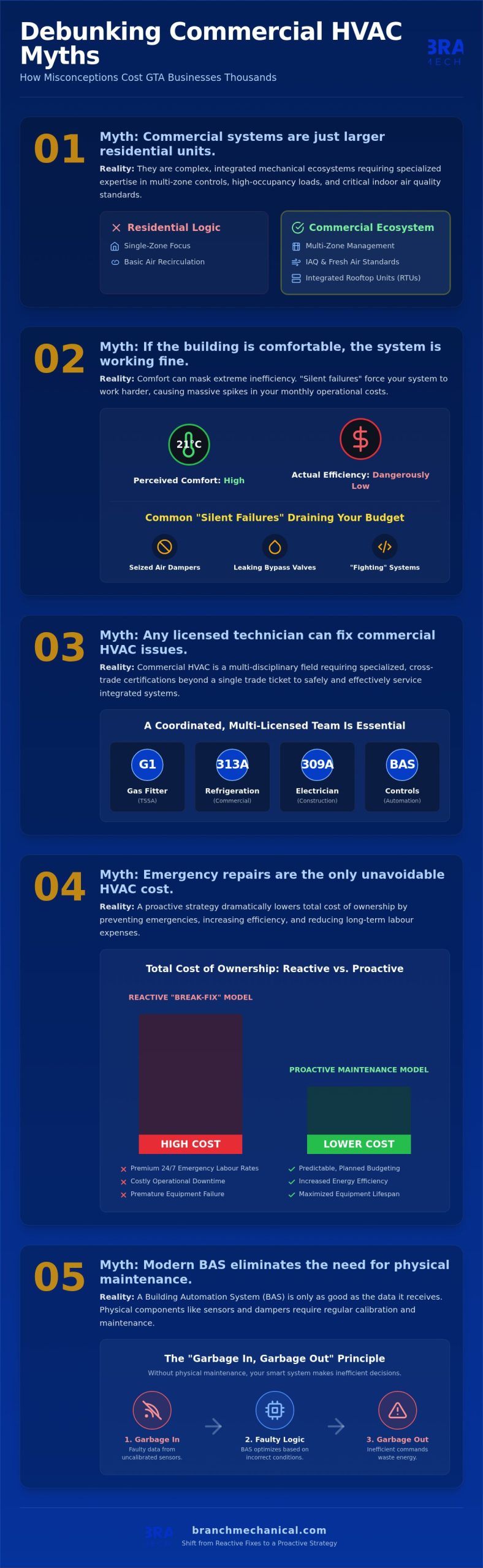
Myth #4: Emergency Repairs are the Only Unavoidable HVAC Cost
Many facility managers view a total system shutdown as an unavoidable stroke of mechanical bad luck. This mindset suggests that machinery simply fails at random, and the only response is to call for an emergency fix. In reality, a reactive approach to commercial hvac repair is one of the most expensive ways to manage a building. Emergency labour rates, expedited shipping for parts, and the cost of diagnostic work during off-hours can triple the price of a standard service call. Most “random” failures are actually the final stage of a long, visible decline that could have been caught months earlier during a routine inspection.
The Business Impact of Unscheduled Downtime
The true cost of a system failure extends far beyond the repair bill itself. For a retail space in Etobicoke, a lost afternoon of air conditioning during a summer heatwave results in immediate lost revenue and damaged brand reputation. In multi-residential buildings, a loss of heating during a Canadian winter creates significant safety risks and potential legal liabilities for property managers. When you’re forced into an emergency situation, technicians often have to implement “band-aid” fixes just to get the system running. These temporary solutions frequently lead to a second, more expensive failure because the root cause wasn’t addressed under the pressure of the emergency.
Preventative Maintenance as an ROI Strategy
Shifting your perspective from “repair” to “investment” is the most effective way to protect your bottom line. Industry data suggests that a consistent maintenance program can reduce overall repair costs by up to 30 percent by catching small issues before they escalate. Consider the long-term value of your infrastructure:
- Extended Lifespan: Routine care can extend the life of a $50,000 Rooftop Unit (RTU) by five or even seven years.
- Energy Efficiency: Clean coils and calibrated sensors ensure your system doesn’t draw excess amperage.
- Predictable Budgeting: Scheduled visits allow you to plan for component replacements during shoulder seasons.
Every facility has unique requirements based on its age, occupancy, and usage patterns. We specialize in creating custom preventative maintenance contracts that turn your mechanical systems into a predictable, manageable asset rather than a source of constant financial surprises.
Myth #5: Modern BAS Eliminates the Need for Physical Repairs
A Building Automation System (BAS) is a powerful tool for energy management, but it’s not a self-healing solution. Many facility managers in Mississauga believe that a smart dashboard eliminates the need for hands-on maintenance. This is a costly misconception. While software can flag an anomaly, it cannot tighten a loose belt, lubricate a bearing, or patch a refrigerant leak. Relying solely on digital alerts without scheduling a physical commercial hvac repair assessment often leads to “garbage in, garbage out” scenarios. If your sensors aren’t calibrated, your BAS is making operational decisions based on false data, which can quietly destroy your equipment’s efficiency while reporting that everything is normal.
When Software Masks Mechanical Issues
Smart systems are designed to keep the building comfortable at any cost. This often means the software will compensate for a failing component by overworking another part of the system. For example, if one pump in a multi-residential heating loop fails, the BAS might increase the speed of the remaining pumps to maintain flow. You won’t see a temperature drop, but you will see a massive spike in energy consumption and premature wear on the surviving motors. Ignoring “minor” alarms or using manual overrides to bypass a persistent fault leads to long-term efficiency losses that eventually require an expensive, unplanned commercial hvac repair. These digital workarounds only delay the inevitable mechanical failure.
The Human Element in Mechanical Service
Data is only as useful as the person interpreting it. Modern technology provides the “what,” but an experienced technician provides the “why.” A dashboard might show a pressure drop, but it takes a trained eye and ear to determine if the cause is a faulty valve, a blocked heat exchanger, or a failing compressor. We help our Mississauga and Etobicoke clients translate their building data into actionable maintenance plans. We combine smart technology with expert 24/7 emergency response to ensure that when your BAS reports a problem, a professional is there to fix the mechanical root cause. This proactive approach ensures your facility stays at the centre of its performance goals without the risk of sudden, catastrophic downtime.
Securing Your Operational Continuity
Managing a commercial facility in the GTA requires a shift from reactive fixes to strategic mechanical oversight. We have explored how “silent failures” can drain your budget even when the thermostat seems perfect. Relying on specialized expertise ensures your complex Rooftop Units and boilers remain TSSA compliant and energy efficient. By debunking these common myths, you can move away from the stress of unpredictable breakdowns and toward a model of long-term reliability. A professional approach to commercial hvac repair isn’t just about fixing what’s broken; it’s about protecting the lifespan of your most expensive infrastructure assets.
Since 2012, we have provided Mississauga and Etobicoke businesses with the stability they need to focus on their core operations. Our TSSA certified technicians are available for 24/7 emergency service, ensuring your facility is never left without support. Don’t wait for a total system failure to realize the value of proactive care. Request a professional mechanical assessment for your Mississauga or Etobicoke facility today. With the right partner, your mechanical systems become a source of peace of mind rather than a financial liability. We look forward to helping you optimize your building’s performance.
Frequently Asked Questions
How often should a commercial HVAC system be serviced in the GTA?
Quarterly maintenance is the industry standard for commercial hvac repair in the Greater Toronto Area. Our local climate in Mississauga and Etobicoke involves extreme temperature swings that stress mechanical components differently each season. A spring visit prepares the cooling system for high humidity, while a fall inspection ensures the heating system is safe for a January cold snap. Regular service prevents minor issues from becoming expensive emergency calls during peak demand periods.
What is the average lifespan of a commercial rooftop unit (RTU)?
A well-maintained rooftop unit typically lasts between 15 and 20 years. However, this lifespan depends heavily on the consistency of preventative care. In environments like Etobicoke, where units are exposed to harsh lakefront winds and industrial pollutants, a neglected system might fail after only 10 or 12 years. Regular cleaning and component lubrication are essential to ensure you get the maximum return on your initial capital investment.
Does a commercial HVAC repair require a specific TSSA licence in Ontario?
Yes, any commercial hvac repair involving gas lines or pressure vessels requires a technician with a specific TSSA licence. In Ontario, the Technical Standards and Safety Authority mandates that only certified professionals handle these high-risk systems. Using uncertified labour for gas fitting or boiler service is a significant liability risk for property managers. Our team maintains all necessary certifications to ensure your facility remains compliant with provincial safety regulations.
How can I tell if my commercial refrigeration system is failing before it stops working?
You should monitor your energy bills and listen for unusual mechanical sounds to catch a failing commercial refrigeration system early. If you notice frost buildup on the coils or if the compressor starts cycling more frequently, the system is likely struggling. Subtle temperature drifts in your walk-in cooler or display cases are also clear indicators of a refrigerant leak or a failing sensor that needs professional attention before a total shutdown occurs.
What are the most common causes of commercial HVAC failure in Mississauga?
Neglected air filters and clogged condenser coils are the most frequent causes of system failure in Mississauga. The dust and debris found in industrial corridors can quickly foul a system, which forces motors to work harder and eventually burn out. Sensor drift and uncalibrated thermostats are also common, as they lead to “fighting systems” where heating and cooling run simultaneously. Proactive cleaning and calibration are the best ways to avoid these avoidable mechanical breakdowns.
Can building automation systems (BAS) really lower my repair costs?
Building Automation Systems lower repair costs by identifying performance anomalies before they lead to hardware failure. A properly calibrated system provides real-time data that allows for targeted, proactive service rather than expensive, reactive repairs. By optimizing run times and preventing short-cycling, a BAS reduces the physical wear on compressors and motors. This technology turns your mechanical infrastructure into a predictable asset rather than a source of constant financial surprises.
What should I do if my building’s heating fails in the middle of a winter night?
You should immediately contact 24/7 emergency mechanical services if your heating fails during a winter night. Building managers in Etobicoke and Mississauga must act quickly to prevent pipe bursts and ensure tenant safety when temperatures drop below freezing. Our team responds to critical failures at any hour to restore operational continuity. While waiting for a technician, ensure all exterior doors are sealed and monitor any critical areas for potential freezing or water damage.
Is it better to repair an old commercial boiler or replace it entirely?
You should consider replacing a commercial boiler if the repair costs exceed 50 percent of the value of a new unit. If your current system is more than 15 years old, the efficiency gains of a modern, high-efficiency model often justify the capital expense. Newer systems provide better reliability and lower monthly utility costs. We provide detailed assessments to help you realize whether a strategic replacement or a targeted repair is the best path for your facility.