

An apparent contract problem may be a service issue, or a misunderstanding of what the agreement covers. An unexpected charge, a missed service expectation, or an approaching renewal can raise difficult questions for a business. When assessing problems with Enercare commercial contracts, the signed agreement matters more than assumptions or online reports. Its details can affect both your obligations and the heating, cooling, or refrigeration systems your building relies on.
For clear answers about covered equipment, charges, renewal dates, cancellation terms, or service expectations, compare the agreement with invoices, service records, and written communications. This helps you identify whether a concern relates to the contract wording, the service delivered, or a gap in understanding, without jumping to conclusions about what Enercare owes.
This article explains what to review, how to document concerns, and how to keep critical building systems supported while you determine next steps. You’ll also learn how planned maintenance for commercial HVAC and refrigeration equipment can help keep operational needs visible during a contract review.
Key Takeaways
- Online reports don’t establish what your agreement requires. Use the signed contract and related records to understand the terms that apply to your property.
- For problems with Enercare commercial contracts, compare the equipment and services named in the agreement with the systems and work at your building.
- Build a clear record by matching contract terms with invoices, work orders, service dates, and the operational impact of each concern.
- Make your inquiry factual, use the agreement’s stated communication methods, and track responses before deciding on next steps.
- Keep building operations in view by tracking equipment condition and maintenance history while you address the contract concern.
Problems with Enercare commercial contracts: identify the issue before acting
An online complaint may describe someone else’s experience, but it doesn’t establish what your agreement says or what happened at your property. Before treating problems with Enercare commercial contracts as one type of dispute, identify the specific concern and compare it with your own documents.
A commercial service contract sets out agreed equipment, service scope, responsibilities, and conditions. It may clarify what work is covered, what falls outside its stated scope, and how particular issues are handled. The signed agreement and its amendments are the starting point. A broader overview of contract management best practices also highlights the value of organizing and tracking contract information.
Which contract problem are you trying to resolve?
First, sort the concern. It may involve service performance, equipment coverage, billing, renewal, cancellation, or communication. For example, an invoice that differs from your expectations is a billing question to investigate. A system issue may raise a service-performance question, while uncertainty about whether a unit is covered is a scope question.
These are categories for review, not claims about Enercare. The same symptom can have different causes under different agreements. If a service visit didn’t address a reported issue, examine the work record, the equipment named in the agreement, and the stated service scope. Separating those details makes the concern easier to explain.
Does a residential rental agreement work like a commercial service contract?
Not necessarily. An equipment rental agreement, a maintenance agreement, and a commercial service contract can serve different purposes. One may focus on use of a particular piece of equipment; another may set out maintenance or service responsibilities. Don’t assume a residential rental example describes the terms of a business agreement.
Check your documents to identify the agreement type and the legal customer named on it. That may be a business, property owner, or another entity. Residential consumer examples or protections shouldn’t automatically be applied to a business contract. The relevant terms and circumstances matter, and a legal question may require advice beyond the agreement itself.
Once you’ve identified the agreement and the type of concern, focus your review on the relevant clauses and records. This gives you a more useful basis for distinguishing a service issue from a billing question or a disagreement about scope.
Read the Enercare agreement for scope, renewal, and service obligations
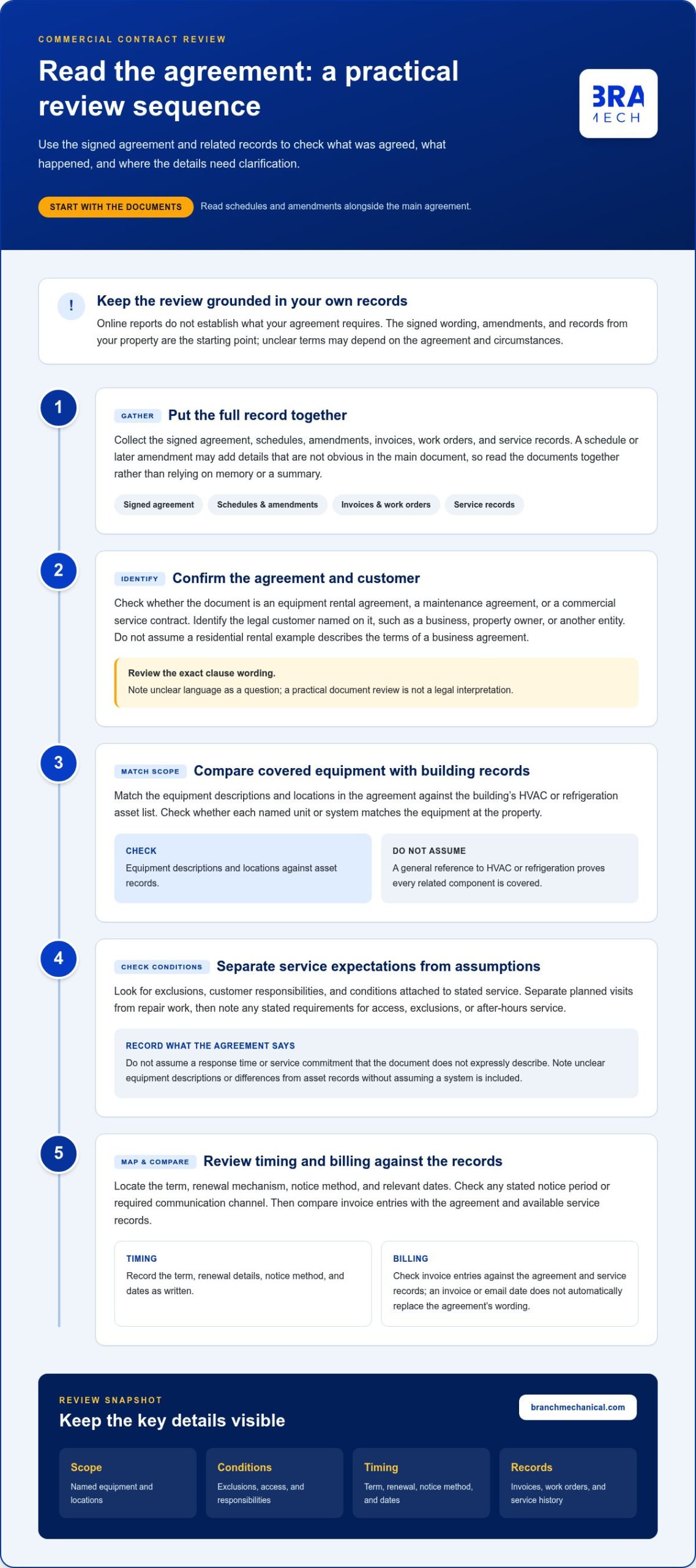
Gather the documents that show what was agreed and what happened: the signed agreement, schedules, amendments, invoices, work orders, and service records. A schedule or later amendment may add detail that isn’t obvious in the main document, so read the documents together rather than relying on a summary or memory.
The exact wording of a clause matters more than a summary or recollection. Read the language carefully and note questions where the wording is unclear. This is a practical document review, not a legal interpretation; the meaning and effect of a term can depend on the agreement and circumstances.
Check equipment coverage and exclusions
Compare the equipment descriptions and locations in the agreement with your building’s HVAC or refrigeration asset list. If the document identifies a particular unit or system, check whether its description and location match the equipment at the property. A general reference to HVAC or refrigeration doesn’t prove that every related component is covered.
Look for exclusions, customer responsibilities, and conditions attached to any stated service. Note unclear descriptions or differences between the agreement and asset records without assuming a system is included. A commercial HVAC installation reference guide can also help you understand which equipment details to keep organized in building records.
Map renewal dates, notices, and service expectations
Locate the agreement’s term, renewal mechanism, notice method, and relevant dates. Check the wording for any stated notice period or required communication channel. Don’t assume that a date in an invoice or email replaces what the agreement says.
Read the service language just as carefully. Separate planned visits from repair work, then note any stated requirements for access, exclusions, or after-hours service. Record what the document says without assuming a response time or service commitment that it doesn’t expressly describe.
- Scope: Match named equipment and locations against the building’s asset records.
- Conditions: Note exclusions, access requirements, and customer responsibilities.
- Timing: Record the term, renewal details, notice method, and dates as written.
- Billing: Compare invoice entries with the agreement and available service records.
This organized review can make problems with Enercare commercial contracts easier to describe precisely, without treating an unclear clause as proof of a particular obligation. For ongoing equipment needs, commercial HVAC and preventative maintenance support can help keep system condition and maintenance records in view.
Compare the agreement with what happened at your GTA property
Put the relevant contract terms beside service and billing records. A simple comparison table can show where the documents align, where details are missing, and what needs follow-up. Use five columns: agreement term, reported issue, supporting record, business impact, and follow-up.
For example, record the equipment or service named in the agreement, describe the concern in neutral terms, and cite the related invoice or work order. Compare equipment identifiers, service dates, and recorded work with the agreement’s stated scope. Keep confirmed facts separate from unanswered questions and assumptions. A work order that records a visit is a fact; whether the work fulfilled a particular contract obligation may still need clarification.
Build a clear timeline of service and communication
Arrange events by date, including the equipment identifier, reported symptoms, site visits, work completed, and follow-up. Keep relevant emails, notices, invoices, work orders, and photographs with your notes. A concise entry such as “cooling concern reported for the rooftop unit; work order records a visit” is more useful than an unverified conclusion about why the issue occurred.
For problems with Enercare commercial contracts, a timeline connects a specific concern to the agreement and supporting records. It also makes gaps easier to spot, such as a missing work description or uncertainty about which unit a record refers to.
Measure the practical effect on building operations
Document what the issue meant for the property, not just what happened mechanically. Note affected tenants or work areas, operating hours, temperature control, and any refrigeration processes affected. If the same equipment concern appears across several service events, record each event separately from an isolated visit. This provides operational context without assuming a cause.
Heating, cooling, and refrigeration can be central to a building’s day-to-day continuity. A factual record of disruption can help distinguish a routine service question from an issue with broader operational consequences. For context on how building systems fit together, see mechanical contractors in Mississauga and the GTA.
- Confirmed: What the agreement, invoice, or work order explicitly records.
- Unresolved: What needs clarification, such as equipment identity or work scope.
- Assumed: Interpretations that aren’t established by the documents.
Clear records support focused conversations and help keep building needs visible while a concern is being addressed. For ongoing commercial system needs, explore commercial mechanical support.
Resolve a commercial contract concern while protecting service continuity
A contract question shouldn’t leave essential building equipment without attention. Manage the contract concern and the system’s operating needs as separate tracks: document the concern carefully while addressing any immediate mechanical risk. These steps help keep the process organized without assuming what the agreement requires.
- Gather the documents. Bring together the agreement and amendments, relevant invoices, work orders, service records, and prior correspondence. Connect each record to the equipment and event in question.
- Define the issue. State whether the concern is about service, equipment coverage, billing, renewal, cancellation, or communication. Separate what the documents confirm from what remains unclear.
- Send a factual written inquiry. Use the notice and communication method stated in the agreement. Identify the relevant equipment, agreement section, event dates, and specific question you need answered.
- Track the response. Save the inquiry and any reply, note when it was sent, and record follow-up. Keep contract correspondence separate from urgent repair updates.
- Review next steps. Compare the response with the agreement and your records. If the issue raises a legal question, seek advice from a qualified professional familiar with the specific agreement and Ontario context.
Don’t stop service, withhold payment, or cancel based on an assumption about the contract. Those actions may have contractual and operational consequences depending on the agreement and circumstances. If you’re uncertain about the implications, get appropriate advice before acting.
Prepare a focused written request
Keep the request professional and specific. Name the equipment, cite the relevant agreement section if identifiable, list the event dates, and describe the unresolved question. Attach records that support your account, then ask for a clear written explanation or correction where appropriate. Retain a copy of the complete message and attachments.
Keep critical equipment supported during a dispute
Identify systems that matter to building operations, such as heating boilers, HVAC equipment, or commercial refrigeration. Note any immediate risk to occupants, work areas, or business processes. Record urgent repair needs separately from contract discussions so a billing or scope question doesn’t obscure an active equipment concern.
Where monitoring and system visibility are relevant, the building automation guide for GTA facility managers offers further context. For ongoing mechanical needs, arrange commercial mechanical support to keep attention on critical building systems while the contract concern is addressed.
Plan dependable commercial mechanical support beyond the contract question
Resolving a contract concern is one part of protecting a building. The next is keeping a clear picture of equipment, its condition, and the operational priorities that shape maintenance decisions. An up-to-date asset record helps owners and property managers plan service around building needs instead of relying on incomplete service history.
Turn contract lessons into a building maintenance plan
Create an equipment inventory that records each system’s location, condition notes, service history, and importance to building operations. Include commercial HVAC, boilers, and refrigeration equipment. Flag systems that support critical spaces or processes, then use seasonal demands and business hours to organize maintenance priorities.
Scheduled inspections and documented maintenance give building teams a consistent basis for tracking equipment condition and planning work. They can also make recurring issues easier to recognize and help keep records together as operating needs change.
A maintenance plan is not the same as an agreement-specific promise or guarantee. It sets out a practical approach to monitoring and maintaining equipment; the scope of a particular service commitment depends on its written terms. Clear records help your team understand what has been maintained and what may need attention next.
When Branch Mechanical can support your commercial systems
Branch Mechanical serves commercial and multi-residential properties in Mississauga, Etobicoke, and the GTA. Its work includes commercial HVAC service, refrigeration systems, boilers and heating systems, and preventative maintenance contracts. For critical HVAC or refrigeration failures, Branch Mechanical also provides 24/7 emergency mechanical services. This support helps keep mechanical needs in view while you address problems with Enercare commercial contracts separately.
Keep maintenance records and contract correspondence in distinct files. This makes it easier to track system condition without confusing ongoing building needs with an unresolved agreement question.
If your Mississauga, Etobicoke, or GTA property needs commercial mechanical service or a preventative maintenance plan, discuss your building’s mechanical needs with Branch Mechanical.
Keep your building’s mechanical support on track
Addressing problems with Enercare commercial contracts starts with the agreement, not assumptions. Compare its written terms with invoices, service records, and what happened at your property. Keep confirmed facts separate from unresolved questions, and consider the operational impact before taking action that could affect service.
Clear contract records are only part of reliable building operations. Tracking equipment condition, maintenance history, and operating priorities can help your team plan ahead for HVAC, boiler, and refrigeration needs. Branch Mechanical provides commercial and multi-residential mechanical contracting across the GTA, along with preventative maintenance and 24/7 emergency mechanical services.
For support with your property’s ongoing mechanical needs, discuss your commercial mechanical service needs with Branch Mechanical. A practical plan can help you move forward with greater clarity and confidence.
Frequently Asked Questions
What problems can occur with an Enercare commercial contract?
Possible concerns include service quality, equipment coverage, billing, renewal, cancellation, or communication. These are areas to investigate, not claims that Enercare has failed to meet an agreement. For problems with Enercare commercial contracts, compare the signed contract and amendments with invoices, work orders, and service records. The same concern can have different explanations depending on the equipment, written scope, and conditions in the specific agreement.
Can I cancel an Enercare commercial contract early?
Whether you can cancel early depends on your particular agreement and the circumstances. Review its term, renewal, notice, and cancellation language, including any schedules or amendments. Follow the notice method stated in the documents, and keep a copy of your communication. Avoid cancelling, withholding payment, or stopping service based on assumptions. If you need to understand your legal position, speak with a qualified professional familiar with the agreement and Ontario context.
How do I dispute an Enercare commercial bill?
Compare the bill with the agreement, relevant amendments, work orders, and service dates. Identify the specific charge or entry you’re questioning, then send a concise written inquiry using the communication method stated in your agreement. Include supporting records and ask for a clear explanation or correction where appropriate. Keep copies of your inquiry and any response. Check what the documents say about scope and billing before concluding that an amount is incorrect.
What happens if a commercial HVAC system fails while a contract concern is unresolved?
Treat an active system failure as an operational concern separate from the contract discussion. Record the affected equipment, symptoms, time, and any impact on occupants, work areas, or building operations. Keep repair communications distinct from billing or contract correspondence, and review your agreement for relevant service terms. Branch Mechanical provides commercial HVAC service and 24/7 emergency mechanical services for critical HVAC and refrigeration failures. No specific response time is implied.
Does a residential Enercare agreement have the same terms as a commercial contract?
Not necessarily. A residential equipment rental agreement and a commercial service agreement may cover different equipment, responsibilities, and service arrangements. Don’t assume that residential examples or protections apply to a business contract. Check the agreement type and the legal customer named in your documents, then review the applicable terms and circumstances. If you have a legal question about a commercial agreement, seek advice from a qualified professional familiar with Ontario context.
What records should I keep when raising a commercial contract concern?
Keep the signed agreement, schedules, amendments, invoices, work orders, service records, emails, notices, and relevant photographs. Organize them by date and connect each record to the equipment involved. Note the reported issue, work performed, business impact, and follow-up. Separate confirmed details from questions or assumptions. This record makes it easier to explain the concern clearly and compare what happened at the property with the written agreement.
Can Branch Mechanical help with commercial HVAC maintenance in Mississauga or Etobicoke?
Yes. Branch Mechanical provides commercial and multi-residential mechanical contracting, including commercial HVAC service and preventative maintenance, in Mississauga, Etobicoke, and the GTA. Maintenance planning helps property teams track equipment condition, service history, and operating priorities. Branch Mechanical also works with commercial refrigeration systems and boilers. An organized equipment record can help inform discussions about which systems and priorities need attention.