

A walk-in cooler starts drifting above its normal temperature during a busy shift. Stock may be at risk, staff need answers, and it may not be clear whether the cause is a simple obstruction or an equipment fault. Commercial refrigeration repair Toronto businesses rely on starts with protecting operations and gathering the details needed to assess the problem.
If your refrigeration system is unstable, record the displayed temperature, when the problem began, any unusual sounds or frost, and which units are affected. These details give a technician a clearer starting point. Branch Mechanical provides commercial refrigeration service and emergency mechanical services for businesses across the Greater Toronto Area, including Mississauga and Etobicoke.
This guide explains what to do when refrigeration equipment fails, what to expect from a diagnostic assessment, and how planned maintenance complements repairs. You’ll also learn what information to gather before requesting service, so your team can prepare for the visit and help reduce disruption to your operation.
Key Takeaways
- Temperature swings, unusual noises, leaks, and repeated cycling can signal a refrigeration problem that needs attention.
- Learn how commercial refrigeration repair Toronto technicians assess symptoms, inspect equipment, and explain repair options based on the system’s condition.
- Use the equipment’s condition and its effect on operations to distinguish an active failure from an urgent concern or planned maintenance need.
- Prepare for a service visit by arranging equipment access, sharing observations, and coordinating around day-to-day operations.
- See how Branch Mechanical’s commercial refrigeration and mechanical services support commercial and multi-residential facilities across the GTA, including Mississauga and Etobicoke.
Toronto Fridge Repair: What to Do When Equipment Fails
Unstable refrigeration can complicate a restaurant’s service, affect product availability in a retail setting, or create extra coordination for a facility team. A unit may still appear to be running while its temperature shifts, so don’t rely on sound or appearance alone. For businesses seeking commercial refrigeration repair Toronto, clear observations help move the response from uncertainty to a useful assessment.
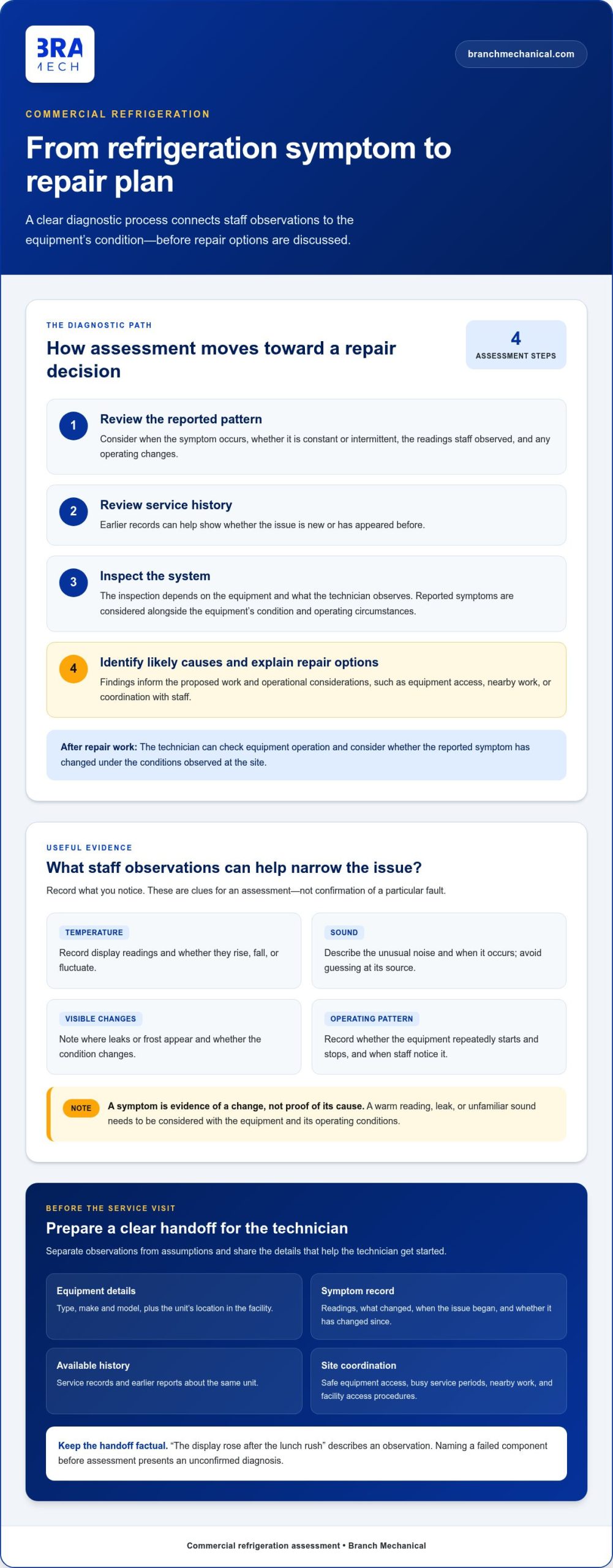
A symptom is evidence of a change, not proof of its cause. A warm reading, leak, or unfamiliar sound tells staff what they observed. An assessment of the equipment and operating conditions is needed to identify the cause.
Which commercial refrigeration warning signs need attention?
Pay attention to temperature drift even if the unit remains powered and seems to be operating normally. Refrigeration removes heat to maintain a cooler environment. A short overview of the principles of refrigeration explains why steady operation matters, but it can’t identify a fault in a particular unit.
Track changes staff can see or hear. These observations are useful clues, not diagnoses:
- Temperature changes: Record display readings and note whether they rise, fall, or fluctuate.
- Unusual noises: Describe the sound and when it occurs instead of guessing at its source.
- Visible leaks or frost: Note where they appear and whether the condition changes.
- Frequent cycling: Record whether the equipment repeatedly starts and stops, and when staff notice it.
Follow the site’s normal procedures for checking and recording readings. Include the time of each observation and any relevant changes in operating conditions. A consistent record can help distinguish a brief variation from a recurring pattern.
What should staff do before a repair visit?
Prepare the area and share the facts. Make sure there is safe access to the equipment, and identify constraints such as busy service periods, nearby work, or facility access procedures. Coordinating these details helps the technician assess the unit with fewer avoidable interruptions.
- Gather the equipment type, make and model, plus its location within the facility.
- Record symptoms, display readings, when the issue began, and whether it has changed.
- Locate available service history, including earlier reports about the same unit.
- Share operating constraints and follow established site procedures while waiting.
Don’t make unsafe adjustments or present a suspected cause as confirmed. Staff reports are most useful when they separate observations from assumptions. For example, “the display rose after the lunch rush” describes a sequence; “the compressor failed” asserts a diagnosis that hasn’t been established. This careful handoff gives the technician a clearer starting point and helps the operation stay organized.
How commercial refrigeration technicians diagnose the cause of a failure
A visible symptom is a starting point, not a diagnosis. A rising temperature, for example, could have more than one explanation. Before deciding what needs attention, a technician considers the equipment, its current operation, the conditions around it, and its service history. This approach helps avoid repair decisions based on an assumption rather than evidence.
Diagnosis identifies the likely cause before repair decisions are made. The process connects reported symptoms to the system’s observed condition and gives the business a clearer basis for choosing next steps.
What information helps narrow down a refrigeration problem?
Technicians begin with the reported pattern: when the symptom occurs, whether it is constant or intermittent, and what readings or operating changes staff have observed. Maintenance records can show whether the issue is new or has appeared before. The equipment’s normal behaviour is a useful comparison, but no single symptom confirms that a particular part has failed.
If a unit’s temperature changes at certain times, for example, that timing is useful context, but it doesn’t establish why the change occurs. A technician considers the observation alongside the equipment’s condition and history. Industry references, including ASHRAE technical resources, provide broader context for HVAC&R practice. A diagnosis still needs to reflect the system and conditions at the site.
How does a technician move from diagnosis to repair?
The assessment generally follows a clear sequence: review reported symptoms and service history, inspect the system, identify likely causes, and explain appropriate repair options. The inspection depends on the equipment and what the technician observes. The goal is to connect the findings to a practical repair scope rather than treat a symptom in isolation.
Once the findings are understood, the technician can outline proposed work and operational considerations. A repair plan may need to account for access, nearby work, or coordination with staff responsible for the equipment. These details affect how the work is organized, while the repair decision remains grounded in the assessment.
After repair work, the technician can check the equipment’s operation and consider whether the reported symptom has changed. This follow-up helps assess the result under the conditions observed at the site. It also gives staff a useful reference for continued monitoring, particularly if the original issue was intermittent.
For businesses arranging commercial refrigeration repair Toronto, a clear explanation of findings connects the technical assessment to operational decisions. Branch Mechanical provides commercial refrigeration service as part of its work supporting facilities across the Greater Toronto Area, including Mississauga and Etobicoke. Learn about commercial refrigeration service for your facility.
Repair, emergency service, or maintenance: choosing the right response
The right response depends on what the equipment is doing and how the issue affects your operation. A developing concern may need assessment before it causes a more serious interruption, while routine care can be scheduled around facility needs. Consider business impact, temperature observations, and equipment condition together. No single sign automatically determines the response priority.
| Situation | What it may involve | Useful next step |
|---|---|---|
| Active failure | Equipment has stopped working or isn’t maintaining stable operation. | Follow site procedures and arrange a repair assessment. |
| Urgent operational concern | Performance is changing and could affect inventory, service, or facility operations. | Escalate according to business procedures and share current observations. |
| Planned maintenance | No immediate failure is reported, but scheduled equipment care is due. | Plan service and review changes in system performance. |
When is commercial refrigeration repair an urgent operational issue?
Unstable or lost refrigeration can affect stored products, interrupt restaurant or retail service, and add pressure to facility operations. The urgency depends on the equipment, observed conditions, and what the unit supports. If operation is disrupted or temperatures are changing, follow your business’s established product-handling and escalation procedures. When arranging an assessment, explain how the issue is affecting operations so it can be understood in context.
Branch Mechanical provides 24/7 emergency mechanical services for businesses facing urgent mechanical concerns. For commercial refrigeration repair Toronto businesses need, clear information about the operational impact helps guide the next steps.
How does preventative maintenance differ from a repair call?
A repair addresses an existing problem. Preventative maintenance is planned care that reviews system condition and performance before a failure becomes the focus. It gives facility teams a way to organize recurring service instead of relying only on calls prompted by a disruption.
Maintenance contracts can help plan recurring work and create opportunities to monitor equipment performance over time. They complement repairs, but don’t eliminate the possibility of breakdowns or promise a particular equipment lifespan. A problem that appears between scheduled visits still needs to be assessed as an active issue.
Choosing between repair, emergency support, and planned maintenance is an operational decision as well as a mechanical one. Consider whether the equipment is functioning, how its condition affects the site, and whether the concern is recurring or scheduled. Branch Mechanical’s commercial refrigeration systems guide provides related context for considering refrigeration as part of a facility’s wider operation.
Preparing for commercial refrigeration repair in Toronto and the GTA
A well-prepared site gives the technician useful context and helps the facility coordinate the work. For a restaurant in Toronto, a retail operation in Mississauga or Etobicoke, or a multi-residential building with shared facility needs, access and operating conditions can shape how an assessment is organized. Clear information supports a more efficient start, though the repair scope and duration depend on the assessment.
What should facility teams have ready?
Before the visit, assign a site contact who can provide access, explain the reported issue, and coordinate with staff. Share what’s known and distinguish observations from assumptions. A concise handoff helps the assessment start with the essential details.
- Equipment location: Identify the unit and route to reach it. Clear nearby items where it’s safe to do so, and note any access procedures.
- Symptoms and readings: Gather display readings, changes in operation, and a timeline of when the issue began or occurs.
- Equipment details: Provide the equipment type, make, and model if available.
- Service history: Collect relevant records, including previous reports or maintenance notes for the same equipment.
- Site constraints: Note operating hours, busy periods, access requirements, and any work or activity near the equipment.
For example, a manager at a busy food-service site might arrange access before a service period and tell staff where the technician will work. A facility contact at a multi-residential property may also need to coordinate building access. These details help set expectations and plan around regular site activities.
How can repair work fit around business operations?
Advance coordination helps teams prepare staff, manage access, and reduce avoidable disruption for customers or occupants. It also gives the technician a clearer picture of operational priorities, such as which area is most affected or when a work area is busiest. Be direct about what needs coordination, without assuming the repair can be completed within a particular window.
Commercial refrigeration repair Toronto businesses arrange often takes place where refrigeration is one part of a larger mechanical operation. Sharing how the issue affects the facility, along with practical access details, supports an orderly assessment. Coordination can be especially important when work intersects with other building operations. Branch Mechanical’s commercial mechanical contractors guide offers related context.
Branch Mechanical serves commercial and multi-residential clients across the Greater Toronto Area, including Mississauga and Etobicoke. If your facility has a commercial refrigeration issue, request commercial refrigeration service and share the site details and observations you’ve gathered.
Commercial refrigeration repair with Branch Mechanical: service and next steps
A refrigeration concern can affect more than one piece of equipment. It may put pressure on staff, interrupt service, or require coordination with other facility work. Branch Mechanical provides commercial refrigeration and mechanical services for commercial and multi-residential clients across the Greater Toronto Area, including Mississauga and Etobicoke. The first step is to understand the reported issue and its operational context, then plan appropriate next steps.
For commercial refrigeration repair Toronto businesses can share the details that help frame an assessment: the equipment’s location and available identification, what staff have observed, any recorded readings, and how the issue affects operations. This information helps inform service planning. The cause and repair scope depend on the equipment and conditions at the site, so they’re determined through assessment rather than assumed from a symptom alone.
What businesses can expect when requesting refrigeration service
Start with a clear account of the concern. Explain whether the equipment is operating differently, when the change was noticed, and whether the issue is ongoing or intermittent. Relevant maintenance records or previous service notes can provide useful context. Also describe access arrangements and operational constraints that may shape the work.
This information connects the reported problem to the facility’s needs. A restaurant may need to coordinate around service, while a property team may need to plan access within a shared building. Branch Mechanical’s commercial refrigeration service is part of a broader mechanical contracting approach, supporting facility operations with an assessment based on the specific reported issue.
For urgent mechanical concerns, Branch Mechanical also provides 24/7 emergency mechanical services. The next steps depend on the details of the issue and the conditions at the site.
How ongoing maintenance supports more predictable operations
Repair addresses a current problem. Scheduled maintenance provides a way to plan recurring mechanical care and review system performance as part of facility operations. Branch Mechanical’s preventative maintenance contracts help businesses organize this work alongside other building priorities.
Planned care doesn’t ensure that equipment will never fail, but it gives facility teams a structured opportunity to track performance and address maintenance needs. Keeping service records together also creates useful context for future assessments. For commercial and multi-residential sites, this coordination can support more informed decisions about refrigeration within the wider mechanical system.
If your business has a refrigeration concern or wants to discuss scheduled care, Contact Branch Mechanical about commercial refrigeration repair. Share what you’ve observed and how the issue affects your operation to start with the right context.
Make your next refrigeration decision with confidence
Use the next service need as an opportunity to strengthen your facility’s response plan. Decide who will record equipment concerns, share updates with staff, and coordinate access if service is needed. After the issue is assessed, keep the findings with your maintenance records so future decisions can draw on the equipment’s history, not just the latest symptom.
For commercial refrigeration repair Toronto businesses need, a clear conversation can help turn an operational concern into a practical next step. Branch Mechanical supports commercial and multi-residential facilities across the GTA, including Mississauga and Etobicoke, with refrigeration and mechanical service, emergency support, and planned maintenance. The right approach depends on your equipment and site conditions.
Contact Branch Mechanical about commercial refrigeration repair to discuss your facility’s needs. Share the equipment details and operational impact to help your team move forward with clarity.
Frequently Asked Questions
What are common signs that commercial refrigeration equipment needs repair?
Common signs include changing temperatures, unusual sounds, visible moisture or frost, and frequent starting and stopping. Also watch for doors that no longer close properly or condensation appearing where it wasn’t previously present. Note when the change occurs and whether it affects one unit or several. These observations help describe the issue, but they don’t confirm its cause.
Can commercial refrigeration equipment still run if it needs repair?
Yes. A unit may continue running while its performance changes, so power and noise alone don’t prove it’s working as expected. For example, the display may remain active while readings fluctuate or the equipment cycles more often than staff are used to. Treat changes as useful signals, follow your site’s procedures, and arrange an assessment rather than assuming continued operation means there’s no fault.
How quickly can commercial refrigeration be repaired in Toronto?
Repair timing depends on the equipment, the conditions found during assessment, and the work required. A technician can’t reliably determine the repair duration from a brief description alone. When arranging commercial refrigeration repair in Toronto, share the operational impact and symptom details. Branch Mechanical provides 24/7 emergency mechanical services, and the repair plan depends on the issue and site conditions.
What happens during a commercial refrigeration repair visit?
A repair visit typically begins with reviewing the concern and assessing the equipment’s condition. The technician uses those findings to identify likely causes and explain appropriate repair options. The work and any coordination depend on the system and site conditions. After the repair, the equipment’s operation can be checked against the reported concern. Keep a staff contact available to explain how the issue has affected normal use.
Is preventative maintenance different from commercial refrigeration repair?
Yes. Repair responds to an existing problem, while preventative maintenance is scheduled care that lets a facility plan recurring attention to its mechanical equipment. Maintenance contracts help organize that work and monitor system performance over time. They don’t guarantee that a breakdown won’t occur or promise a specific equipment lifespan. A new or worsening symptom still calls for assessment, even if routine maintenance is planned.
What information should I provide when requesting commercial refrigeration service?
Share the equipment’s location, type, make and model if available, along with what staff have observed and when the issue began. Mention whether the concern is continuous or intermittent, and describe its effect on operations. Previous service records can add useful context. Also identify the site contact and any access or scheduling constraints, so the service discussion can account for how the facility operates.
Does Branch Mechanical provide commercial refrigeration repair in the Toronto area?
Yes. Branch Mechanical provides commercial refrigeration services for commercial and multi-residential clients across the Greater Toronto Area, including businesses in Mississauga and Etobicoke. Its broader mechanical service offering supports facility operations, and the company provides 24/7 emergency mechanical services. The appropriate next step depends on the equipment concern and site conditions. Sharing the issue’s impact and relevant details helps frame the service request clearly.