

What if the biggest obstacle during an insurance inspection isn’t the equipment itself, but unclear records or blocked access? For facility teams, it can be difficult to know what the inspector may review and what to prepare. Effective boiler and machinery insurance inspection prep starts with a current equipment list, organized maintenance records and a safe plan for site access.
A little preparation can help the visit run smoothly and reduce avoidable follow-up. This checklist explains how to gather equipment information, locate service records and prepare inspection areas without rushing or taking unsafe shortcuts. It also covers how to record findings and coordinate next steps.
An insurer’s inspection and an Ontario regulatory inspection serve different purposes, so don’t assume one replaces the other. Follow the insurer’s instructions and consult the Technical Standards and Safety Authority (TSSA) for applicable regulatory requirements. The sections ahead cover what to organize before the visit, how to provide access and how to respond to findings afterward.
Key Takeaways
- Start boiler and machinery insurance inspection prep with the insurer’s instructions, which explain the visit’s purpose and expected scope.
- Prepare an equipment list with identifiers, locations and available manufacturer details, along with accessible service and maintenance records.
- Confirm the appointment, gather requested documents and arrange safe, unobstructed access to relevant equipment and service areas.
- Keep insurance and regulatory inspections distinct. Consult TSSA guidance to understand which requirements apply to your equipment.
- Use the written report to clarify requested actions, assign follow-up and plan maintenance around equipment condition and operational needs.
Boiler and Machinery Insurance Inspection Prep: What the Visit Is For
An insurer’s inspection is generally a risk review of equipment and the conditions in which it operates. The inspector may review a boiler, related machinery, its surroundings and maintenance information. There is no universal checklist for every facility: the insurer’s notice, policy context and equipment involved shape the visit.
Boiler and machinery insurance, also known as equipment breakdown insurance, relates to damage from equipment failures, subject to the specific policy terms. An inspection helps the insurer assess risk. It does not replace reading the policy or confirming which inspection requirements apply to your equipment in Ontario.
What may an insurer review during a boiler inspection?
The review may cover the boiler’s visible condition, operating environment, maintenance history and apparent safety concerns. The inspector might ask to see service records or note whether equipment and nearby service areas are accessible. Since the scope varies, use the insurer’s inspection notice as your guide and clarify any instructions you don’t understand.
An insurance inspection is a risk review, not a determination that a facility meets every regulatory requirement. Keep that distinction in mind when preparing records or responding to observations. An insurer may identify risk-related concerns, while a regulatory inspection follows a separate purpose and process.
Who should coordinate inspection preparation?
Assign the facility manager or another designated site contact to coordinate the visit. Operations staff can explain normal schedules, identify equipment locations and describe access procedures. Involve the maintenance provider when technical history or safe access requires support. Clear roles help the team answer questions consistently without guessing about equipment or making changes just to influence the inspection.
Good boiler and machinery insurance inspection prep means being organized and candid, not staging the site or hiding visible issues. Gather the records you have, make relevant areas safely accessible and tell the right staff when the visit is scheduled. If a record is missing or an issue is already known, note it accurately rather than guessing what the inspector will conclude.
Keep the insurance inspection separate from any applicable Ontario regulatory process. The Technical Standards and Safety Authority (TSSA) regulates designated equipment and activities, but applicability depends on the equipment and circumstances. Use official TSSA information for regulatory requirements, and follow the insurer’s notice for its review. This helps the facility team prepare without assuming one process replaces the other.
What to Gather Before a Boiler and Machinery Insurance Inspection
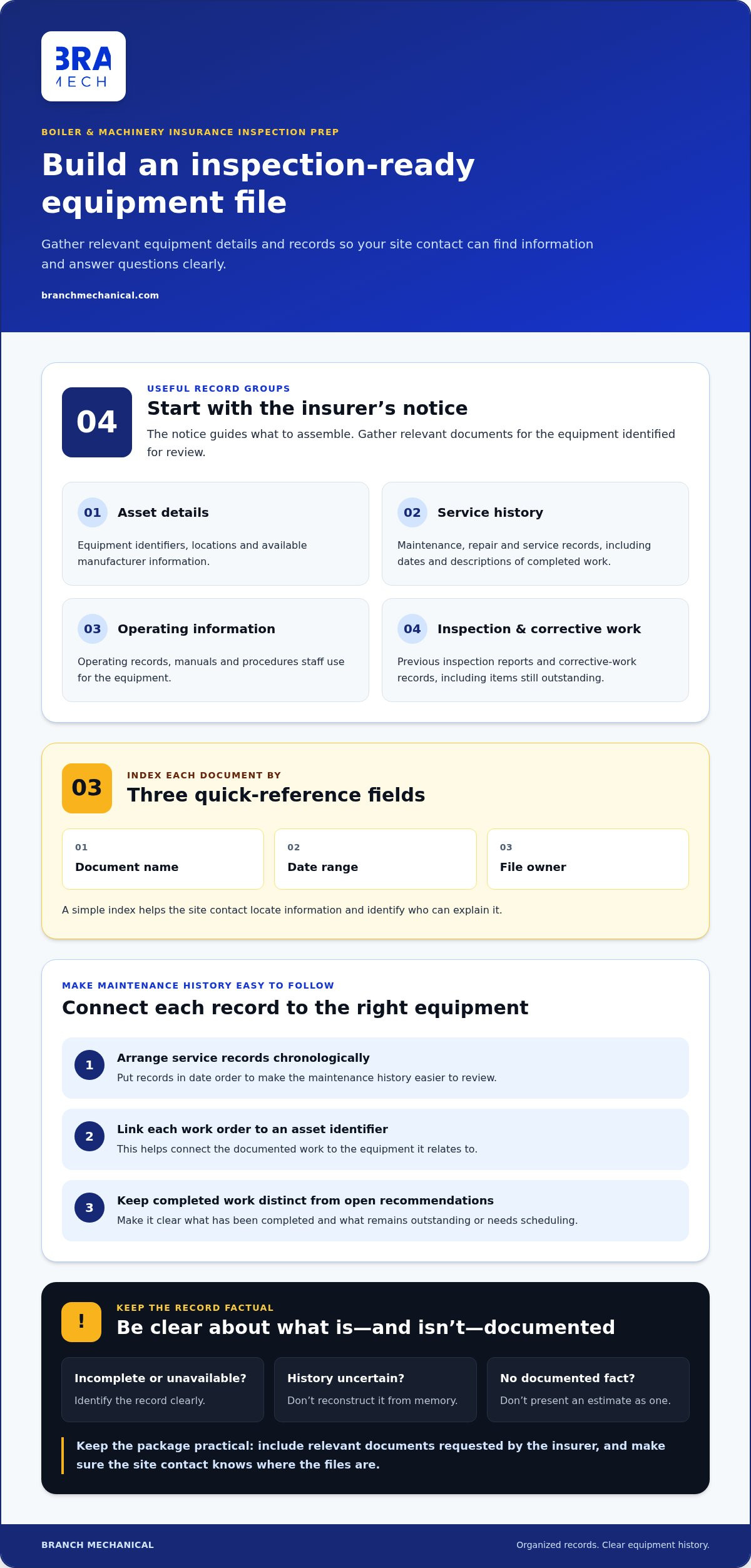
Start with a clear record of the equipment on site. The insurer’s notice should guide what you assemble, but an organized file makes it easier to find relevant details and answer questions. For each boiler or other piece of machinery that may be reviewed, record its identifier, location and available manufacturer information.
Which boiler and equipment records are useful?
Gather the documents your facility keeps for the equipment identified in the inspection notice. Useful records may include:
- Asset details, including equipment identifiers, locations and available manufacturer information.
- Maintenance, repair and service records, with dates and descriptions of the work completed.
- Operating records, manuals and procedures staff use for the equipment.
- Previous inspection reports and records of corrective work, including items still outstanding.
Create a simple index showing each document’s name, date range and file owner. This lets the site contact find information promptly and shows where records are held. If a record is incomplete or unavailable, identify that clearly. Don’t reconstruct a history from memory or present an estimate as a documented fact.
How should maintenance history be presented?
Arrange service records chronologically and link each work order to the relevant asset identifier. Separate completed work from recommendations that remain open or need scheduling. For example, make it easy to distinguish a completed repair from a technician’s recommendation for future work. This helps the inspector understand what was addressed without suggesting an outstanding item has been resolved.
Keep the package practical rather than exhaustive. Include relevant documents requested by the insurer, and make sure the site contact knows where the files are and who can explain them. Organized boiler and machinery insurance inspection prep supports a clear, factual account of equipment history. It does not require creating documents the facility doesn’t have.
Maintenance planning can also keep equipment information current between visits. Branch Mechanical provides commercial boiler maintenance services for commercial and multi-residential heating systems. For broader facility planning, see the commercial HVAC maintenance checklist.
For facilities in Mississauga and Etobicoke, keep regulatory records organized separately from insurer-requested documents. The Technical Standards and Safety Authority (TSSA) regulates designated equipment and activities in Ontario, and applicable requirements depend on the equipment and circumstances. Use current official TSSA information for regulatory questions, and follow the insurer’s inspection notice for its review.
A Site-Readiness Checklist for the Inspection Day
Use the insurer’s instructions to confirm the appointment, expected scope and requested documents. Resolve unclear details with the insurer before inspection day so the site team can plan access and have the right people available. Share the schedule with staff whose work may be affected, and account for normal building operations rather than making last-minute equipment-setting changes.
A practical readiness check can cover:
- Confirming the visit time, site contact and areas expected to be reviewed.
- Preparing the requested documents, equipment list and document index.
- Clearing routine routes to the boiler and relevant service areas.
- Briefing operators on timing, access arrangements and who will answer questions.
- Keeping equipment in its normal operating state unless a safe, planned procedure requires otherwise.
Preparation should make the visit orderly, not create a staged picture of the facility. Don’t adjust controls or operating settings solely to influence what the inspector observes. If operational work or a safety concern affects access, explain the situation and follow established site procedures.
How can a facility provide safe access?
Clear routine obstructions from walkways and service routes to make relevant equipment areas accessible. Follow site security and safety procedures throughout the visit, including sign-in or escort requirements. Don’t remove guards, bypass controls or operate equipment outside normal safe procedures to make inspection easier. If an area can’t be accessed safely, explain why and coordinate an appropriate next step.
What should the site contact do during the visit?
Keep the equipment list, document index and relevant staff contact information close at hand. Answer questions using records or direct observation, and distinguish confirmed facts from estimates or recollections. Note questions, observations and requested follow-up, including who raised each item, so the facility can review them afterward.
Don’t treat an informal comment as a final determination. If a point is unclear, record the wording and seek clarification through the appropriate channel. This creates a useful account of the visit without assigning meaning that hasn’t been confirmed in writing.
Good boiler and machinery insurance inspection prep also respects the building’s operating needs. A facility manager can coordinate with operators and the maintenance provider when technical context or safe access requires support. Planned commercial boiler maintenance can help keep service history and maintenance planning organized between inspections.
Insurance Inspection vs. Regulatory Inspection: Know the Difference
An insurance inspection and a regulatory inspection may both involve a boiler, but they serve different purposes. An insurer’s review considers equipment and operating conditions in relation to its risk assessment and the facility’s policy context. A regulatory process concerns applicable safety requirements and oversight. The people conducting the reviews, the questions they ask and the records they produce may differ.
Passing one type of review doesn’t automatically establish the outcome of another. An insurer’s observations don’t, by themselves, confirm regulatory compliance. A regulatory inspection record likewise doesn’t determine how an insurer assesses risk or interprets its policy. Treat each process on its own terms, and keep its instructions and documentation distinct.
What does a TSSA-related review cover?
The Technical Standards and Safety Authority (TSSA) oversees designated equipment and activities in Ontario, including boilers and pressure equipment where applicable. Exact requirements depend on the equipment and circumstances. Use current official TSSA information to understand the regulatory process for your facility. Separately, follow the insurer’s inspection notice. Don’t treat insurer questions as regulatory requirements unless an appropriate source establishes that connection.
For facility teams, the useful distinction is the source and purpose of each request. The insurer’s instructions guide its risk review; official TSSA materials guide your understanding of Ontario’s regulatory framework. If a document or observation appears relevant to both, retain it for each process as appropriate, but don’t assume one report answers the other’s questions.
How should a facility handle different inspection findings?
Keep a clear record of every observation or requested action. Note who issued it, the date, the equipment involved and the exact wording. Track insurer recommendations separately from formal regulatory notices or requirements. This helps prevent confusion between a risk-management suggestion and a direction issued through a regulatory process.
Assign follow-up through the appropriate facility, insurer and qualified service channels. If wording or responsibility is unclear, ask the issuing party for clarification and record the response. For technical work, involve the relevant maintenance provider and keep resulting service documentation with the equipment record. This helps managers prioritize action without assuming that findings from separate processes are interchangeable.
Clear records support boiler and machinery insurance inspection prep and ongoing equipment planning. Branch Mechanical provides planned care for commercial boilers and heating systems. Schedule commercial boiler maintenance with Branch Mechanical.
After the Inspection: Turn Findings into a Reliable Maintenance Plan
The inspection is most useful when its findings lead to clear, documented next steps. Review the written report with the appropriate facility staff. Identify each requested action, clarify unfamiliar terms or deadlines with the issuing party, and distinguish recommendations from formal requirements. Don’t treat an informal comment as a final instruction if the report or follow-up correspondence says otherwise.
Prioritize actions using the report, equipment condition, operational needs and applicable professional guidance. If an observation raises an immediate safety or operating concern, follow the facility’s established safety and service processes. For other items, agree on a reasonable sequence and schedule without assuming every finding has the same urgency.
How should inspection recommendations be tracked?
Create an action register that links each observation to the relevant asset and report reference. For every item, record its source, owner, target date, status, decisions made and evidence of completion. Keep related work orders or service records with the entry. This gives facility staff a shared view of progress and helps prevent open recommendations from disappearing into routine correspondence.
Review the register regularly with the people responsible for completing and approving the work. Update it when an action is scheduled, completed or awaiting clarification, and retain the supporting record. Clear tracking turns the report into a practical maintenance tool rather than a document filed and forgotten.
How can Branch Mechanical support ongoing boiler readiness?
Branch Mechanical provides commercial boiler and heating-system service and preventative maintenance for commercial and multi-residential facilities. Planned maintenance supports consistent equipment oversight and helps keep service history organized. For a Mississauga or Etobicoke facility, discuss commercial mechanical maintenance with Branch Mechanical as a practical step for ongoing building needs.
Connect recurring work to the facility’s maintenance plan. Add agreed tasks to the appropriate schedule, assign responsibility and retain records of completed service. This creates continuity between inspection follow-up and routine equipment care, and gives the team a reliable reference for future planning.
Keep Your Boiler Inspection Follow-Up on Track
Reliable boiler and machinery insurance inspection prep comes down to clear information, safe access and an organized response after the visit. Follow the insurer’s instructions, keep equipment and maintenance records easy to navigate, and distinguish an insurer’s risk review from any applicable Ontario regulatory process.
Once you receive the written report, turn each finding into a tracked action. Record who’s responsible, the target date and evidence of completed work. Connecting follow-up to planned maintenance helps your team keep service history current and equipment oversight consistent.
Branch Mechanical provides commercial boiler and heating-system installation and service, along with preventative maintenance contracts for commercial and multi-residential facilities. For Mississauga and Etobicoke building needs, discuss commercial boiler maintenance with Branch Mechanical. Branch Mechanical also provides 24/7 emergency mechanical services across the Greater Toronto Area.
With a practical plan and maintenance support, your facility can approach the next inspection with greater confidence and keep routine equipment care moving forward.
Frequently Asked Questions
What does a boiler and machinery insurance inspection involve?
It’s an insurer’s risk review of equipment and its operating conditions. Depending on the insurer’s instructions, the inspector may review the boiler’s visible condition, surroundings, maintenance history and access to relevant areas. The scope isn’t fixed for every facility. Treat the inspection as distinct from a regulatory compliance determination, and use the inspection notice and policy context to understand what the insurer plans to review.
How do I prepare my boiler for an insurance inspection?
Follow the insurer’s inspection instructions and prepare the site without changing equipment conditions just to affect what the inspector sees. Confirm the appointment, arrange safe access, and have the site contact and relevant operators available. Clarify any requested preparation that could affect operations with the insurer. If the review requires internal access or other work that affects the boiler’s operating state, plan it safely with appropriate maintenance support.
What documents should I have ready for an insurance inspection?
Gather documents requested in the insurer’s notice, along with records that identify and explain the equipment. These may include an asset list with locations and available manufacturer information, service and repair records, operating logs, manuals, procedures and previous inspection reports. Keep completed work separate from open recommendations. An index with document names, date ranges and file owners helps staff locate records. Identify missing or incomplete documents accurately rather than guessing.
Is an insurance inspection the same as a TSSA inspection in Ontario?
No. An insurer’s inspection assesses risk in the context of its policy, while the Technical Standards and Safety Authority (TSSA) oversees designated equipment and activities in Ontario. The processes may involve different people, questions and records, and one doesn’t automatically replace or determine the outcome of the other. Consult current official TSSA information for requirements that apply to your equipment, and follow the insurer’s notice for its review.
Can a facility continue operating during an insurance inspection?
It depends on the inspection scope, equipment involved and insurer’s instructions. Don’t assume the boiler must be shut down or that it can continue operating throughout the visit. Confirm operational requirements in advance and plan with facility operations and maintenance staff. Keep equipment within normal safe procedures, and don’t bypass controls or alter settings to accommodate the inspection or influence observations.
What happens if an insurer identifies a boiler maintenance concern?
Review the written report and clarify the wording, requested actions and any deadlines with the issuing party. Record the observation against the relevant equipment, assign an owner and track its status and supporting completion records. Separate insurer recommendations from formal regulatory notices. Prioritize work based on the report, equipment condition, operational needs and appropriate professional guidance. If there’s an urgent safety or operating concern, follow the facility’s established procedures.
How often should commercial boiler maintenance records be updated?
Update records whenever maintenance, service, repair or relevant inspection work is completed, and promptly record new recommendations or follow-up actions. Keep entries chronological and link each one to the correct equipment identifier. Record the date, work performed and whether an item remains open. Mississauga and Etobicoke facility teams can use a consistent record process to keep equipment history accessible for routine planning and future insurer reviews.