

What if the first sign of a plumbing leak is a damp ceiling far from the pipe causing it? In a commercial building, water can travel through walls, floors, and service spaces before becoming visible. Effective commercial plumbing leak detection starts with recognizing small changes and responding in a way that accounts for the building’s layout and daily operations.
A leak can affect multiple areas, disrupting tenants, staff, customers, or essential services. In buildings with complex plumbing, finding the source is not always straightforward. Clear observations and a timely, organized response help narrow down the issue and support a focused assessment.
This guide explains warning signs to watch for, how to judge their urgency, and what information to gather before arranging service. It also covers how professional diagnosis and repair can fit into a building-aware response. Branch Mechanical provides commercial plumbing as part of its broader mechanical contracting services for commercial and multi-residential properties across the Greater Toronto Area, including Mississauga and Etobicoke.
Key Takeaways
- Recognize warning signs that could point to a concealed leak, and consider how they may affect building operations.
- Commercial plumbing leak detection starts with reported symptoms and building-system context. The appropriate diagnostic approach depends on the piping, access, materials, and signs observed.
- Visual inspection, acoustic investigation, thermal imaging, and targeted access can each reveal different clues. Understand what each approach can show and when more assessment may be needed.
- Respond in a clear sequence: protect people, limit water exposure when safe, document what you observe, and arrange an assessment. Stay clear of unsafe areas and water-exposed electrical equipment.
- Branch Mechanical’s commercial plumbing and broader mechanical contracting services support a methodical, building-aware path from suspected leak to appropriate plumbing work.
Commercial plumbing leak detection: warning signs facility teams should not ignore
A ceiling stain, unexplained puddle, or change in water use can point to a leak, but none identifies its source. Commercial plumbing leak detection means locating and assessing water loss within a building’s plumbing system. A methodical approach helps facility teams move from an uncertain sign to useful observations and appropriate next steps.
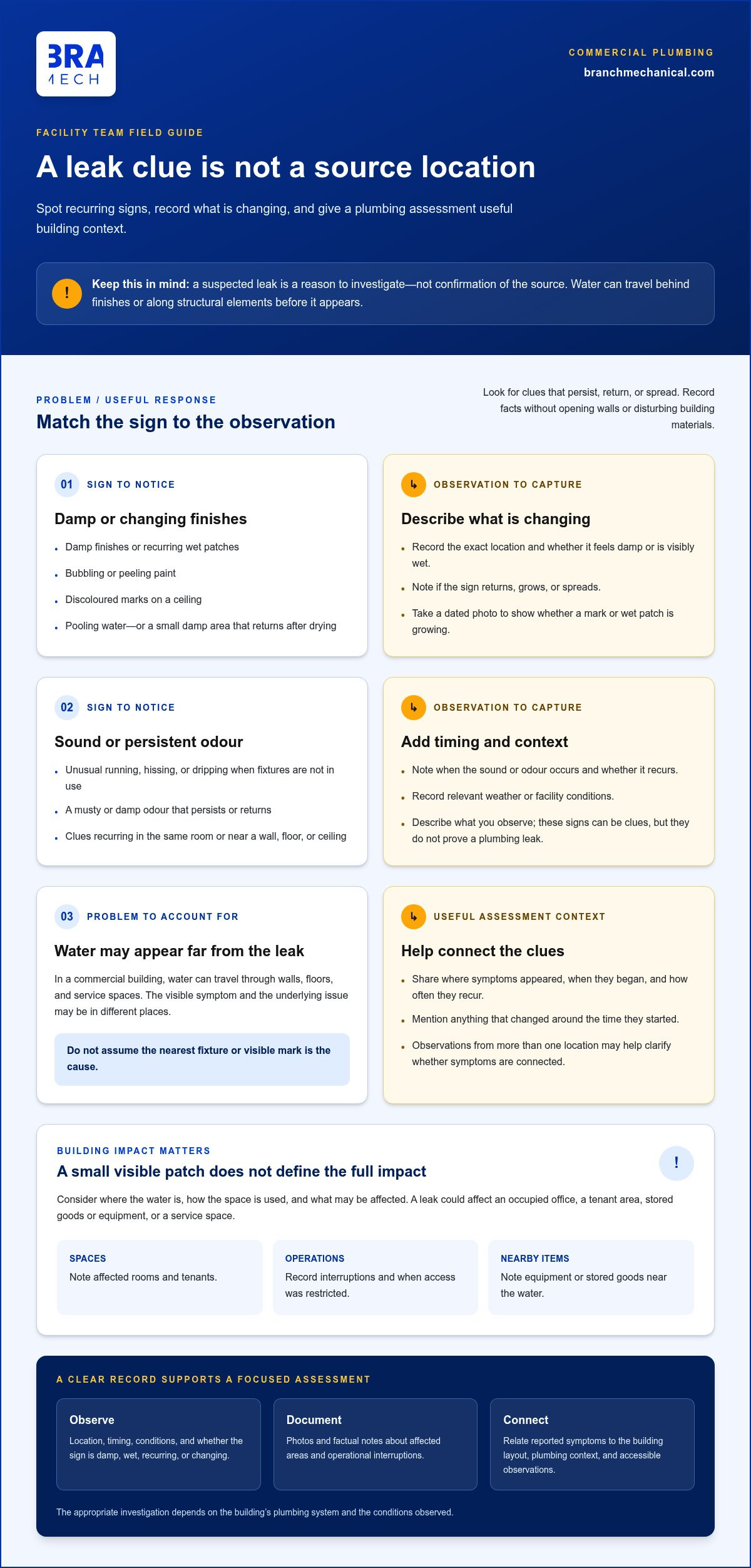
A suspected leak is a reason to investigate, not confirmation of the source. Water may travel behind finishes or along structural elements before appearing, so the visible symptom and the underlying issue may be in different places.
What signs can indicate a hidden plumbing leak?
Watch for changes that persist, return, or spread. Damp finishes, bubbling or peeling paint, discoloured ceiling marks, and recurring wet patches all warrant closer assessment. Pooling water may be easier to notice, but a small damp area also deserves attention if it returns after drying.
Listen for other changes. Unusual running, hissing, or dripping sounds when fixtures are not in use may warrant investigation. Persistent musty or damp odours can also be a clue, particularly when they return in the same room or near a wall, floor, or ceiling. These signs do not prove a plumbing leak, but together they help describe what is happening. General leak detection methods and technologies use different ways to identify a suspected loss; the useful approach in a commercial building depends on its system and conditions.
Record what you can observe without opening walls or disturbing building materials. Note the location, time, relevant weather or facility conditions, whether the area feels damp or is visibly wet, and whether the symptom changes. A dated photo can show whether a mark or wet patch is growing.
Why can a leak disrupt commercial building operations?
The impact depends on where the water is, how much is escaping, and how the space is used. A leak near an occupied office may affect staff and access; one above a tenant area can disrupt normal use. Water near stored goods or equipment raises other concerns, while a leak in a service space can complicate building operations even if few people see it.
Small clues matter when they appear near sensitive equipment, spread across finishes, or keep returning in an active work area. Do not assume a small visible patch means the impact is limited. The concealed path of the water, the materials involved, and the room’s function all affect what needs attention.
Before arranging a service assessment, document the affected areas and any operational interruptions. Note which rooms or tenants are involved, when access was restricted, and whether equipment or stored items are near the water. These clear, factual observations give the assessment a useful starting point and connect the suspected plumbing issue with the building’s day-to-day needs.
How commercial plumbing leak detection investigates a suspected source
A report of moisture or an unusual plumbing symptom is a starting point, not a diagnosis. Commercial plumbing leak detection relates the reported sign to the building’s system layout, operating conditions, and accessible observations. The aim is to narrow down where water may be escaping and determine what further investigation is appropriate, with the facility’s use and access needs in view.
Leak detection narrows the likely source before repair planning begins. In a complex building, water may appear some distance from the pipe or fitting responsible. A methodical assessment considers the possible path of water instead of assuming the nearest fixture or visible mark is the cause.
What happens during an initial plumbing leak assessment?
The assessment starts with the reported symptoms. Useful details include where they appeared, when they began, how often they recur, and whether anything changed around the time they started. For example, a symptom noticed after a particular area is in use provides different context from one that persists during quiet periods. Facility staff can share their observations and any records already collected.
Next, the plumbing context and affected areas are reviewed. This may include visible piping and connections, nearby fixtures, accessible shut-offs, and the rooms or service areas related to the report. Observations from more than one location can help clarify whether symptoms may be connected.
Together, these details help determine whether further investigation is needed and what it should focus on. They can also reduce unnecessary disruption by informing the next step before concealed areas are accessed.
When can specialized leak detection methods help?
The appropriate method depends on the suspected system, pipe material, access, and symptoms. Acoustic listening may help investigate a pressurized pipe leak by identifying sounds associated with escaping water. Results need to be considered alongside the system layout and other site observations, since building activity and background noise can affect what is heard.
Thermal imaging can reveal surface temperature patterns that may direct attention to an area. It does not prove a plumbing leak is present or identify the source on its own. The pattern needs to be interpreted in context, including the materials and conditions around the suspected area.
Targeted inspection access may be considered when initial observations point to a particular concealed section. Whether it is appropriate depends on site conditions and the suspected plumbing system. The goal is to focus access on an area supported by the findings rather than disturb finishes without a clear reason.
For commercial facilities, the investigation plan should also account for occupants, access constraints, and affected areas. Branch Mechanical’s broader mechanical contracting experience supports a building-aware approach to commercial plumbing. Information about its commercial plumbing services outlines the plumbing work available for commercial and multi-residential properties.
Choosing a commercial leak detection approach for your building
The right investigation method depends on what the symptoms suggest and what the building allows. Moisture near an accessible fixture may call for a straightforward visual review, while a suspected leak behind a finished wall or in pressurized piping may need additional diagnostic techniques. No single method suits every pipe material, leak location, or building condition. Commercial plumbing leak detection works best when the method is selected to answer a specific question, rather than treated as a one-size-fits-all test.
Use the comparison below to understand what each approach may contribute. Interpret findings together and in the context of the plumbing system.
| Method | Useful clues | Practical limitations | When further assessment is needed |
|---|---|---|---|
| Visual inspection | Visible dampness, staining, pooling, fixture leaks, or accessible pipe conditions | Won’t reveal the full route of water or show concealed pipe conditions | Symptoms persist, recur, or appear away from visible plumbing |
| Acoustic investigation | Sounds that may help narrow the location of a leak in pressurized piping | Background noise, pipe material, and building conditions can affect interpretation | Sound clues are inconclusive or don’t align with visible symptoms |
| Thermal imaging | Surface temperature patterns that may direct attention to an area | A temperature pattern alone doesn’t confirm a plumbing leak | Findings need comparison with the system, site conditions, or other observations |
| Targeted access | Direct inspection of a concealed area identified for closer examination | May require opening finishes and coordinating work in occupied spaces | Other findings point to a location that needs direct confirmation |
Which clues help narrow down the investigation method?
Start with what can be seen and safely accessed. Moisture around a fixture, a visible connection, or an accessible pipe can help focus an initial visual assessment. If symptoms point to concealed or pressurized piping, other techniques may help narrow the likely area. Sound, temperature, and moisture readings are clues, not conclusions. Their meaning depends on the materials, system layout, nearby equipment, and conditions at the time of assessment.
How should teams weigh access, disruption, and certainty?
Less intrusive checks can direct attention without immediately disturbing finishes, but they cannot always locate or confirm a leak. Direct access may provide a clearer view of a suspected section, though it can affect finishes and require coordination. The decision should account for the strength of the available clues and the value of confirming the source before planning repair work.
Site coordination matters in an operating building. Identify occupied areas, operating hours, access restrictions, and tenants or teams who may be affected. This helps plan where and when investigation can take place while limiting avoidable disruption. Keep two stages distinct: locating a suspected source guides the repair plan, while checking the system after repair helps assess whether the issue has been resolved. Finding the likely location alone does not confirm that the repair has stopped the water loss.
What to do when you suspect a commercial plumbing leak
Act in a calm, organized sequence. A facility team can reduce immediate risks, limit further water exposure where it is safe, and give the person assessing the issue a clearer picture. Do not try to locate a concealed source by opening walls or entering areas that may be unsafe.
- Protect people. Keep occupants away from wet or potentially hazardous areas. Do not enter spaces that appear unsafe or handle electrical equipment exposed to water. Follow your site’s safety procedures and notify the appropriate building contacts.
- Limit water exposure if it’s safe. If the source is accessible and staff are authorized to operate the relevant shut-off, follow established procedures to limit water flow. Do not take risks to reach a valve or operate equipment in a wet area.
- Document what you observe. Record the location and timing of symptoms, visible changes, nearby fixtures or equipment, and any areas or operations affected. Take photos only when it is safe and permitted by site procedures.
- Arrange an assessment. Share your observations, access constraints, and any steps already taken. Clear information supports a focused commercial plumbing leak detection and repair assessment.
For facility teams in Etobicoke, this commercial plumbing contractor guide for Etobicoke offers additional context for planning plumbing work in an operating building.
What information should a facility manager record?
Make a concise record of when symptoms began, whether they recur, and which rooms or building areas seem affected. Note visible changes and nearby fixtures, equipment, or access points that may help orient the assessment. Photograph signs only when safe and allowed by site procedures. Include access restrictions, such as occupied rooms or controlled service areas, and describe operational changes already made.
How can teams coordinate access and reduce disruption?
Notify relevant building contacts and follow established site safety procedures before arranging access. Identify occupied spaces, sensitive areas, tenant needs, and business-critical activities so the assessment can be coordinated with facility operations. Keep a brief incident log of observations, notifications, access, and actions taken. That record can help clarify how the issue developed and support a later review of the repair.
Commercial plumbing work should account for both the suspected issue and the building around it. Information about Branch Mechanical’s commercial plumbing services describes support for plumbing needs in commercial and multi-residential facilities.
Commercial plumbing leak detection and repair with Branch Mechanical
A suspected leak needs a response that considers more than the pipe. In an active commercial or multi-residential property, access, occupancy, and the affected building systems all shape how plumbing work is assessed and planned. Branch Mechanical provides commercial plumbing within its broader mechanical contracting services, with a methodical approach focused on site conditions and facility needs.
The process starts with the information available: reported symptoms, their location and timing, and any changes observed by facility staff. Affected areas and accessible plumbing can then be assessed to help establish the next steps. Findings guide the appropriate plumbing work, while the project scope and sequence are shaped around the specific building rather than assumed in advance.
How does building context shape plumbing service?
Occupancy and system layout matter. A symptom in a shared service area may call for different access coordination than one inside an occupied tenant space. Pipe locations, access restrictions, and operating requirements also inform how work is planned. In multi-residential properties, communication may need to account for residents and shared areas; in active commercial facilities, teams may need to coordinate around staff, customers, equipment, or essential activities.
That context helps make the work plan practical. The scope and timing depend on the assessment findings and how the affected spaces are used. Branch Mechanical serves commercial and multi-residential clients across the Greater Toronto Area, including Mississauga and Etobicoke. Its commercial plumbing and gas fitting guide also offers relevant context for facility managers planning plumbing work in Etobicoke.
What can ongoing maintenance contribute?
Scheduled maintenance gives facility teams a structured opportunity to monitor plumbing concerns and system condition. Records of observations and completed work can help distinguish a new issue from a recurring symptom. If a damp area, unusual sound, or other concern returns, those records may clarify when it appeared and what had previously been observed.
Maintenance records do not replace an assessment of an active suspected leak. They do give facility teams useful background to share, supporting clearer decisions about what needs attention and how to plan plumbing work within broader building operations. For a wider view of mechanical contracting in the region, see Branch Mechanical’s information on mechanical contractors serving Mississauga and the GTA.
For a suspected plumbing issue or repair need, Branch Mechanical’s commercial plumbing services support commercial and multi-residential facilities.
Move from uncertainty to a clear next step
A suspected leak does not need to become a prolonged source of uncertainty. Use the information your team has gathered to start a focused discussion about the building, affected areas, and operational needs. That context helps shape a practical path from commercial plumbing leak detection to appropriate plumbing work.
Branch Mechanical is a Canadian-owned and operated mechanical contractor, founded in 2012. Its commercial plumbing work sits within broader mechanical contracting services for commercial and multi-residential facilities across the Greater Toronto Area. A clear discussion about the issue and the site can help identify the next steps for your facility in Mississauga, Etobicoke, or the surrounding area.
Contact Branch Mechanical about commercial plumbing to discuss a suspected leak or plumbing repair need. Share the location, observed symptoms, affected areas, and site access requirements to help set the conversation on a clear, practical path.
Frequently Asked Questions
How do I know if a commercial building has a hidden plumbing leak?
Repeated changes in water use, unexplained pressure changes, or moisture that returns after drying can point to a hidden leak. Compare water use during similar operating periods, since occupancy and equipment schedules affect normal demand. A sudden change outside those patterns warrants investigation, but does not identify the source by itself. Commercial plumbing leak detection can help assess whether the signs are connected to a plumbing issue.
Can a plumbing leak be detected without opening a wall?
An investigation can often begin without opening a wall. A technician can review accessible plumbing and symptoms, then consider whether other diagnostic approaches may help narrow the suspected area. Pipe material, layout, and access all affect what can be established without direct access. If clues remain inconclusive, a limited opening may be considered to inspect a specific area. Non-invasive methods can guide an investigation, but they cannot always confirm a concealed source.
What should I do first if water is leaking in a commercial building?
First, keep people away from water that could create a safety hazard, especially near electrical equipment. Follow the building’s procedures and notify the appropriate site contacts. If the source is safely accessible and you are authorized, use the relevant shut-off according to site protocol. Otherwise, do not enter a hazardous area or attempt to operate equipment exposed to water. Once the immediate risk is managed, record where the water is appearing and arrange a plumbing assessment.
How long does commercial plumbing leak detection take?
There is no one standard timeframe for commercial plumbing leak detection. An accessible leak near a fixture may be simpler to assess than a suspected issue in concealed piping across a complex facility. The time needed can depend on the building layout, symptoms, pipe access, operating conditions, and whether additional investigation is necessary. Discuss what the assessment covers and any access coordination needed so you can plan around tenants, staff, and essential building activities.
Can a small plumbing leak cause problems in a commercial property?
Yes. Even a slow leak can keep finishes damp, affect stored materials, or disrupt an occupied workspace or equipment area. The consequences depend on where the water travels and how the space is used. A small mark in a low-traffic service area may have different implications from moisture near electrical equipment or business-critical operations. Treat recurring signs as a reason to assess the situation rather than judging risk by puddle size alone.
How can facility managers reduce the risk of recurring plumbing leaks?
Use maintenance records to spot repeat trouble areas and track completed work. Keep plumbing access points clear, ensure staff know how to report unusual changes, and include recurring concerns in scheduled maintenance discussions. After a repair, note the location and observations used to review the issue. For facilities in Mississauga and Etobicoke, planned maintenance can help teams consider plumbing condition alongside wider building operations.
Does commercial leak detection include the plumbing repair?
Detection and repair are related, but they are distinct parts of addressing a leak. Detection investigates the suspected source; the findings then inform the appropriate plumbing work. The repair scope depends on the system and the condition found, so discuss both assessment and repair needs as part of the same service conversation. Branch Mechanical provides commercial plumbing and gas fitting for commercial and multi-residential properties in the Greater Toronto Area, including Mississauga and Etobicoke.