
A TempMaster rooftop unit’s design can make HVAC repair and routine cleaning more straightforward. The Series 5 packaged rooftop unit has a capacity of 3-6 tons, and its double-wall construction is designed to help prevent insulation fibres from entering conditioned air and to facilitate periodic cleaning. Understanding these features is a useful starting point for TempMaster rooftop unit HVAC repair.
When a rooftop system needs attention, start with the fault, but understanding the unit can help clarify what maintenance involves and why a technician may inspect specific areas. This article explains how light commercial rooftop units are built, which features affect cleaning and service, and what to consider when repairs are needed. Use this practical overview to understand the equipment and support a clear plan to restore reliable heating and cooling.
Key Takeaways
- The Series 5 packaged rooftop unit serves light commercial applications at 3-6 tons, with double-wall construction designed to support cleaner conditioned air and periodic cleaning.
- Learn what a TempMaster rooftop unit is and how its manufacturer information can help you identify the equipment.
- Locate the unit’s model and serial details to give a technician useful information when arranging service.
- Understand the methodical checks technicians use when a rooftop unit won’t start, and when commercial HVAC service can help.
Light commercial rooftop units
Light commercial rooftop units combine heating and cooling components in one cabinet. The rooftop placement keeps major equipment outside occupied areas, while ducts carry conditioned air indoors. The Series 5 packaged rooftop unit has a capacity of 3-6 tons. Its double-wall construction is designed to help prevent insulation fibres from entering conditioned air and to facilitate periodic cleaning. These features matter during inspection and TempMaster rooftop unit HVAC repair.
Commercial rooftop units serve spaces such as offices, restaurants, and small retail buildings. A technician assesses the unit, duct connections, controls, and visible cabinet condition together. For example, poor airflow could stem from a filter, fan, or duct issue, rather than one obvious fault. The unit’s model and serial details help match service procedures and replacement parts to the equipment.
What qualifications or certifications should a Canadian HVAC technician have? Requirements vary by province and type of work. Look for commercial HVAC training and rooftop-unit experience. Refrigerant or electrical work should be handled by technicians with applicable credentials for their jurisdiction.
Where can I find TempMaster service manuals and wiring diagrams? Use manufacturer technical documents that match the unit’s model and serial number. A matching wiring diagram helps technicians trace controls and wiring accurately.
What replacement parts are commonly needed? Depending on the fault, repairs may involve filters, belts, motors, contactors, capacitors, or sensors. A technician identifies the failed component before choosing a compatible replacement.
Is it safe to troubleshoot or repair a unit myself? From indoors, you can note thermostat settings or visible changes in airflow. Don’t open electrical panels or attempt rooftop repairs. Electrical components, moving parts, and roof access require care.
How can I find a repair technician near me in Canada? Search for commercial HVAC technicians serving your city, and look for experience with packaged rooftop equipment. Share the model and serial details, symptoms, and whether heating, cooling, or airflow is affected.
What is a TempMaster rooftop HVAC unit and who manufactures it?
A TempMaster rooftop HVAC unit is a packaged commercial system installed on a building’s roof. The cabinet houses the heating and cooling equipment, while ductwork carries conditioned air indoors. TempMaster is a name associated with packaged rooftop units. To identify the manufacturer of a particular unit, check its rating plate rather than relying on the brand name alone. The plate also helps locate documentation specific to the model.
TempMaster product families include Series 5, Core and Omni Pro. These names distinguish equipment ranges, but they don’t mean every unit has identical features or performance. For example, standard-efficiency Omni Pro models are rated up to 12.2 EER and 14.8 IEER. High-efficiency Omni Pro models reach up to 15.2 IEER, while ultra-high-efficiency models reach up to 14.0 EER and 21.2 IEER.
EER, IEER and SEER are separate efficiency measures, so compare like with like. EER describes cooling performance under a set condition. IEER reflects performance across a range of operating conditions. Efficiency ratings can vary across packaged rooftop unit models and rating measures. Series 5 units have an efficiency of 13-14 SEER.
These figures help describe equipment performance, but they don’t determine the right service approach on their own. A technician also needs the installed unit’s model and serial details, its controls, duct connections and the building’s requirements. Record the rating plate information before arranging service. If a TempMaster system needs attention, commercial HVAC service can address equipment faults and support its operation.
How do I find the model and serial number on a TempMaster rooftop unit?
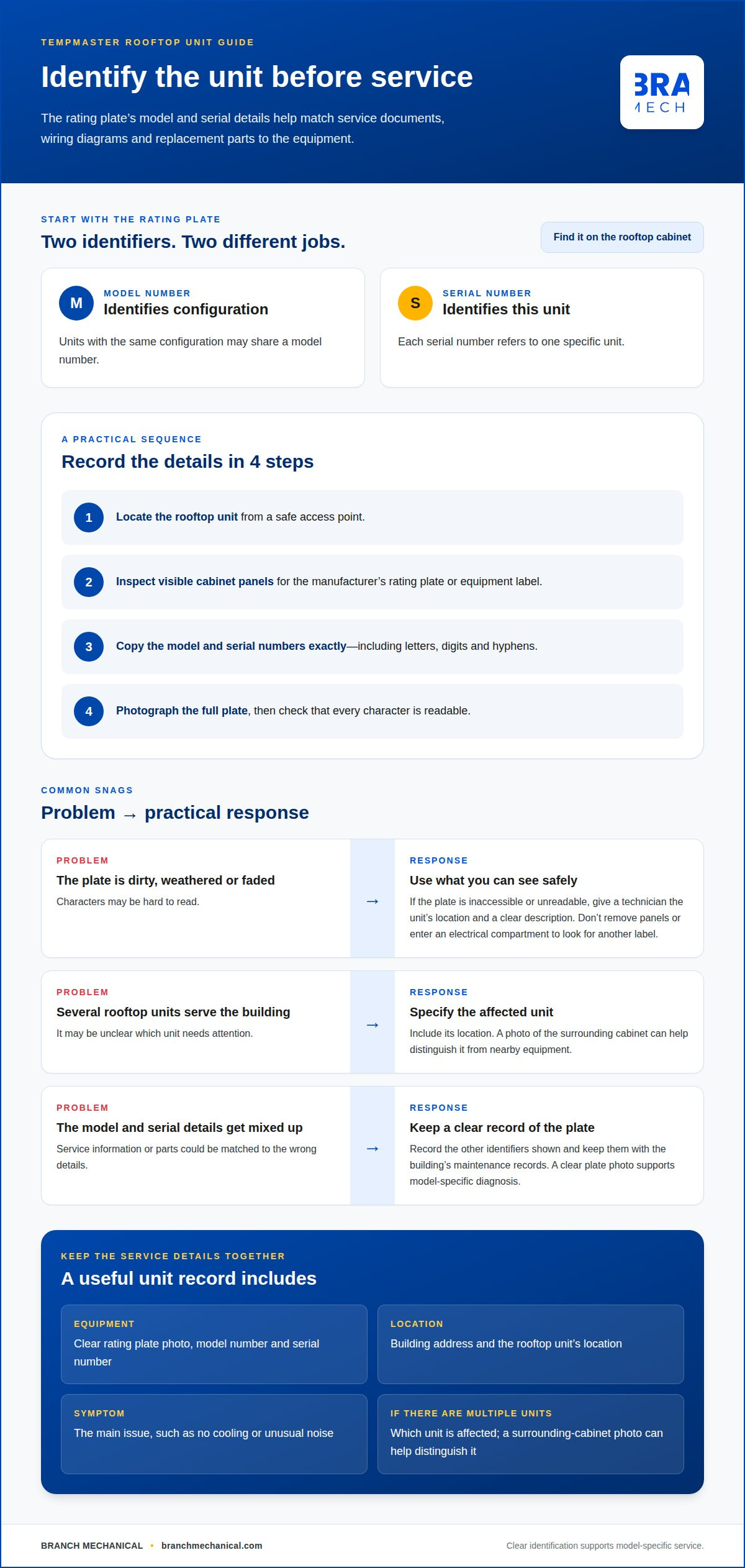
Start with the rating plate on the rooftop cabinet. Its identification details distinguish the unit and help match service documents, wiring diagrams, and replacement parts. The model number identifies the equipment configuration; the serial number identifies the individual unit.
Use this practical sequence to record the information:
- Locate the rooftop unit from a safe access point.
- Inspect visible cabinet panels for a manufacturer’s rating plate or equipment label.
- Copy the model and serial number exactly, including letters, digits and hyphens.
- Photograph the full plate, then check that every character is readable.
Don’t confuse the model number with the serial number. Multiple units with the same configuration may share a model number, while each serial number refers to one specific unit. Record any other identifiers on the plate and keep them with the building’s maintenance records.
Roof conditions can make labels hard to read. Dirt, weathering, or fading may obscure characters. Don’t remove panels or enter an electrical compartment to look for another label. If the plate is inaccessible or unreadable, give a technician the unit’s location and a clear description so they can assess the equipment safely and identify the correct details.
Before arranging TempMaster rooftop unit HVAC repair, send the technician a clear photo of the rating plate, along with the building address, unit location, and main symptom, such as no cooling or unusual noise. If several rooftop units serve the building, specify which one is affected. A photo of the surrounding cabinet can help distinguish it from nearby equipment. Accurate identification reduces the risk of confusion and supports model-specific diagnosis. Keep the image where building staff can find it for future service calls.
How do technicians troubleshoot a TempMaster rooftop unit that will not start?
A technician starts by clarifying the reported symptom. “Won’t start” could mean no display, no fan, or no heating or cooling. These distinctions help narrow down the fault. The technician also records the TempMaster model and serial details before consulting equipment-specific service information.
Next, the technician checks the building controls and power path. The thermostat may not be calling for heating or cooling. A control setting, power interruption, or open safety control could also prevent operation. Systematic checks help identify the cause without replacing parts based on a guess.
- Confirm the call. Compare the thermostat setting with the requested mode and indoor conditions.
- Check power and controls. Inspect the supply, disconnect, control circuit and relevant safety devices.
- Review fault indications. Record displayed codes or status lights, then interpret them using the matching service information.
- Test components. Check the control sequence and inspect relevant wiring, contactors, motors or sensors.
A sound diagnosis follows the sequence from the call for heat or cooling to the equipment’s response. For example, a thermostat call with no control response points to a different issue than a running fan with no heat. The technician uses test results to distinguish control, electrical, and component faults, then explains the necessary repair before replacing a failed part.
Leave electrical testing, panel access, and rooftop work to qualified service personnel. Don’t repeatedly reset a tripped device or bypass a safety control. Record when the failure began, any unusual sounds, and whether the unit stopped during heating or cooling. This history gives the technician a clearer starting point for TempMaster rooftop unit HVAC repair.
If the unit remains off, request commercial HVAC repair service for a systematic diagnosis.
Branch Mechanical: Commercial & Multi-Residential Mechanical Contracting
Branch Mechanical provides professional diagnosis, repair, and ongoing care for TempMaster rooftop units. Its commercial HVAC installation and service supports businesses experiencing interrupted heating, cooling, or airflow. Share the unit’s model and serial details, symptoms, and any recent changes to give the service team a clear starting point.
For buildings that need planned equipment care, Branch Mechanical’s preventative maintenance contracts help organize routine service and identify maintenance needs. The company also provides commercial and multi-residential mechanical contracting, including commercial boilers and heating systems. If a rooftop unit has stopped operating or recurring issues are affecting building comfort, contact Branch Mechanical to discuss service.
Keep your rooftop system ready for its next season
A rooftop unit’s service history helps inform future decisions. Keep a simple record of symptoms, completed repairs, and changes in heating or cooling performance. If the building has several units, note which one is affected and share the details during service planning. This gives the technician useful context beyond the immediate fault.
When arranging TempMaster rooftop unit HVAC repair, consider how the equipment fits into the building’s broader mechanical needs. Branch Mechanical provides commercial HVAC service, preventative maintenance contracts, and commercial and multi-residential mechanical contracting. These services can address an equipment concern and help organize ongoing care for building systems.
When service is needed, share the unit’s identification details and a concise description of the problem. Contact Branch Mechanical for HVAC service to discuss the next step. A clear service conversation can help you move forward with greater confidence.
Frequently Asked Questions
What are common TempMaster rooftop unit problems and their symptoms?
Common problems include weak airflow, uneven temperatures, unusual sounds, water around the unit, or heating and cooling that fail to maintain the thermostat setting. Airflow that weakens over time, for example, differs from a system that stops suddenly. Note when the symptom occurs, whether it affects the whole building or one area, and any visible changes. These details help a technician assess the issue.