
A certified refrigeration mechanic in Mississauga installs, maintains, services, and retrofits refrigeration and air-conditioning systems. In Ontario, refrigeration and air conditioning systems mechanic is a compulsory trade. Legal practice requires a qualifying certificate or registered training agreement, along with an entry on the Skilled Trades Ontario Public Register. The work can involve commercial, industrial, institutional, and residential equipment.
For businesses, reliable refrigeration supports daily operations, so understanding what a mechanic does helps clarify the role and its responsibilities. This guide explains the trade’s core duties and outlines what to consider when looking at employment prospects in Mississauga.
You’ll also learn how Ontario’s certification pathway relates to the work, and how refrigeration mechanics contribute to commercial buildings and operations. The overview provides a practical starting point for understanding the occupation and the local job market.
Key Takeaways
- Understand how refrigeration and air-conditioning mechanics install, maintain, service and retrofit equipment across different types of buildings.
- Use questions about certification, the equipment’s issue and the proposed work to make a more informed hiring decision.
- Learn which details affect how quickly a mechanic can respond to a service call, and why response timing can vary.
- Know why Ontario’s compulsory-trade requirements matter when choosing someone to work on refrigeration and air-conditioning systems.
Refrigeration and air conditioning mechanic duties
A refrigeration and air conditioning mechanic installs, maintains, services and retrofits heating, ventilation, air conditioning and refrigeration equipment. The trade covers residential, commercial, industrial and institutional systems, from a home air conditioner to refrigeration equipment in a commercial building. For each call, the mechanic identifies the equipment and reported problem, then determines the work needed to address it.
Servicing involves assessing a system and carrying out work to restore or maintain its function. For example, a mechanic may investigate a cooling problem, service the affected equipment, and assess its operation afterward. Maintenance focuses on keeping systems operating as intended, while retrofits adapt existing equipment or systems. Installation means putting new equipment or systems in place.
Ontario’s certified trade has two branches: Refrigeration and Air Conditioning Systems Mechanic, and Residential Air Conditioning Systems Mechanic. The residential air conditioning branch is limited to systems operating at no more than 240 volts single-phase power, with a maximum branch circuit capacity of 60 amps. It also covers systems with a maximum cooling capacity of 60,000 British thermal units per hour and a saturated suction temperature above 2 degrees Celsius in the cooling cycle. These limits distinguish the residential branch from the broader systems mechanic branch.
When arranging service for commercial refrigeration in Mississauga, provide the site address, equipment type, and a clear description of the issue. Mention any change in performance, such as a commercial cooler no longer holding its set temperature.
These details clarify the equipment and service needed. Residential air conditioning is a separate service need from commercial refrigeration, which concerns equipment used in business operations. Identifying whether the issue involves air conditioning, refrigeration, or both gives the service request a clear starting point.
Training provides another distinction between the branches. In Ontario, residential air conditioning systems mechanic apprenticeship training consists of two 1,800-hour periods and one 900-hour period of classes and on-the-job work experience; the program includes a 900-hour period of classes and on-the-job work experience. The Refrigeration and Air Conditioning Systems Mechanic trade is named under the Building Opportunities in the Skilled Trades Act, 2021.
In Ontario, the Refrigeration and Air Conditioning Systems Mechanic apprenticeship requires 9,000 hours of training and takes approximately five years. It includes 8,280 hours of on-the-job work experience. These training requirements apply to the respective apprenticeship paths and provide context for the scope of work each mechanic may undertake.
What questions should I ask before hiring a refrigeration mechanic?
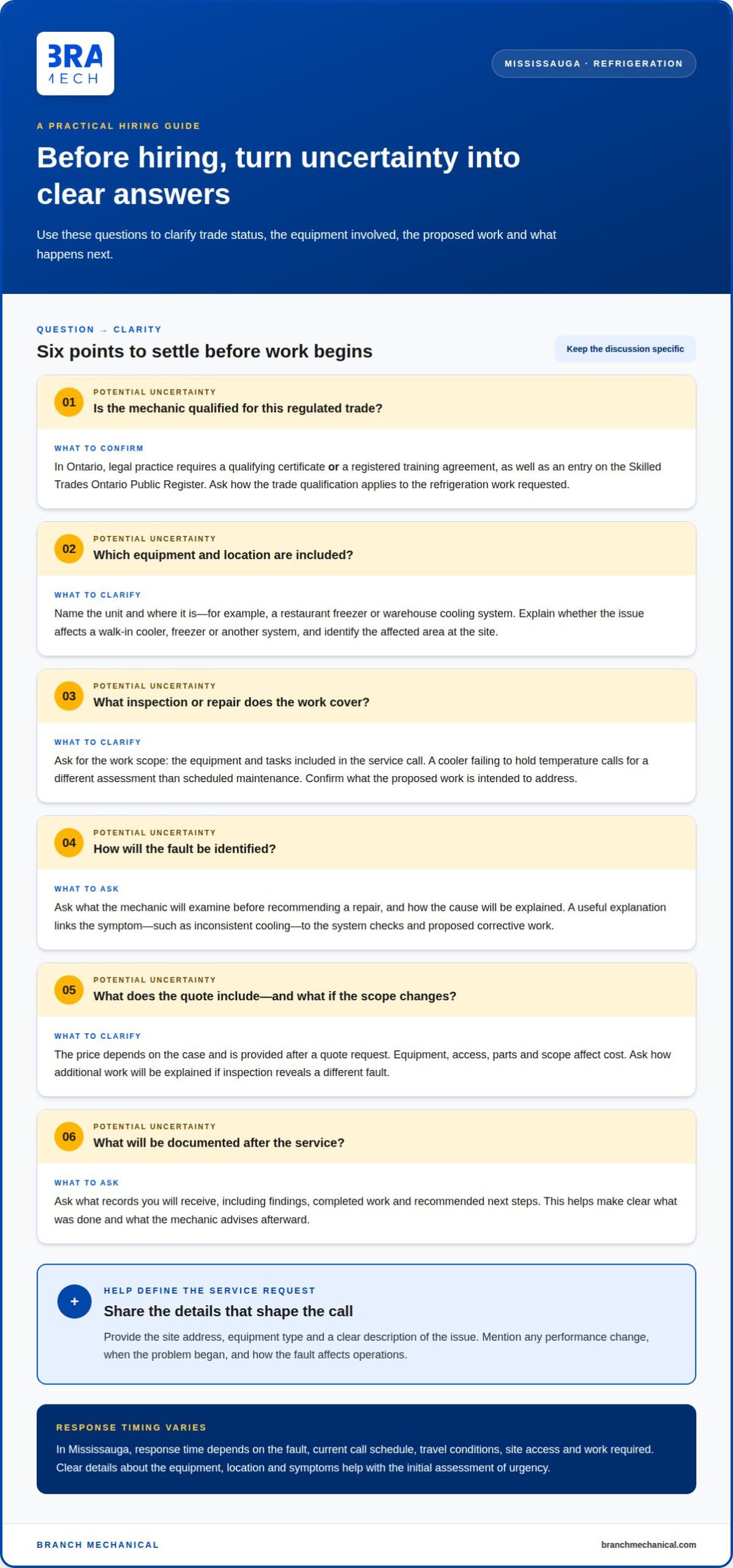
A trade credential confirms a worker’s status in Ontario’s compulsory refrigeration and air conditioning trade. In Ontario, legal practice requires a qualifying certificate or a registered training agreement, as well as an entry on Skilled Trades Ontario’s Public Register. Checking these details distinguishes legally qualified trade work from experience alone.
A work scope describes the equipment and tasks included in a service call. Explain whether the issue affects a walk-in cooler, freezer, or another system, and clarify what inspection or repair the work covers. A cooler failing to hold temperature, for example, calls for a different assessment than scheduled maintenance. Clear scope helps you understand what the service is intended to address.
A diagnostic approach is the process used to identify a fault. Ask what the mechanic will examine before recommending a repair and how they will explain the cause. A useful explanation connects the reported symptom, such as inconsistent cooling, with the system checks and proposed corrective work.
- What trade qualification applies? Ask how the mechanic’s Ontario trade status relates to the refrigeration work requested.
- What equipment will the work cover? Name the unit and its location, such as a restaurant freezer or warehouse cooling system.
- What does the quote include? The price depends on the case and is provided after a quote request; equipment, access, parts, and scope affect the cost.
- How will changes be handled? Ask how additional work will be explained if inspection reveals a different fault.
- What records will I receive? Ask what findings, completed work, and recommended next steps will be documented.
For a commercial site, identify the affected area and explain how the fault affects operations. This helps define the service request before work begins. Keep the discussion focused on trade status, equipment, diagnosis, scope, and documentation. Together, these details make it easier to understand whether the proposed work addresses the reported problem.
How quickly can a certified refrigeration mechanic respond to service calls in Mississauga?
Response time is the interval between requesting service and a mechanic arriving on site. In Mississauga, timing depends on the fault, current call schedule, travel conditions, site access, and work required. A restaurant cooler affecting stored food, for instance, may call for a different response than a routine inspection of a secondary unit.
Call triage is the initial assessment of a service request and its urgency. Describe the equipment, its location, the symptoms, and when the problem began. For example, say whether a walk-in freezer has stopped cooling entirely or is still running but showing a temperature change. Clear information helps the service team understand the situation before dispatch.
Dispatch timing covers assigning a mechanic and arranging travel to the site. Existing calls, the mechanic’s location, Mississauga traffic, and building entry procedures can all affect arrival. A warehouse with a designated loading entrance may be easier to access than a secured commercial property requiring an escort. Provide entry instructions and an on-site contact when arranging service.
Diagnosis is the on-site process of finding the cause of an equipment problem. Arrival does not mean the repair is complete: the mechanic must assess the system, identify the fault, and determine the work required. A commercial cooler that has lost cooling may need a different repair process from a unit operating inconsistently.
- State the impact: Explain whether the fault has stopped refrigeration or affected only one area.
- Identify the equipment: Name the unit type and its location, such as a restaurant freezer or warehouse cooler.
- Explain access: Provide the address, entry instructions, and contact for site coordination.
- Describe changes: Note when the issue began and how system performance has changed.
Details about the fault and site access help clarify urgency and coordinate the service response. For Mississauga businesses, the operational impact and site logistics are important when arranging a call.
What risks come with hiring an uncertified refrigeration mechanic?
A compulsory trade is an occupation with legal qualification requirements in Ontario. Refrigeration and Air Conditioning Systems Mechanic is a compulsory trade, so legal practice requires a qualifying certificate or registered training agreement, along with an entry on the Skilled Trades Ontario Public Register. A worker without a certificate may legally practise under a registered training agreement if the required register entry is in place.
One risk is unauthorized work, which occurs when someone practises without meeting Ontario’s requirements. Practical experience alone does not establish that a worker meets the legal conditions. Even someone who has serviced coolers for years needs the required status and register entry to practise this compulsory trade legally. Confirming a worker’s standing helps distinguish experience from legal qualification.
Another risk is a mismatch between a worker’s qualifications and the requested task. Refrigeration equipment can be part of a restaurant, warehouse, or multi-residential building. If a mechanic cannot properly assess the specific system, the diagnosis may not address the fault. For example, a walk-in cooler that continues to lose cooling after a repair may need further investigation before the business can rely on it.
Incomplete records can create practical problems. Without a clear account of the reported fault, findings, and work performed, it may be harder to understand what was repaired or what needs attention next. For a commercial freezer, those details help a business track recurring symptoms and communicate the system’s condition to staff.
Before work begins, use these steps:
- Identify whether the worker holds a qualifying certificate or has a registered training agreement.
- Confirm the required entry appears on the Skilled Trades Ontario Public Register.
- Describe the equipment and issue, then ask how the proposed work addresses them.
- Request a clear record of the diagnosis and completed work.
For commercial equipment, choose a route that connects the service request to properly qualified trade work. Arrange commercial refrigeration service for a business system that needs attention.
Branch Mechanical: Commercial Refrigeration Systems
Branch Mechanical installs and services commercial refrigeration systems for businesses. This is a practical next step when a restaurant cooler, warehouse system, or other commercial refrigeration equipment needs attention.
Commercial refrigeration works alongside other building systems. For sites with related mechanical needs, Branch Mechanical also provides commercial and multi-residential mechanical contracting, commercial HVAC installation and service, preventative maintenance contracts, and commercial boilers and heating systems.
When requesting service, describe the equipment, its location, the fault, and its effect on operations. This information helps define the work involved. For planned support, preventative maintenance contracts help businesses organize ongoing care for their mechanical systems.
Contact Branch Mechanical to discuss your commercial refrigeration needs.
Plan your next step for dependable building operations
For a Mississauga business, refrigeration is one part of a building’s wider mechanical operation. Consider how cooling equipment, HVAC, and other building systems affect daily work, then identify the service support that fits the site. A certified refrigeration mechanic in Mississauga can address refrigeration needs, while broader mechanical planning can coordinate work across connected systems.
Branch Mechanical provides commercial and multi-residential mechanical contracting, commercial HVAC installation and service, and preventative maintenance contracts. These services are useful when planning work beyond a single refrigeration issue or arranging ongoing care for building equipment. Start by outlining your operational needs and the systems involved.
Share the equipment or building concern you want to address, and start a practical conversation about service. Contact Branch Mechanical to discuss your commercial mechanical needs. With a clear plan and the right scope of work, you can move forward with greater confidence in your facility’s operations.
Frequently Asked Questions
What refrigeration repair and installation services do Mississauga mechanics offer?
Commercial refrigeration equipment in Mississauga includes walk-in coolers, walk-in freezers, ice machines, and display coolers. Branch Mechanical provides commercial refrigeration installation and repairs for businesses in Mississauga and Etobicoke. This service can support a restaurant replacing or servicing a walk-in freezer, or a retail space needing a display cooler repaired. The equipment type and site requirements shape the work involved.
How much does refrigeration repair cost in Mississauga?
The cost depends on the equipment, access, parts, and work required. Branch Mechanical provides free, no-obligation quotes upon request.