

The most impressive BAS proposal isn’t necessarily the right one for your building. If a system can’t communicate reliably with existing equipment, or isn’t properly commissioned and explained to staff, it may create more uncertainty than control. For facility managers comparing BAS installation companies Toronto has to offer, integration and handover deserve as much attention as the technology itself.
Before committing to a building automation project, get clear answers to practical questions. Will the controls work with your current HVAC equipment? What will commissioning include? Who can help your team after installation? The right contractor should discuss these details in the context of your building, not just present a list of features.
This guide offers a building-focused framework for assessing contractors, comparing project capabilities and understanding the main stages and deliverables of a BAS installation. You’ll also learn what to clarify about platform compatibility, staff training, ongoing support and local service coverage. A methodical review can help you choose a contractor with confidence and plan a system around your facility’s needs.
Key Takeaways
- Compare BAS installation companies Toronto by asking for building-relevant project examples and a clearly defined scope, not broad claims alone.
- Use the site assessment to identify existing equipment, control points and integration needs before installation planning begins.
- Clarify how testing, commissioning, documentation and staff handover will be addressed in the proposed project.
- Record operating schedules, access limits and critical equipment early to help coordinate work with tenants, staff and other contractors.
- Branch Mechanical offers building automation alongside commercial HVAC and other mechanical services. Confirm your building’s location, project fit and requirements directly.
Toronto BAS Companies: Services and Building Needs
A building automation system (BAS) lets facility operators monitor and manage compatible building equipment through a coordinated controls system. It can bring information from selected equipment and control points into a shared interface, rather than requiring staff to check separate controls one by one. For a general overview of Building automation systems (BAS), see Wikipedia.
A BAS is not simply another name for HVAC service. An HVAC provider may install or maintain heating and cooling equipment, while BAS installation involves designing and configuring controls to communicate with compatible equipment. A standalone thermostat or equipment controller may handle one unit or zone. A BAS can coordinate multiple systems and provide broader monitoring, depending on the project design. When comparing BAS installation companies Toronto facility managers are considering, ask what controls work the contractor will perform, not just whether it offers HVAC services.
What does a building automation system control?
Coverage depends on the equipment, existing controls and integration requirements. A BAS may coordinate schedules and settings across compatible HVAC equipment while giving operators visibility into selected system conditions. For example, an office with different occupied hours across its spaces could use coordinated schedules so compatible equipment follows the building’s operating plan. Ask the contractor to identify the equipment and control points that can be included, as well as anything that would remain outside the system’s scope.
Don’t assume every building system will connect automatically. Compatibility, available control points and the project design all affect what a BAS can monitor or manage. A site assessment should establish what is already in place and identify any equipment or controls that need further review.
When should a Toronto facility consider BAS installation?
Recurring comfort complaints, limited visibility into equipment operation, or controls staff must manage separately can be useful prompts for an assessment. These signs don’t automatically mean the building needs a new BAS. They may point to a configuration issue, a maintenance need or an opportunity to improve existing controls.
Start by establishing the condition of the current system. A contractor can review existing equipment and controls, document what’s in place and determine which elements may be suitable for integration. That baseline helps avoid assuming replacement is the only option.
Build the project brief around how the facility is used. An office, restaurant, warehouse or multi-residential property may have different equipment, occupancy patterns and operating priorities. For buildings in Mississauga and Etobicoke, include local site access, operating schedules and any constraints that could affect planning. Share comfort concerns, operating hours and equipment priorities with prospective BAS installation companies Toronto so they can assess the building before recommending a scope.
How a Toronto BAS installation moves from assessment to commissioning
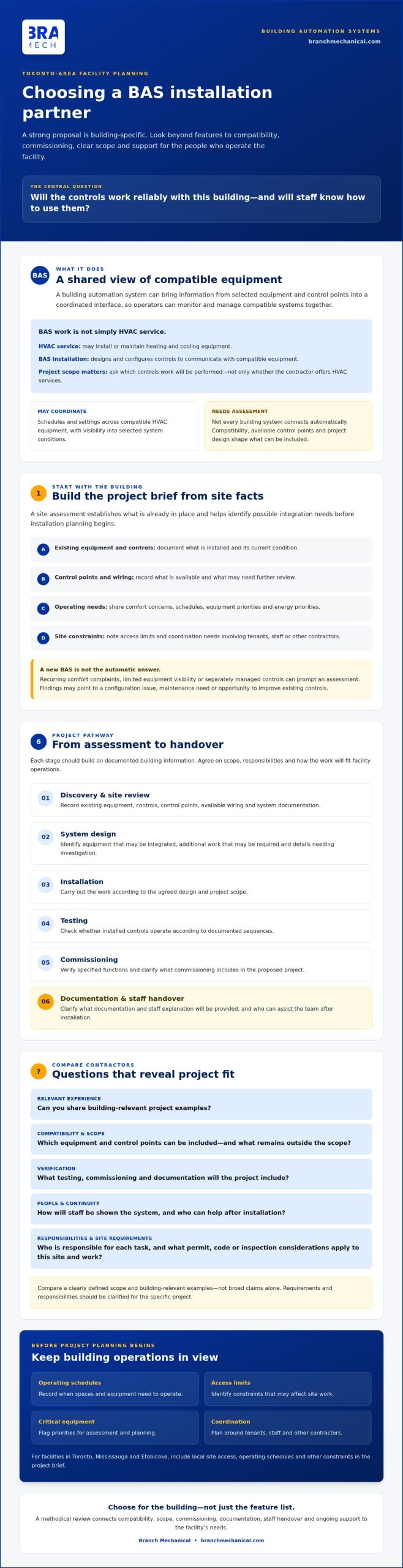
A well-planned BAS project follows a clear path: discovery and site review, system design, installation, testing, commissioning and handover. Each stage should build on documented information about the building, not assumptions. Before work begins, agree on the project scope, who is responsible for each task and how work will be coordinated with facility operations.
During planning, the contractor should record existing equipment, control points, available wiring and system documentation. The contractor can then identify which equipment may be integrated, what additional work may be required and which details need further investigation. Energy priorities can also inform the project brief. The U.S. Department of Energy discusses approaches to reduce commercial building energy consumption, but any expected performance from a specific BAS project should be assessed against the building’s own conditions.
Installation follows the agreed design and scope. Testing and commissioning then check whether the installed controls operate according to the documented sequences and whether specified functions can be verified. Confirm permit, code and inspection considerations for the specific site and work, and clarify responsibilities among the owner, contractor and other project participants. Don’t assume the same requirements apply to every building or project.
What happens during a BAS site assessment?
A useful assessment looks beyond the control panel. Ask the contractor to review existing controls, connected equipment, wiring and available system records with your facility team. Discuss operating schedules, user concerns and priority spaces, such as areas with recurring comfort issues or equipment that needs closer monitoring. Request a written scope that separates confirmed site conditions from items requiring additional investigation. This gives you a clearer basis for comparing proposals.
Why commissioning and handover matter
Commissioning is a verification process, not a promise of savings or flawless performance. Ask how the contractor plans to test control sequences, alarms, sensors and operator access, and how test results and outstanding items will be recorded. Before closeout, request as-built documentation, system settings and a list of unresolved issues that identifies who is responsible for follow-up. Confirm who will receive operator training, what it will cover and whether it will be delivered in a format staff can use.
These deliverables help your team understand what was installed and how to operate the system after the project is complete. As you evaluate BAS installation companies Toronto facilities can work with, include the assessment, testing records and handover plan in your comparison. Branch Mechanical lists building automation and energy management alongside commercial HVAC and other mechanical services. Review its commercial mechanical services and confirm whether your location and project requirements are a fit.
How to compare BAS installation companies serving Toronto
Service lists alone won’t tell you whether a contractor can deliver the controls scope your building needs. Compare BAS installation companies Toronto facility managers are considering against the same project criteria, then ask for evidence to support each proposal. Focus on the work, its boundaries and who will be accountable at each stage.
Use this framework to guide proposal reviews:
| Comparison area | What to look for | What to verify |
|---|---|---|
| Relevant experience | Examples involving a similar building type and project scope | References you can contact about comparable work |
| Defined scope | Included equipment, control points, software and exclusions | Written assumptions, owner responsibilities and change procedures |
| Integration | A plan for connecting compatible existing equipment and controls | Which systems are included, excluded or subject to further review |
| Commissioning and handover | Testing, training and documentation identified as project deliverables | How test results, outstanding items and final records will be provided |
What should a BAS installation proposal include?
Look for clear project boundaries and a record of the existing-system conditions the proposal assumes. The contractor should identify the equipment and control points in scope, describe how integration will be approached, and explain how software, testing, operator training and documentation fit into the work. Check exclusions carefully. A proposal, for example, may depend on access to equipment records or work by another contractor. Confirm how changes will be reviewed and approved so added requirements don’t become surprises.
Coordination matters if the project also involves mechanical or electrical work. Ask how responsibilities will be divided and how the BAS work will align with related equipment and site activities. An integrated mechanical contractor may be a practical fit for projects involving several building systems, but confirm the proposed team’s specific scope and experience.
How can you verify a contractor’s BAS experience?
Ask for examples and references relevant to your building type and the systems you need to integrate. Clarify who will lead design, installation, programming, commissioning and any ongoing service included in the proposal. Request evidence for stated credentials, manufacturer relationships and insurance, then verify details directly rather than relying on broad claims about expertise or energy performance.
For a broader overview of automation considerations, consult this GTA building automation guide. Use it alongside your site information to prepare focused questions and compare proposals based on their documented fit for your facility.
Plan a Toronto BAS project around building operations and support
A BAS installation needs to fit the way a building operates, not just the equipment being connected. Before work starts, share operating schedules, comfort concerns, equipment priorities and access constraints with the project team. This information helps shape a practical work plan for tenants, staff and critical operations, including at facilities in Mississauga and Etobicoke.
If the BAS project is part of an HVAC upgrade, coordinate the controls scope with the equipment work. This commercial HVAC installation planning resource can help frame that discussion.
How should building teams prepare for installation?
Gather useful records before the contractor arrives. These may include equipment schedules, control drawings, maintenance records and available system documentation. Arrange access to relevant system credentials through an approved, secure process rather than sharing passwords informally. Identify who can authorize access and explain how work may affect building operations.
Map the practical constraints with the facility team:
- Note occupied spaces, operating periods and activities that limit access.
- Identify priority equipment and areas where interruptions require extra coordination.
- Confirm how tenants and staff will receive updates about planned work.
- Name one facility decision-maker to coordinate approvals, questions and issue resolution.
Share this information with other contractors whose work may overlap. Agree on sequencing, site access and how operational concerns will be raised during installation. The plan should reflect the building’s actual use, whether it serves offices, residents, restaurant operations or warehouse activity.
What support should owners confirm after commissioning?
Before work begins, clarify what happens once the installation is complete. Ask who handles troubleshooting, software updates and future system changes, and which services fall outside the installation scope. Confirm how staff can report an issue, who receives it and how escalation works. These details matter alongside giving operators the right access and usable system documentation.
Discuss preventative maintenance separately. If it’s relevant, ask whether it can be arranged, what it covers and which service terms apply. Don’t assume ongoing support is automatically included in an installation proposal.
Branch Mechanical lists building automation and energy management alongside commercial HVAC and other mechanical services, which may suit projects involving related building systems. When comparing BAS installation companies Toronto building teams may consider, confirm the project scope and service availability for your location directly with the contractor.
Choose a BAS installation partner for your Toronto-area building
A suitable BAS partner should connect its proposal to your building’s actual needs. Look for relevant project experience, a clearly defined scope, a practical integration plan and a documented approach to commissioning and handover. These details help you compare providers on what they plan to deliver, rather than broad claims about expertise or potential performance.
Before choosing a contractor, check that the team can explain what existing equipment may be integrated, what needs further assessment and how related mechanical or electrical work will be coordinated. Confirm who is responsible for testing, operator training and records of the completed work. For facility teams reviewing BAS installation companies Toronto, location matters too: Branch Mechanical identifies Mississauga and Etobicoke as service areas. Confirm directly whether your Toronto address and project requirements can be accommodated.
Questions to ask before requesting a BAS proposal
Give potential contractors a useful starting point. Describe your building type, existing controls and equipment, operating schedule and main concerns, such as recurring comfort issues or limited system visibility. You don’t need to know the technical solution in advance. Clear building information helps a contractor assess the project before proposing a scope.
- Who will review integration requirements and identify equipment or controls that need further investigation?
- How will BAS work be coordinated with related mechanical or electrical work?
- What will commissioning, operator training and project documentation include?
- Which ongoing service responsibilities are included, and which must be arranged separately?
Compare the answers in writing. If a proposal leaves key responsibilities unclear, ask for clarification before making a decision.
Discuss BAS installation with Branch Mechanical
Branch Mechanical lists building automation and energy management among its commercial services, alongside HVAC, electrical and refrigeration capabilities. That wider mechanical scope may be relevant when a BAS project involves related building systems, but the right fit depends on the site, equipment and requested work. Confirm the available project scope, integration experience, commissioning deliverables and service coverage directly.
For broader context on its regional contractor scope, see mechanical contractors serving Mississauga and the GTA. A clear conversation about building needs and project responsibilities is a practical first step toward choosing with confidence.
Move forward with a BAS plan that fits your building
The right contractor should offer more than installation capability. Look for relevant building experience, a clearly defined scope, a realistic integration plan and documented commissioning and handover. These details help you assess whether a proposal fits your existing equipment and day-to-day operations.
As you compare BAS installation companies Toronto, confirm who will coordinate related mechanical or electrical work and what support is available after commissioning. Branch Mechanical lists commercial building automation and energy management among its services, alongside commercial HVAC, electrical and refrigeration services. Mississauga and Etobicoke are identified service areas, so confirm directly whether your Toronto address and project requirements can be accommodated.
A focused discussion about your building, existing controls and priorities can help establish whether there’s a practical fit. Discuss your building automation project with Branch Mechanical to take the next step towards a well-planned BAS installation.
Frequently Asked Questions
What does a BAS installation company do?
A BAS installation company assesses a building’s equipment and existing controls, defines the project scope, and installs or integrates control components. The contractor may also test the system and provide project documentation. Exact responsibilities depend on the facility and its existing infrastructure. Ask who handles design, programming, commissioning, operator training and handover so you can compare proposals based on the full project, not just the equipment listed.
How do I choose a BAS installation company in Toronto?
Compare BAS installation companies Toronto building owners are considering on relevant experience, a clear scope, integration planning, commissioning and post-installation support. Request references for projects similar to your building and verify stated credentials directly. Confirm the provider serves your address and can plan around operating requirements. Branch Mechanical identifies Mississauga and Etobicoke as service areas, so Toronto facility teams should confirm project availability for their location.
Can a new BAS work with existing HVAC equipment?
A new BAS may work with existing HVAC equipment, but compatibility depends on the equipment, current controls, communications protocols and proposed system design. Ask the contractor to review the equipment and available documentation before confirming what can connect. Request a written breakdown of equipment proposed for integration, items that may need replacement and assumptions that still require checking. This helps set a realistic scope before installation planning proceeds.
What happens during BAS commissioning?
Commissioning checks whether installed controls and programmed sequences operate as intended. Ask the contractor which control points, alarms, schedules and operator functions will be tested, and how results will be recorded. The handover should identify outstanding items and provide relevant commissioning documentation. Confirm that operator training is included in the project scope, who will attend and what system information staff will receive for day-to-day use.
How long does a commercial BAS installation take?
There isn’t one timeline for every commercial BAS installation. Duration can depend on building size, system complexity, existing controls, equipment availability, site access and operational restrictions. Ask each contractor for a schedule based on a site assessment. It should identify key milestones, dependencies, planned interruptions and how schedule changes will be communicated. Share access constraints and critical operating periods early so the proposed timing reflects the facility’s needs.
Does a BAS installation require permits or inspections in Toronto?
Permit and inspection requirements depend on the project scope, building conditions and work involved, so don’t assume every BAS installation follows the same approval process. Ask the contractor to identify potential permit, inspection and code considerations for the specific project, and clarify who is responsible for each step. Before work begins, verify applicable requirements with the relevant authorities. Keep those responsibilities and any required approvals clear in the project documentation.
Should BAS installation include ongoing maintenance?
Installation and ongoing maintenance are related but separate scopes. Before signing, clarify what support is included after commissioning, who handles system issues and whether preventative service is available under a separate agreement. Confirm how staff can access operating documents, request system changes and report controls that aren’t working as expected. Branch Mechanical lists preventative maintenance contracts among its services. Confirm the terms and whether a suitable option is available for your building.