
Better indoor air quality starts with finding the cause, not masking the symptom. Commercial air quality solutions in Toronto can include investigating pollutant sources, correcting ventilation or moisture issues, and checking that HVAC systems are operating as intended. The City of Toronto’s indoor air quality guidelines recommend keeping relative humidity below 60%.
Stale air, recurring odours, damp areas, or comfort complaints can point to different problems. For commercial air quality solutions in Toronto, a measured assessment is more useful than a one-size-fits-all fix. The right response depends on what is affecting the space and how the building’s ventilation and mechanical systems are performing.
This guide explains practical ways to address indoor pollutants, moisture, and ventilation problems, and how to investigate complaints in a commercial space. You’ll learn what an air quality assessment can cover, which monitoring measures are useful, and how commercial HVAC service and preventative maintenance can support a consistent response.
Key Takeaways
- Identify likely pollutant sources, including building materials, cleaning products, and outdoor air entering the space, before choosing a response.
- Use humidification or dehumidification to address moisture conditions, while considering how the building and HVAC system affect humidity.
- Look for patterns in air quality complaints, such as when and where they occur, to help narrow down possible causes.
- Track PM2.5, PM10, carbon dioxide, volatile organic compounds, and humidity to build a clearer picture of indoor conditions.
- Assess ventilation performance and mechanical systems together, since equipment operation and how air moves through a space can shape the findings.
Indoor air pollutants
Commercial indoor air quality testing in Toronto and the GTA can help identify pollutants and their sources. A useful assessment connects measured conditions with building activities, ventilation, and occupant complaints.
Biological and Chemical Pollutants
Biological pollutants include mould, bacteria, and allergens associated with damp materials, dust, or poorly maintained equipment. Chemical pollutants can come from cleaning products, furnishings, building materials, and combustion appliances. During air quality testing, record odours, visible moisture, product use, and where complaints occur. These clues help focus sampling and distinguish a likely source from symptoms alone.
Common Causes and Health Risks
Blocked or poorly maintained filters, inadequate outdoor-air ventilation, water leaks, and chemical use can affect indoor air quality. Outdoor nitrogen oxides, ozone, and particulate matter can also enter Toronto buildings. The City of Toronto identifies respiratory and cardiovascular health risks associated with poor indoor air quality. People with heart or lung disease, children, and seniors can be especially sensitive to air pollution.
What are common causes and health risks of poor indoor air quality in Toronto commercial buildings? Moisture, insufficient ventilation, pollutants from products or materials, and outdoor pollution are common concerns. The City of Toronto links poor indoor air quality with respiratory and cardiovascular risks.
Improvement and Remediation Options
Start by correcting the source: repair leaks, remove contaminated materials appropriately, and improve ventilation where needed. Replace clogged filters with suitable options, including HEPA or MERV-13-A-rated filters, to reduce indoor pollutants. Portable HEPA air cleaners can add filtration in high-traffic spaces such as lobbies and conference rooms. Review HVAC operation alongside any filtration changes.
The City of Toronto’s indoor air quality guidelines recommend relative humidity below 60%. They set carbon dioxide below 1,000 ppm or below 700 ppm above outdoor concentration, and carbon monoxide below 9 ppm. For formaldehyde, the guideline is below 0.1 ppm; TVOC levels have a 1 mg/m3 target and a 5 mg/m3 action level.
How often should Toronto workplaces test indoor air quality? Test when complaints recur, after building or ventilation changes, or when moisture or odours suggest a source. Plan routine checks around the building’s maintenance and operating conditions.
What commercial indoor air quality services are available in Toronto? Services can include pollutant sampling, ventilation assessments, moisture investigations, filtration improvements, and remediation planning. The appropriate scope depends on the suspected source and affected spaces.
Which Toronto companies provide commercial air quality testing and remediation? Environmental and industrial hygiene specialists can conduct pollutant testing and source investigations, while mechanical contractors can assess HVAC operation and ventilation. Remediation work depends on the issue identified.
Are there rebates or grants for commercial HVAC and air quality upgrades in Toronto? Funding depends on the program, building, and upgrade. HVAC improvements and energy-management changes may have different eligibility criteria.
What Can You Do to Improve Indoor Air Quality?
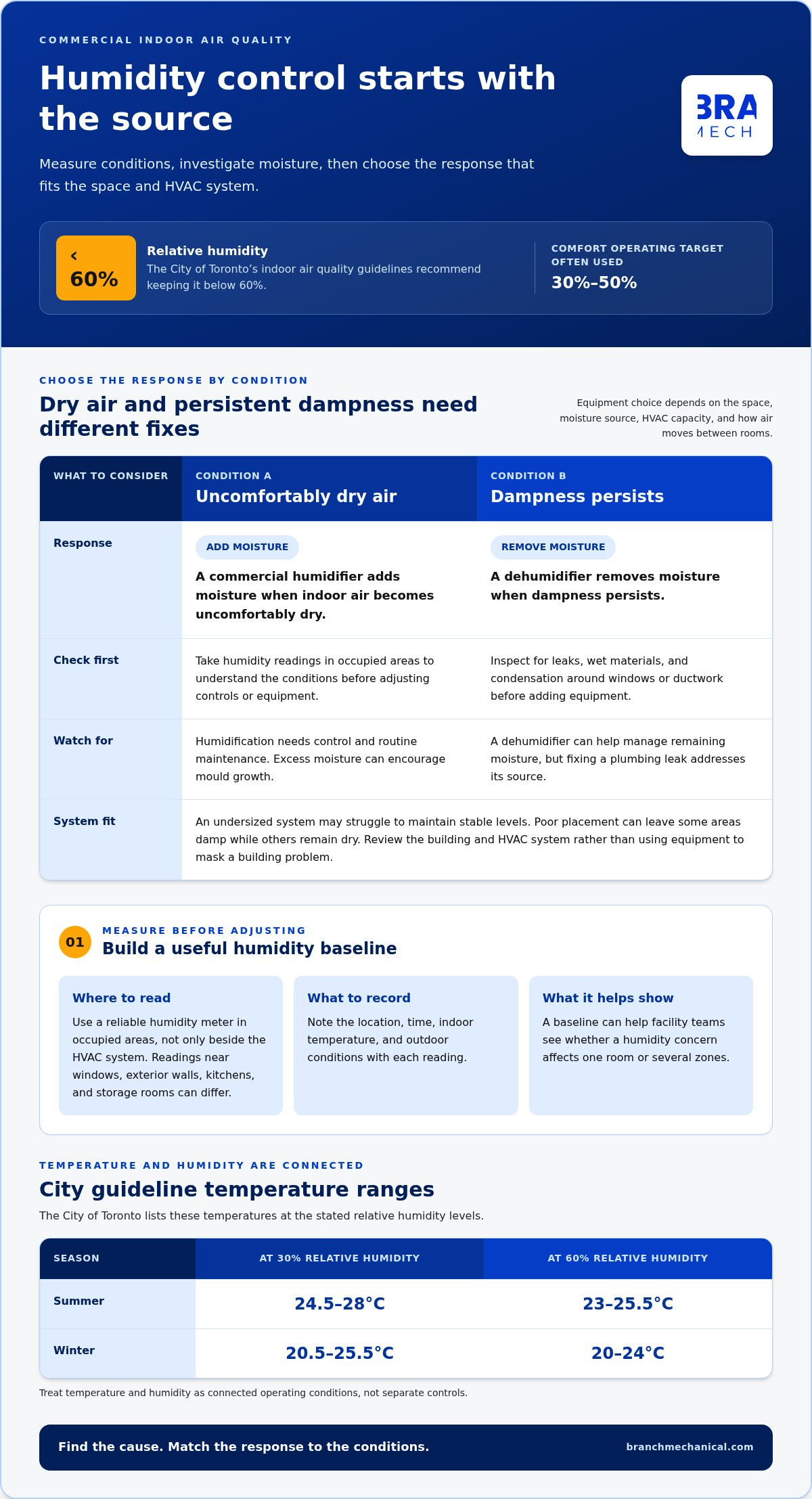
Start with a humidity reading, then adjust the building’s controls or equipment to address the cause. In Toronto, the City’s indoor air quality guidelines recommend relative humidity below 60%. A practical operating target often used for comfort is 30% to 50%, with seasonal conditions and occupant needs shaping the appropriate setting.
Measure Before Adjusting
Use a reliable humidity meter in occupied areas, not only beside the HVAC system. Readings near windows, exterior walls, kitchens, and storage rooms can differ. Record the location, time, indoor temperature, and outdoor conditions with each reading. This gives facility teams a useful baseline and helps show whether a humidity concern affects one room or several zones.
For additional context, the City of Toronto’s guidelines list summer temperatures of 24.5-28°C at 30% relative humidity and winter temperatures of 20.5-25.5°C at that humidity level. At 60% relative humidity, the listed summer range is 23-25.5°C and the winter range is 20-24°C. Treat temperature and humidity as connected operating conditions, not separate controls.
Choose Humidification or Dehumidification
A commercial humidifier adds moisture when indoor air becomes uncomfortably dry. A dehumidifier removes moisture when dampness persists. Choose equipment based on the space, moisture source, HVAC capacity, and how air moves between rooms. An undersized system may struggle to maintain stable levels; poor placement can leave some areas damp while others remain dry.
Before adding equipment, inspect for leaks, wet materials, and condensation around windows or ductwork. Fixing a plumbing leak addresses the source, while a dehumidifier can help manage remaining moisture. Humidification also requires control and routine maintenance, because excess moisture can encourage mould growth. Don’t use equipment to mask a building problem.
Manage Filters, Chemicals, and Controls
Check that filters fit correctly and match the HVAC system’s capacity. A higher-efficiency filter can reduce airborne particles, but a poorly matched filter can restrict airflow. Follow the equipment’s maintenance schedule and replace filters when they’re loaded with dust. Review cleaning chemicals and products used in occupied rooms; ventilation and careful storage can limit indoor pollutant sources.
For larger spaces, building automation can help operators monitor humidity and adjust HVAC settings by zone. Keep a simple log of readings, maintenance, and occupant concerns. If the controls need assessment or adjustment, commercial HVAC installation and service can address system operation as part of the indoor air quality response.
Moisture and ventilation problems
Moisture and ventilation affect occupant comfort, building materials, and exposure to indoor pollutants. Filtration captures particles, ventilation brings in outdoor air and exhausts indoor air, while air purification treats air already circulating indoors.
Moisture Control and Fresh-Air Intake
Look for condensation on windows, damp ceiling tiles, musty odours, or water staining near plumbing and exterior walls. These signs can point to leaks, cold surfaces, or ventilation that isn’t removing moisture effectively. Fix the moisture source first; drying equipment alone won’t stop recurring dampness. Check fresh-air intakes for blockages and keep them clear of stored items, debris, and nearby exhaust sources.
Toronto buildings also face changing outdoor conditions. Discuss intake locations and operating schedules with facilities staff, especially where vehicle exhaust or outdoor pollutants could enter. The goal is to bring in outdoor air while managing its path through occupied areas.
Ventilation and Thermal Comfort
Ventilation supports air exchange, but its effect on comfort depends on air temperature, movement, and the location of supply outlets. A cold draft near a workstation can cause discomfort even when the room feels warm overall. Compare occupant feedback with the location of diffusers, return grilles, windows, and exterior doors before changing system settings.
Seasonal operation matters in Canada. Cold incoming air can increase heating demand, while warm, humid outdoor air can add cooling and moisture loads. Adjusting airflow without considering the HVAC system may shift discomfort from one area to another.
Ventilation and HVAC Systems
Inspect the full air path, from outdoor-air dampers and filters to ducts, fans, and room outlets. A stuck damper, dirty coil, or blocked return can limit effective air movement, even when equipment appears to run. Compare system schedules with actual occupancy and note spaces that feel stuffy during normal operation.
The City of Toronto’s indoor air quality policy ties HVAC inspections to the frequency set out in the City’s Facilities Maintenance Standards. Maintenance records can help staff track recurring faults and distinguish equipment issues from changes in building use.
Filtration and Air Purification Solutions
Filtration, ventilation, and purification address different problems. HVAC filters capture airborne particles as air passes through equipment; ventilation dilutes indoor pollutants by exchanging air; air purifiers treat air locally or within a recirculating system. None removes every pollutant or corrects a moisture source, so match the approach to the identified concern.
For example, particle filtration may help manage dust, while ventilation can reduce the build-up of some indoor-generated compounds. Portable HEPA cleaners can supplement filtration in busy areas, but placement and room airflow affect their reach. Review filter compatibility with the HVAC system before upgrading, since increased resistance can affect airflow.
When ventilation complaints persist, document the affected rooms, operating schedules, odours, and comfort patterns. This record gives an HVAC assessment a clearer starting point and helps focus attention on the parts of the system most likely to affect air movement and exposure.
IAQ complaints, investigations and monitoring
A useful investigation connects reported symptoms with locations, operating conditions, and indoor air measurements. In Toronto, start by documenting where complaints occur, when they begin, and whether they change with occupancy or HVAC schedules.
Build a Clear Complaint Record
Ask occupants to describe the concern, such as eye irritation, odours, stuffiness, or temperature discomfort. Record the room, time, activity, and whether symptoms ease after leaving. Compare reports from different areas. Complaints clustered near a loading entrance, print area, or kitchen can point investigators toward distinct pollutant sources or airflow patterns.
Check building records alongside the reports. Note recent renovations, cleaning products, water leaks, filter changes, and HVAC interruptions. A timeline can reveal whether a new material or change in building operation coincided with an indoor environment concern. Keep observations factual, and avoid assuming that one symptom identifies a particular contaminant.
Choose Monitoring Equipment for the Question
Use instruments suited to the suspected pollutant. A particulate monitor can track PM2.5 or PM10; carbon dioxide sensors help assess ventilation patterns; humidity meters identify damp or dry conditions. Separate sampling may be needed for formaldehyde or other volatile organic compounds. Readings from one sensor cannot represent every pollutant or every room.
Place monitors in occupied areas, away from supply vents, open windows, and direct sources that could distort readings. Record location, time, occupancy, and HVAC status with each result. Compare readings across rooms or operating periods, then investigate unusual patterns with targeted sampling. This makes the data more useful than an isolated number.
Interpret Results Against Toronto Guidance
The City of Toronto’s indoor air quality guidelines set carbon dioxide below 1,000 ppm or below 700 ppm above outdoor concentration. They set carbon monoxide below 9 ppm and formaldehyde below 0.1 ppm. The guidelines give TVOCs a target level of 1 mg/m3 and an action level of 5 mg/m3. PM10 is set at 150 µg/m3 averaged over 24 hours.
These values help structure an investigation, but each measurement needs context. Compare indoor readings with outdoor conditions, occupancy, equipment operation, and the sampling method. For PM10, preserve the 24-hour averaging period when interpreting results. A short reading and a 24-hour average describe different exposure patterns.
Use Outdoor Information Carefully
Outdoor air quality forecasts can help explain changes in incoming air, but they don’t replace indoor monitoring. Toronto outdoor pollution, including particulate matter and ozone, may enter through fresh-air intakes. Track indoor PM2.5, PM10, carbon dioxide, volatile organic compounds, and humidity alongside intake operation. Share the resulting record with building operations staff to guide the next investigation step.
Commercial and office air quality assessments in the Greater Toronto Area
A useful assessment examines the building, occupant concerns, and mechanical operation together. In Toronto and across Ontario, a clear scope connects test results with practical next steps. Commercial air quality solutions in Toronto begin with identifying the specific concern and the spaces affected.
The cost of a commercial air quality assessment and related solutions depends on the case and is provided after a quote request. Factors include building size, areas sampled, suspected pollutants, testing methods, and any required equipment or remediation.
How can a Toronto business arrange a commercial indoor air quality assessment? Document the affected rooms, complaint patterns, building activities, and recent maintenance, then define which pollutants or system conditions need investigation. Include floor plans and HVAC schedules where available to help focus the assessment.
Set the Scope Around the Building
Begin with a walkthrough of occupied offices, meeting rooms, storage areas, and mechanical spaces. Note odours, visible moisture, renovation materials, cleaning activities, and ventilation concerns. An intermittently used conference room may need a different assessment plan than a continuously occupied reception area. Record the building’s age and recent changes, since materials and operating practices can suggest different pollutant sources.
For multi-tenant properties, map complaints by floor and suite. A pattern near one shared air-handling unit may point toward a system issue, while a concern limited to one renovated suite may call for targeted testing. Toronto-area buildings vary in layout and use, so commercial air quality solutions Toronto property managers choose should reflect each facility’s conditions.
Choose Testing That Answers a Question
Testing should follow the concern, not a generic checklist. Investigate volatile organic compounds where new finishes or chemical odours are reported. Check particulate levels where dust or outdoor pollution is suspected. Measure affected spaces and, when useful, compare them with an unaffected area or outdoor air. Record sampling locations, occupancy, and HVAC operation alongside results.
The City of Toronto policy describes acceptable office air quality using an ASHRAE criterion: at least 80% of exposed people do not express dissatisfaction, with no known contaminants at harmful concentrations. The City identifies ASHRAE Standard 62.1-2010 or its most recent version as related information. Measurements still require building-specific context.
Turn Findings into an Action Plan
A useful report identifies observed conditions, test results, likely sources, and recommended actions. Separate immediate source-control steps from longer-term changes to ventilation, filtration, or building operation. Assign responsibility for each action, then document follow-up observations or testing. This gives property managers a way to track whether the response addressed the original concern.
If findings point to mechanical system performance, arrange commercial HVAC installation and service as part of the follow-up. Match the work to the identified issue, such as airflow, equipment operation, or ventilation controls, and retain the assessment record for future maintenance reviews.
Branch Mechanical: Commercial & Multi-Residential Mechanical Contracting
Branch Mechanical supports commercial and multi-residential properties with mechanical contracting and commercial HVAC installation and service. If an air quality assessment points to ventilation, airflow, or equipment operation, these services can address the mechanical systems involved. Preventative maintenance contracts also help building teams plan routine system care and track recurring equipment concerns.
For example, a ventilation issue may require attention to HVAC operation, while a heating concern may involve commercial boilers and heating systems. Mechanical work is a suitable next step when findings relate to building systems; pollutant sampling or remediation of hazardous materials requires the relevant environmental assessment and scope.
Share your building’s assessment findings and mechanical concerns with Branch Mechanical to discuss a practical next step.
Turn Your Findings Into a Practical Plan
Use your assessment to set priorities, assign responsibility, and keep a record of follow-up work. A clear plan helps property teams connect indoor air concerns with the building systems they manage, then revisit the issue during routine maintenance. For commercial air quality solutions in Toronto, match mechanical work to the findings rather than making changes without a clear purpose.
Branch Mechanical offers Commercial & Multi-Residential Mechanical Contracting, Commercial HVAC Installation & Service, and Preventative Maintenance Contracts. These services can support businesses when assessment findings point to HVAC operation, installation, or ongoing system care. They’re a practical fit for mechanical concerns, while pollutant sampling and environmental remediation remain distinct assessment needs.
To discuss a mechanical issue identified in your building, contact Branch Mechanical. A well-organized follow-up can help your team move forward with greater clarity and confidence.
Frequently Asked Questions
Why Indoor Air Testing?
Indoor air testing helps identify concerns that routine maintenance or visual checks can’t explain. For example, recurring odours in one office may require targeted sampling, while complaints across several rooms may call for a broader review. Testing can also provide a baseline after ventilation or filtration changes, helping facility teams compare later conditions. The City of Toronto notes that poor indoor air quality can contribute to respiratory and cardiovascular health risks.
What indoor air quality standards and regulations apply to Toronto workplaces?
Toronto’s municipal indoor air quality policy provides guidance for office environments and cites the Occupational Health and Safety Act (R.S.O. 1990) as an authority, according to the City of Toronto. The policy uses an ASHRAE criterion for acceptable office air quality: at least 80% of exposed people do not express dissatisfaction, with no known contaminants at harmful concentrations. It also references ASHRAE 62.1-2010 or its most recent version.
What are Toronto commercial buildings’ ventilation and filtration requirements?
Requirements depend on the applicable rules and the building’s use. The City of Toronto’s indoor air quality policy says HVAC inspections follow the frequency in the City’s Facilities Maintenance Standards. It also identifies ASHRAE 62.1-2010 or its most recent version as related information. For filtration, HEPA or MERV-13-A-rated filters can reduce indoor pollutants; filter selection should account for HVAC system capacity and airflow.
What is included in a commercial air quality inspection and report?
A commercial inspection can review the building’s ventilation, HVAC operation, moisture indicators, and reported concerns. Testing is selected to investigate the suspected issue and may assess measures such as carbon dioxide, particulate matter, humidity, or volatile organic compounds. A useful report records the areas examined, sampling conditions, findings, and recommended next steps. For example, it can distinguish a localized concern from one that appears across multiple occupied areas.