
Yes, 24/7 emergency commercial rooftop unit repair is available in Mississauga and Etobicoke for critical HVAC failures. Repairs can address a unit that has stopped heating or cooling, including blower and compressor problems. The right repair depends on the cause of the failure and the equipment’s condition.
A rooftop unit problem can disrupt building operations and make conditions uncomfortable for staff, tenants, or customers. When a failure can’t wait for routine maintenance, you need a clear explanation of what has gone wrong and what needs attention.
This article covers rooftop unit repair in Toronto, including commercial HVAC services, emergency response, and how technicians diagnose common unit, blower, and compressor problems. It also explains how the next steps depend on the fault and the equipment’s condition.
Key Takeaways
- Commercial rooftop units can be repaired for faults affecting heating, cooling, airflow, and electrical controls. Identifying the underlying cause helps guide the next step.
- Emergency commercial HVAC repairs are available around the clock for critical failures, helping businesses address disruptions to essential building systems.
- Maintenance needs vary by filter type and building conditions; dust, construction nearby, and high outdoor-air intake can call for more frequent filter changes.
- Snow or ice buildup, dirty coils, refrigerant leaks, and motor or compressor failures are common issues to recognize when a unit’s performance changes.
- Blower and compressor troubleshooting starts with diagnosing the fault and assessing the affected components, so repairs address the problem rather than just its symptoms.
Do you repair commercial rooftop units?
Yes. Commercial rooftop units can be repaired when inspection identifies a fault with heating, cooling, airflow, or controls. Regular maintenance can help identify developing problems before equipment failure disrupts operations in Mississauga or Etobicoke.
Repair Versus Replacement Decisions
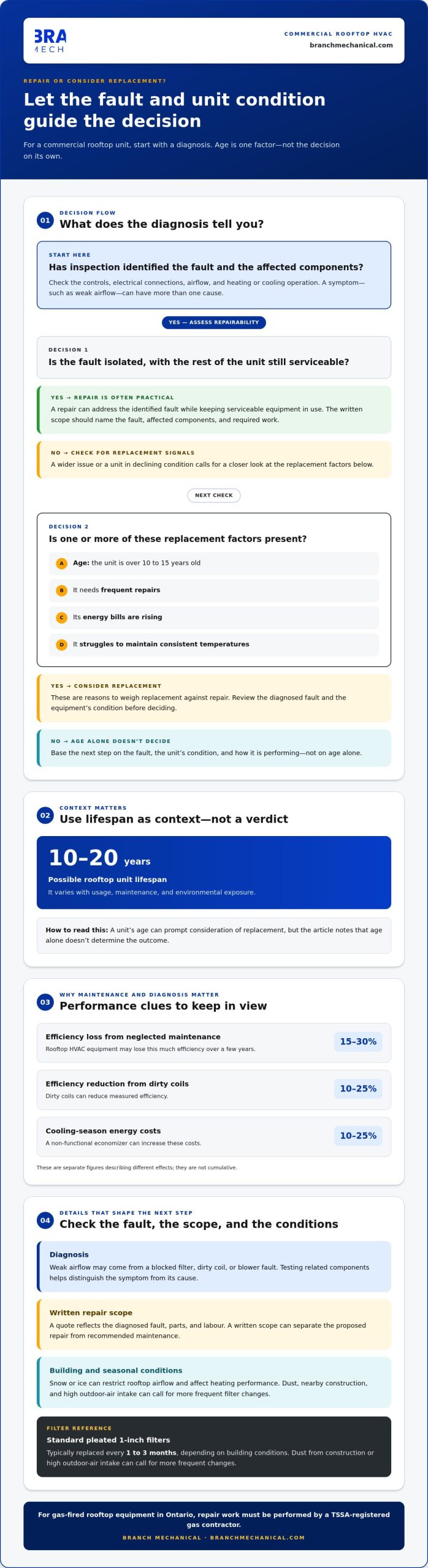
Repair is often practical when a fault is isolated and the rest of the unit remains serviceable. Consider replacement when a rooftop unit is over 10 to 15 years old, needs frequent repairs, has rising energy bills, or struggles to maintain consistent temperatures. Rooftop units can last 10 to 20 years, depending on usage, maintenance, and environmental exposure, so age alone doesn’t decide the outcome.
Neglected maintenance can affect performance across several components. Rooftop HVAC equipment may lose 15 to 30% of its efficiency over a few years, while dirty coils can reduce measured efficiency by 10 to 25%. A non-functional economizer can increase cooling-season energy costs by 10 to 25%. Seasonal inspections help identify dirty coils, worn blower components, and controls that aren’t operating as intended.
Preventive maintenance agreements can organize recurring inspections around seasonal heating and cooling needs. During a visit, technicians can inspect the commercial rooftop unit, check its filter, and look for airflow restrictions or signs of wear. Standard pleated 1-inch filters are typically replaced every 1 to 3 months, depending on building conditions. Construction dust or high outdoor-air intake can call for more frequent changes.
Pricing, Warranties, and Service Plans
For properties in Mississauga and Etobicoke, rooftop HVAC repair costs depend on the unit’s capacity, configuration, accessibility, and required work. A quote reflects the diagnosed fault, parts, and labour. Request a written scope that separates the proposed repair from recommended maintenance, and compare maintenance plans by their inspections, seasonal tasks, visit schedules, and parts and labour terms.
When choosing commercial rooftop HVAC service, look for experience with the equipment and heating system involved. In Ontario, gas-fired rooftop work must be performed by a TSSA-registered gas contractor. Review the written repair scope and applicable insurance documentation to understand the work and responsibilities covered.
Permit and code requirements depend on the work and the building systems affected. Clarify whether the repair changes equipment, gas connections, electrical controls, or other components. Work must meet applicable Ontario and municipal building and safety requirements. Gas-fired equipment requires appropriately qualified service.
Winter Problems and Prevention
Mississauga and Etobicoke winters can bring snow or ice that restricts rooftop unit airflow, affecting heating performance and putting strain on components such as the blower. Include rooftop inspections in seasonal maintenance, watch for blocked air intakes, and address buildup before it interferes with operation. A technician can check heating controls and airflow before winter demand increases.
Emergency commercial HVAC repairs in Toronto and the GTA
Critical rooftop unit failures can disrupt heating, cooling, and building operations. Emergency commercial HVAC repairs are available around the clock for critical system failures affecting businesses in Mississauga and Etobicoke.
Emergency Repair Coverage Across the GTA
Emergency commercial HVAC service addresses urgent faults in equipment such as rooftop units serving offices, warehouses, and retail buildings. A failed unit can affect indoor comfort, while an electrical fault may stop heating or cooling altogether. Note symptoms, alarm messages, and recent changes, then share them when reporting the problem.
In Ontario, gas-fired rooftop equipment must be repaired by a TSSA-registered gas contractor. A major failure involving a compressor, heat exchanger, or control board may require extensive, unplanned work. A technician assesses the affected component and whether repair or replacement is the practical next step.
Commercial Rooftop Installation and Repair
Commercial rooftop HVAC repair restores existing equipment when a fault can be isolated; replacement may be more suitable for a unit with recurring failures or declining performance. Installation planning considers the building’s heating and cooling needs, rooftop access, duct connections, electrical supply, and control compatibility. These details help match equipment to the building.
Product specifications matter during equipment selection. For example, the WeatherMaker® 48FC rooftop unit is rated up to 14.0 SEER and 15.0 IEER. The WeatherMaster® 48GE uses Puron Advance™ (R-454B) refrigerant. Review model, refrigerant, and efficiency ratings against the building’s project requirements.
RTU Diagnostics and Repair
Accurate diagnostics distinguish a symptom from its cause. A technician can check thermostat settings, control-board signals, electrical connections, airflow, and heating or cooling operation. Weak airflow, for example, may result from a blocked filter, dirty coil, or blower fault. Testing related components helps determine whether the repair should target one part or a wider system issue.
After diagnosis, the repair scope should identify the fault, affected components, and required work. For gas-fired units, use a TSSA-registered gas contractor. A specific rooftop repair might involve replacing a filter drier rather than the entire unit.
For emergency RTU repair in Mississauga or Etobicoke, share the equipment details, symptoms, and affected areas. This helps focus troubleshooting on the building’s needs.
What commercial rooftop HVAC services do you provide?
Emergency rooftop HVAC service addresses critical failures affecting commercial buildings across Toronto and the GTA. A clear report of the symptoms helps focus the repair.
Emergency Rooftop HVAC Service
Emergency service addresses critical HVAC failures that interrupt heating, cooling, or building operations. A rooftop unit that stops heating can affect comfort in an occupied workplace, while cooling failure can disrupt retail operations. Emergency commercial mechanical service can also address critical refrigeration and electrical failures that threaten business continuity.
For a rooftop HVAC problem, note the affected area, temperature changes, unusual sounds, and any fault message on the display. Share the unit’s make and model if available. These details describe the problem clearly and help guide diagnosis.
Emergency RTU Repair Response
Emergency RTU repair begins by identifying what has stopped working and how the failure affects the building. A technician can inspect the unit’s operating condition, controls, airflow, and electrical components, then identify the fault and required repair. For example, if a blower won’t run, the technician checks its motor and electrical supply rather than assuming the entire unit needs replacement.
Useful information to gather before reporting a failure includes:
- The rooftop unit’s location and equipment identification details.
- Whether heating, cooling, or both have stopped.
- Any thermostat message, control alarm, or change in system behaviour.
- Whether the problem affects one area or multiple building zones.
These observations help distinguish a local comfort issue from a wider commercial HVAC problem. Keep staff away from equipment that appears damaged, and don’t open electrical panels or attempt rooftop repairs without appropriate training.
24/7 Emergency Dispatch
24/7 emergency dispatch provides a way to report critical mechanical failures outside regular business hours, including overnight or weekend disruptions. For a commercial rooftop unit, describe the immediate impact, such as lost heating in an occupied building or a failed system affecting business operations. Clear details help dispatch understand the nature of the request.
Emergency support is for critical failures, not routine filter changes or planned seasonal inspections. If a rooftop HVAC system is still running but performing poorly, record the symptoms and arrange repair service. If the unit has stopped and building operations are affected, report the failure as an emergency, including its location and equipment details.
For rooftop HVAC failures in Toronto, a structured report helps connect the problem to the right equipment and repair work. Share what changed, when the issue began, and which areas are affected. This gives the service team practical starting points for diagnosis.
What are the most common commercial rooftop unit problems?
Commercial rooftop units can develop heating, cooling, airflow, refrigerant, and electrical faults. Tracking when symptoms occur helps technicians narrow the diagnosis and reduce avoidable downtime.
Heating Failures
A rooftop unit that runs without warming the space may have a heating component or control problem. Note whether the blower starts, whether the thermostat calls for heat, and whether the problem affects one zone or the whole building. These observations help distinguish a unit-wide failure from a localized comfort complaint.
For gas-fired equipment, a technician can inspect the heating sequence and related controls. A failure to start, repeated shutdowns, and uneven heating can have different causes, so don’t assume every cold space has the same fault. Record the affected rooms and any control messages before arranging service.
Cooling Failures
Cooling problems may show up as warm supply air, weak airflow, or uneven room temperatures. A refrigerant leak, dirty coil, compressor problem, or fan motor failure can affect cooling. The symptom alone doesn’t identify the failed component, so diagnosis should include the unit’s operation and the condition of related parts.
Compare the thermostat setting with the conditions in the affected area, then note whether the rooftop unit continues running. A dirty or clogged coil can reduce measured equipment efficiency by 10 to 25%. Keeping a record of recurring cooling issues can help identify patterns, such as a fault that returns after the unit cycles.
Heating and Cooling Faults
Some rooftop unit problems affect both heating and cooling. Snow or ice restricting airflow, a failed fan motor, dirty coils, and electrical control issues are common examples. Temperatures can vary even when the unit appears to be running, because airflow and controls affect how conditioned air reaches occupied areas.
Start with safe observations, not component repairs. Check for a thermostat alert, note unusual sounds, and identify which rooms have changed. Don’t open electrical panels or handle refrigerant. A technician can use these details to assess the blower, controls, coils, and refrigerant circuit, then identify the fault.
When reporting a failure, separate symptoms from causes. “The west-side rooms are warm” describes the impact; “the compressor has failed” is a diagnosis that requires inspection. Clear descriptions help focus service on the affected equipment and areas. Prompt attention to a new airflow or temperature change can also help prevent an operating problem from causing extended downtime.
Blower motor and compressor repairs
A blower motor and a compressor perform different jobs in a commercial rooftop unit. The blower moves conditioned air through the building; the compressor supports the cooling cycle. If either stops working properly, technicians diagnose the fault before recommending repair or replacement. The unit’s symptoms, electrical readings, and component condition guide that decision.
Blower motor diagnosis and repair
A blower problem may cause weak airflow, uneven temperatures, unusual noise, or a fan that won’t run. Restricted airflow, a control fault, or an electrical issue can produce similar symptoms. Technicians inspect the motor and related components to determine whether the fault is limited to the motor or involves another part of the system.
Describe what happens when the rooftop unit starts. Does the fan run continuously, stop intermittently, or fail to start? Note which areas of the commercial building are affected and whether the problem changes during operation. These observations help technicians compare the reported symptoms with the unit’s behaviour during diagnosis. Don’t open electrical panels or attempt to repair rooftop equipment yourself.
After identifying the failed component, technicians can explain the repair scope and how it relates to the unit’s condition. Replacing a damaged motor won’t resolve a separate control or airflow problem. Clear diagnosis matters: replacing a part without addressing the underlying fault can leave the original operating issue unresolved.
Compressor diagnosis and repair
A compressor fault can interrupt cooling and affect rooftop unit operation. Diagnosis includes checking the compressor, its electrical supply, controls, and cooling circuit. A cooling problem alone doesn’t prove the compressor has failed. Technicians use operating symptoms and component checks to distinguish compressor failure from other faults with similar effects.
A documented York rooftop HVAC repair at Yorkdale Mall involved a failed 3-ton, 3-phase, 575-volt compressor. These specifications illustrate why technicians need the unit’s model and component details before selecting a replacement part. Capacity, phase, and voltage must match the equipment requirements. The example is specific to that repair, not a specification for every commercial rooftop unit.
Once a compressor fault is diagnosed, the repair plan should identify the failed component and explain the proposed work. The unit’s age, maintenance history, frequency of previous failures, and overall condition can inform a repair-versus-replacement decision. A technician can also assess whether related components need attention before the equipment returns to operation.
For a diagnosed blower or compressor issue, arrange commercial HVAC service to address the rooftop unit’s specific fault.
Branch Mechanical: Commercial & Multi-Residential Mechanical Contracting
Branch Mechanical provides commercial HVAC installation and service for businesses with rooftop units that need diagnosis, repair, or planned equipment work. If performance is declining or recurring faults are disrupting operations, commercial HVAC service can address the equipment issue and assess next steps.
Branch Mechanical also offers preventative maintenance contracts to support ongoing equipment care. Scheduled maintenance can help identify developing concerns, support seasonal inspections, and organize service needs across a commercial property. For buildings with heating-system issues, Branch Mechanical provides commercial boiler and heating system service as part of its mechanical contracting work.
Contact Branch Mechanical to discuss commercial rooftop HVAC service or maintenance for your building.
Plan the next step for your rooftop system
A useful repair request starts with a clear picture of the building’s needs. Before arranging rooftop unit repair in Toronto, record the equipment identifier, affected areas, and what staff noticed before performance changed. Include any control messages and note whether the issue is constant or intermittent. These details give the service conversation a practical starting point.
Consider how the unit supports daily operations. Note which spaces depend on it, whether the problem affects comfort or business activity, and any access information for the rooftop equipment. With these details ready, you can explain the issue and its impact and plan an appropriate next step for the building.
Branch Mechanical works with commercial and multi-residential properties on mechanical needs. Contact Branch Mechanical about your rooftop unit to discuss the equipment concern and move toward a clear service plan.
Frequently Asked Questions
Do you provide emergency commercial RTU repair?
Yes. Branch Mechanical provides 24/7 emergency mechanical services for critical HVAC failures, including commercial RTU problems. Businesses in Mississauga and Etobicoke can contact the team when a rooftop unit failure disrupts operations. Share the building address, unit location, affected areas, and any controller alert. Mention whether the unit has stopped completely or still operates intermittently. These details communicate the fault and its impact when arranging emergency support.
What should I do if my rooftop unit is making unusual noises?
Note the sound and when it occurs, then arrange a professional inspection if it persists or changes. A sharp squeal, repeated rattle, or heavy vibration can help a technician narrow down which part needs attention. Record whether the noise starts with the fan, continues during operation, or occurs only during heating or cooling. Don’t climb onto the roof or open equipment panels to investigate. If you notice smoke or a burning smell, keep people clear and report it promptly.
Why does my rooftop HVAC unit keep turning on and off?
Repeated cycling can result from a thermostat signal, control fault, restricted airflow, or heating or cooling component that stops working properly. Check the thermostat schedule and note whether cycling affects one zone or the whole building. Record any alert and how long the unit runs before stopping. Frequent resets can obscure the pattern, so avoid repeatedly restarting the equipment. A service technician can test the controls and operating sequence to identify the cause.
Why is my commercial RTU blowing cold air when it should be heating?
A heating call that produces cold air may point to incorrect thermostat settings, a control-sequence problem, or a fault in the heating section. Check that the thermostat is set to heat and its schedule hasn’t changed. Note whether the blower runs without warm air or the unit stops shortly after starting. For gas-fired equipment, leave internal checks and adjustments to a qualified technician. Include the unit’s model and any fault message in the service request.
Why is there weak airflow from my commercial HVAC system?
Weak airflow may result from a blocked supply or return, dirty filter, blower issue, or control problem. Compare airflow in several rooms and note whether the change affects one area or the whole building. Check accessible grilles for obvious obstructions, but don’t remove rooftop panels or reach into equipment. Tell the technician whether airflow declined gradually or dropped suddenly. This can help narrow the inspection to distribution, filtration, or the unit itself.
What types of rooftop unit (RTU) repairs are common in Toronto?
Common commercial RTU repairs address blower motors, compressors, refrigerant leaks, clogged coils, electrical controls, and airflow restrictions. The repair depends on the diagnosed component, not just the symptom. Poor cooling, for example, may involve a refrigerant circuit or fan, while a control fault can affect the operating sequence. In Toronto, winter snow or ice can also restrict airflow. A technician assesses the equipment before recommending a repair.
What are the signs a rooftop HVAC unit needs repair?
Arrange an inspection if the unit repeatedly fails to start, makes unusual sounds, or leaves occupied areas at inconsistent temperatures. Other warning signs include visible damage, a persistent control alert, water around the equipment, or a sudden change in operation. Record when each symptom occurs and which rooms are affected. A pattern, such as problems starting only during a heating call, gives a technician useful diagnostic context.
What is the average cost of rooftop unit repair in Toronto?
There’s no single useful average for rooftop unit repair in Toronto. The price depends on the fault, and a quote reflects factors such as the component involved, parts required, unit configuration, roof access, and labour. A control adjustment differs from replacing a major component, so diagnosis and repair scope shape the quote. Ask for a written description of the work and included parts to understand what the proposed repair covers.