
A TSSA red tag in the middle of a January cold snap isn’t just a mechanical failure; it’s a direct threat to your facility’s operational continuity and your bottom line. While many property managers view annual service as a simple line-item expense, the most successful leaders in the GTA treat commercial boiler maintenance Etobicoke as a strategic insurance policy. When temperatures drop and the wind picks up off Lake Ontario, your heating system shouldn’t be a source of constant anxiety.
We understand that managing aging hydronic systems while keeping up with the 2026 Ontario Fire Code updates for carbon monoxide alarms can feel like a moving target. You want to ensure your tenants stay warm and your equipment lasts for decades without facing regulatory fines or staggering emergency repair bills. This guide outlines the exact steps to maintain your commercial boiler system for peak performance. We’ll cover TSSA compliance, the impact of the 90% thermal efficiency mandate on your future replacements, and the proactive preventative measures that help extend equipment life well beyond the 20-year mark.
Key Takeaways
- Protect your bottom line by identifying the specific risks of winter downtime and why proactive commercial boiler maintenance Etobicoke is your best defense against emergency repair costs.
- Learn the technical essentials of a professional maintenance routine, from heat exchanger inspections to burner calibration for maximum fuel efficiency.
- Navigate the complexities of TSSA inspections and the 2026 Ontario Fire Code updates to keep your building compliant and your tenants safe.
- Master the criteria for the “Maintain, Retube, or Replace” decision to optimize your capital expenditure and extend the lifespan of your mechanical assets.
- Discover how a preventative maintenance contract provides a 24/7 safety net and ensures your system is stabilized long before the first GTA frost.
Why Commercial Boiler Maintenance in Etobicoke is a Business Necessity
Reliability is the foundation of effective facility management. In Etobicoke’s industrial corridors and residential hubs, a heating failure is more than an inconvenience; it’s a financial drain. When a system goes offline, costs accumulate quickly through lost productivity in warehouses or emergency relocation fees for tenants. Investing in professional commercial boiler maintenance Etobicoke shifts your strategy from reactive crisis management to proactive asset protection. It’s about ensuring that the heart of your building operates without interruption when it’s needed most.
Precision tuning directly impacts your bottom line by reducing gas consumption. Even a minor misalignment in the fuel-to-air ratio can spike utility bills significantly over a single season. Since the 2025 federal mandate now requires new commercial boilers to meet a 90% thermal efficiency standard, maintaining your current equipment is the most cost-effective way to delay high-capital replacements. Beyond fuel savings, routine service mitigates the risk of catastrophic failures. A basic understanding of What is a Boiler? reveals it is a complex pressure vessel; without regular checks, small leaks can evolve into property-damaging floods or safety hazards. Modern energy management also relies on this data. Integrating your boiler’s performance with Building Automation Systems (BAS) allows for real-time adjustments that stabilize the entire building environment.
The Etobicoke Winter Factor
The Greater Toronto Area is known for extreme temperature swings that put immense stress on commercial hydronic systems. A mild afternoon can quickly turn into a -20°C night, forcing boilers to ramp up to peak capacity instantly. This thermal shock often exposes underlying weaknesses in seals and valves. Scheduling maintenance during the “shoulder season” in September is critical. It ensures your system is stabilized and calibrated before the first deep freeze, preventing the high cost of emergency calls when every technician in the GTA is already booked. Proactive preparation allows your facility to handle peak demand without the risk of a lockout.
Extending Equipment Lifespan in Multi-Residential Settings
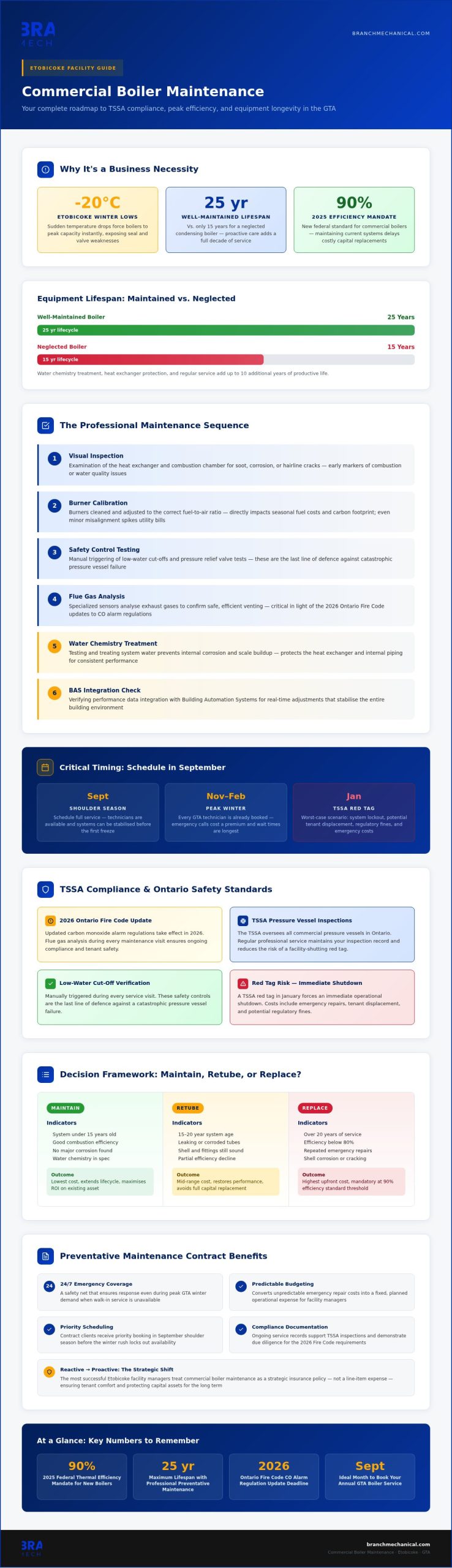
In large-scale multi-residential buildings, boilers represent significant capital investments. While a neglected condensing boiler might only last 15 years, a well-maintained system can reach a 25-year lifecycle. The key often lies in water chemistry. Regular service includes testing and treating the system water to prevent internal corrosion and scale buildup. By protecting the heat exchanger and internal piping, you ensure consistent performance for tenants while deferring the massive expense of a full system overhaul. This methodical approach turns a potential liability into a long-term, predictable asset.
A Step-by-Step Guide to Commercial Boiler Preventative Maintenance
Understanding the technical sequence of commercial boiler maintenance Etobicoke helps facility managers verify that their service providers are performing a truly comprehensive review. A professional maintenance visit is a methodical process designed to catch minor component wear before it leads to a total system lockout during a GTA cold snap. Following a structured approach ensures that every safety and efficiency metric is met according to Ontario standards.
- Step 1: Visual Inspection – Technicians begin by examining the heat exchanger and combustion chamber for signs of soot, corrosion, or hairline cracks. These physical markers often signal underlying issues with combustion or water quality.
- Step 2: Burner Calibration – Burners must be cleaned and adjusted to maintain the correct fuel-to-air ratio. Precise calibration is essential for Commercial Boiler Preventative Maintenance as it directly impacts your seasonal fuel costs and carbon footprint.
- Step 3: Safety Control Testing – This involves manually triggering low-water cut-offs and testing pressure relief valves. These components are the last line of defense against catastrophic pressure vessel failure.
- Step 4: Flue Gas Analysis – Technicians use specialized sensors to analyze exhaust gases. This ensures the boiler is venting safely and efficiently, which is particularly critical given the 2026 updates to carbon monoxide alarm regulations.
- Step 5: Documentation – Every adjustment is recorded in the on-site maintenance log. TSSA inspectors prioritize these logs during their audits to confirm the building is in full compliance with Ontario Regulation 220/01.
If your current records are incomplete or you haven’t had a combustion analysis recently, it may be time to schedule a professional system review to establish a reliable baseline for the season.
Mechanical Components to Prioritize
Beyond the burner, the auxiliary mechanical components require close attention. Circulating pumps and expansion tanks should be checked for leaks or signs of bearing wear. In modern high-efficiency condensing units, the condensate trap and neutralizer are high-priority items. Because the liquid produced is acidic, a clogged trap or an exhausted neutralizer can lead to internal component damage or the corrosion of building drain lines. Technicians also verify gas line connections and pressure regulators to ensure they meet current gas fitting standards.
Electrical and Control System Calibration
Reliability often depends on the “brain” of the system. Technicians test the integration between the boiler and the Building Automation System (BAS) to ensure they are communicating accurately. This includes verifying sensor accuracy and thermostat response times. Electrical panels are inspected for oxidation or loose wiring caused by vibration. Proper electrical maintenance prevents nuisance tripping and ensures that the boiler’s modulation logic is operating as intended for maximum energy conservation.
Navigating TSSA Compliance and Ontario Safety Standards
In Ontario, the Technical Standards and Safety Authority (TSSA) is the primary regulator for all boilers and pressure vessels. For facility managers, staying ahead of these requirements isn’t just about safety; it’s about legal protection. Under Ontario Regulation 220/01, your equipment must be inspected and maintained according to specific cycles. This includes strict adherence to CSA B149.1, the Natural Gas and Propane Installation Code. When you schedule commercial boiler maintenance Etobicoke, your technician ensures that every component, from the venting to the gas piping, aligns with these provincial standards.
During a TSSA inspection, the inspector looks for proof of routine maintenance and safe operation. They verify that safety controls function correctly and that the mechanical room meets ventilation requirements. If a deficiency is found, the inspector may issue a “Red Tag.” A Type A red tag requires an immediate shut-off because of an imminent hazard. A Type B red tag gives you a set window, usually 45 days, to resolve the issue before the gas is disconnected. Proactive service is the only reliable way to avoid these operational disruptions and the associated fines. It’s also vital to account for the 2026 updates to the Ontario Fire Code, which mandate stricter carbon monoxide alarm placements in buildings with fuel-burning appliances.
Mandatory Documentation and Record-Keeping
Compliance relies heavily on your paper trail. TSSA regulations require a dedicated boiler room logbook that stays on-site. This isn’t just a suggestion; it’s a mandatory record of all tests, inspections, and repairs. You must also ensure that gas permits are filed for any major modifications or equipment replacements. Keeping a clean file of TSSA inspection certificates and technician sign-offs allows you to demonstrate due diligence instantly if an inspector arrives unannounced. This organized approach proves that your facility is managed with a focus on stability and safety.
Certified Gas Contractor Requirements
Legally, all work on fuel-burning equipment in Ontario must be performed by a TSSA-certified mechanical contractor. Hiring a “general” contractor for gas fitting or boiler repair is a significant liability risk. Before any work begins, verify that the company holds a valid TSSA registration number and that the individual technicians carry the appropriate gas technician license. This certification ensures the person working on your system understands the complexities of high-pressure steam or high-efficiency hydronic heating. It also protects your building insurance, as many policies are voided if non-certified personnel handle specialized mechanical systems.
Evaluating Your System: When to Maintain, Retube, or Replace
Facility managers in the GTA often face a difficult decision as their heating infrastructure ages. Determining whether to continue with routine commercial boiler maintenance Etobicoke or to commit to a major capital expenditure requires a methodical evaluation of the system’s current state. Most boilers move through three distinct lifecycle phases, and identifying which phase your equipment is in will prevent you from “throwing good money after bad.”
The “Maintain” phase is appropriate for systems under 15 years old where the pressure vessel and heat exchanger remain structurally sound. In this stage, replacing consumables like igniters, gaskets, and sensors is sufficient to keep the unit reliable. However, for older fire-tube or water-tube boilers, you may enter the “Retube” phase. Retubing involves replacing the internal tubes while retaining the existing boiler shell. This process can often be completed for a fraction of the cost of a full replacement, effectively resetting the clock on a robust cast-iron or steel vessel for another decade of service. It is a highly effective middle ground that many competitors overlook.
The “Replace” phase becomes the logical choice when a system requires frequent, expensive repairs or when the efficiency gains of new technology justify the ROI. With the 2025 federal mandate requiring a minimum 90% thermal efficiency for new installations, moving from an old 80% efficient unit to a 95% AFUE condensing model can reduce seasonal fuel consumption by nearly 20%. When analyzing the ROI, factor in the reduced frequency of emergency service calls and the long-term energy savings that a modern, modulating system provides.
Signs Your Boiler Needs More Than Just Maintenance
Routine service can mask deep-seated issues for only so long. Persistent leaks from the boiler vessel or heat exchanger are clear indicators of structural fatigue that gaskets cannot fix. If your facility experiences frequent “lockouts” or safety control failures that disrupt building heat, the internal components may be reaching the end of their reliable life. Additionally, visible signs of heavy scale build-up or internal corrosion during a visual inspection suggest that the heat transfer efficiency has been permanently compromised, leading to higher stress on the metal and eventual failure.
The Advantage of High-Efficiency Condensing Boilers
Modern condensing units are engineered to handle the fluctuating demands of large Etobicoke facilities with precision. Unlike older “on-off” boilers, these units modulate their output to match the building’s real-time heat load, significantly lowering operating costs. GTA businesses should also investigate “Save On Energy” rebates, which offer financial incentives for upgrading to high-efficiency mechanical equipment. Beyond the financial benefits, these low-emission systems align with modern sustainability goals by reducing the overall environmental impact of your building’s operations.
If you are unsure whether your system is a candidate for retubing or if a full upgrade is necessary, request a comprehensive system assessment to evaluate your best path forward with a detailed ROI analysis.
Why a Preventative Maintenance Contract is Your Best Strategy
For facility managers, the difference between a smooth winter and a season of crisis often comes down to a single agreement. A professional service contract transforms commercial boiler maintenance Etobicoke from a reactive chore into a managed business process. Instead of scrambling to find a technician during a record-breaking freeze, you gain the stability of a partner who already knows your mechanical room’s history and specific requirements. It’s about moving away from “break-fix” thinking toward a model of continuous reliability.
One of the most significant advantages is the 24/7 emergency mechanical services safety net. When a system fails at 2:00 AM, contract holders aren’t lost in the queue behind hundreds of other callers. You receive priority response, ensuring that your tenants or operations remain heated even during peak demand periods across the GTA. Scheduled service also ensures that all critical tuning and safety checks happen well before the first frost. This allows you to enter the heating season with complete confidence. Whether you manage a high-turnover restaurant, a temperature-sensitive warehouse, or a large multi-residential complex, these plans are customized to your facility’s unique load and equipment type.
What a Comprehensive Branch Mechanical Contract Includes
Our approach is methodical and thorough. Every agreement is built around the specific needs of your building’s infrastructure to ensure long-term durability. A typical contract includes:
- Regular multi-point inspections: We perform seasonal tuning to optimize fuel-to-air ratios and verify all safety controls.
- Broad emergency support: Beyond the boiler, we provide 24/7 coverage for your commercial HVAC, refrigeration, and plumbing systems.
- Strategic energy advice: We offer expert guidance on Building Automation Systems (BAS) and energy management upgrades to lower long-term operating costs.
Taking the Next Step for Your Etobicoke Facility
Securing your building starts with a clear understanding of your current system’s health. You can request a comprehensive mechanical system audit to identify hidden inefficiencies or potential TSSA compliance gaps. Following the audit, we set up a consultation to review your boiler’s performance and discuss a plan that aligns with your capital budget. By choosing a Preventative Maintenance Contract from Branch Mechanical, you aren’t just buying repairs; you’re investing in the long-term stability and safety of your GTA property. This proactive step ensures that your facility remains operational, compliant, and efficient through 2026 and beyond.
Securing Your Building’s Operational Future
Effective facility management relies on predictability and the elimination of mechanical surprises. By prioritizing commercial boiler maintenance Etobicoke, you aren’t just checking a box; you’re safeguarding your tenants and your budget against the volatility of GTA winters. We’ve explored how methodical tuning, TSSA compliance, and strategic retubing can extend your system’s life well beyond industry averages.
Branch Mechanical has been serving the GTA since 2012, providing the technical expertise required to manage complex hydronic systems. Our TSSA Certified Gas Contractors deliver the precision needed to meet 2026 safety standards, while our 24/7 emergency support acts as your ultimate safety net. Don’t wait for a red tag or a mid-winter lockout to address your heating infrastructure.
Taking a proactive stance today ensures a stable and efficient building for years to come. Request a Professional Boiler Maintenance Quote in Etobicoke to stabilize your facility before the next deep freeze.
Frequently Asked Questions
How often should a commercial boiler be serviced in Ontario?
Commercial boilers in Ontario must be serviced at least once per year to comply with TSSA Regulation 220/01. For high-demand facilities in Etobicoke, semi-annual checks are often recommended to ensure reliability during extreme temperature swings. Scheduling your commercial boiler maintenance Etobicoke in early autumn allows technicians to identify worn gaskets or failing sensors before the heating season begins. Consistent servicing is the most effective way to prevent the “Red Tags” that disrupt building operations.
What is the average cost of commercial boiler maintenance in Etobicoke?
The cost of maintenance depends on the size, age, and type of your system. Because industrial warehouses have different requirements than multi-residential buildings, we provide customized pricing after an on-site assessment. Factors like the number of boilers in your plant and the complexity of your Building Automation System (BAS) integration will influence the final rate. Investing in a structured plan is a cost-effective alternative to the high expense of emergency repairs during a GTA cold snap.
Why is my commercial boiler making a loud banging or “kettling” noise?
A loud banging or “kettling” sound usually indicates scale buildup on the heat exchanger or restricted water flow. When minerals accumulate, they create hot spots that cause water to boil localized and turn into steam bubbles. This creates pressure shocks that stress the metal components. If you hear these noises, it’s a sign that your system’s water chemistry needs immediate attention. Ignoring this issue can lead to premature heat exchanger failure and expensive capital replacements.
Can I perform any boiler maintenance tasks myself as a property manager?
Property managers should limit their involvement to visual inspections and maintaining the mandatory on-site logbook. You can check for visible leaks, monitor pressure gauges, and ensure the mechanical room is clear of debris. However, all mechanical repairs, gas fitting, or control calibrations must be performed by a TSSA-certified contractor. Handling these tasks yourself isn’t just dangerous; it can void your building’s insurance and lead to significant provincial fines for non-compliance with Ontario safety codes.
What is a TSSA Red Tag, and how do I get it removed?
A TSSA Red Tag is a formal notice that your equipment is non-compliant or hazardous. A Type A tag requires an immediate gas shut-off, while a Type B tag gives you a set window to resolve the issue. To remove a tag, a licensed technician must repair the deficiency, sign the tag to certify the work, and return the documentation to the gas utility. Proactive commercial boiler maintenance Etobicoke is the best strategy to prevent these tags before they cause a shutdown.
How long does a typical commercial boiler maintenance visit take?
A standard preventative maintenance visit for a single commercial boiler typically takes between two and four hours. If your facility uses a multi-boiler plant or complex modulating controls, the process may take longer to ensure every sensor is calibrated correctly. During this time, our technicians perform combustion analysis and safety valve testing without necessarily shutting down the entire building’s heat. We work methodically to minimize any disruption to your tenants or daily business operations.
Does my boiler maintenance contract cover emergency 24/7 repairs?
Yes, Branch Mechanical provides 24/7 emergency mechanical services as a core part of our preventative maintenance contracts. While we focus on preventing failures before they happen, we understand that mechanical issues can occur at any time. Contract holders receive priority response, which is a critical advantage during peak Etobicoke winters when service demand is highest. This ensures you aren’t left waiting in a long queue while your building’s temperature drops and pipes risk freezing.
What is the difference between a hot water boiler and a steam boiler maintenance routine?
Steam boilers require more intensive monitoring of water levels and frequent “blowdowns” to remove sludge and sediment from the vessel. Their safety controls and low-water cut-offs are under higher stress and need rigorous testing. Hot water (hydronic) boilers focus more on circulating pumps, expansion tanks, and maintaining proper system pressure. While the heat source is similar, the distribution mechanics differ significantly, requiring specialized knowledge of both high-pressure steam and modern hydronic modulation techniques.