
What separates the safest refrigeration contractors from those making the biggest promises? Look for a clear approach to managing risk, planning work and communicating about disruptions. A refrigeration failure can put temperature-sensitive stock, daily operations and customer confidence at risk, so choosing a service partner calls for more than a reassuring slogan.
Before selecting a contractor, compare how the proposed service fits your equipment and operating needs. Ask how work will be planned around staff and customers, what information you’ll receive after a visit, and how maintenance and urgent service fit into your facility’s plan. A structured assessment makes those differences easier to evaluate.
This guide explains how to assess contractor safety, plan for refrigeration continuity and identify maintenance needs before they become urgent. It also covers practical considerations for commercial facilities in Mississauga, Etobicoke and the wider Greater Toronto Area. Branch Mechanical provides commercial refrigeration service, preventative maintenance contracts and 24/7 emergency mechanical services for commercial and multi-residential clients.
Key Takeaways
- Assess the safest refrigeration contractors by looking for clear risk controls, practical work planning and communication that supports continuity.
- Compare service scope, maintenance planning, emergency support and documentation against your facility’s needs.
- Identify critical refrigeration equipment and assign clear escalation roles before a failure disrupts operations.
- Use preventative maintenance to support equipment reliability and identify service needs, without assuming it can prevent every breakdown.
- Build a practical plan around your GTA facility, whether it is in Mississauga, Etobicoke or elsewhere in the region.
Why refrigeration contractor safety matters to commercial operations
Commercial refrigeration safety extends beyond the technician’s immediate work area. It includes protecting staff and customers, working carefully around equipment, handling refrigerants responsibly and preserving temperature control while service is underway. A contractor’s plan should consider how the work could affect nearby operations, not just how to complete the repair.
A safety-focused refrigeration contractor plans and communicates work to manage risks to people, equipment, refrigerant systems and temperature-sensitive stock. That approach can reduce avoidable disruption, but it can’t guarantee that equipment failures or incidents will never occur. The value lies in identifying foreseeable risks, setting sensible controls and keeping facility staff informed.
Understanding the equipment helps put those controls in context. Many commercial systems use a vapor-compression refrigeration cycle, which moves heat through components operating under different pressure conditions. Service work needs to reflect the actual system and site conditions. Broad claims such as “safety first” tell buyers less than a clear explanation of the planned tasks, work-area controls and communication during service.
What does a safety-focused refrigeration contractor do?
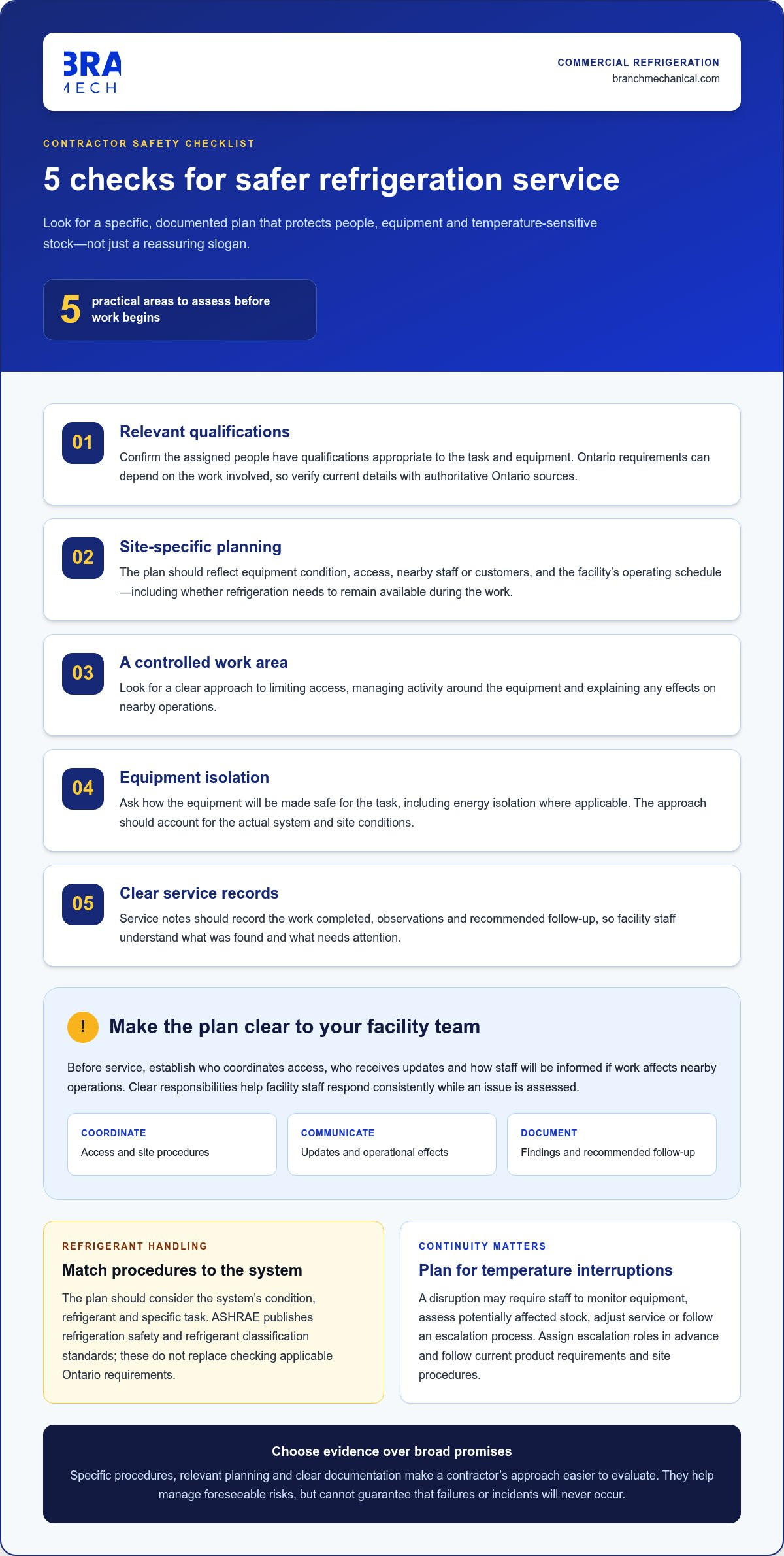
A contractor should identify site-specific hazards, establish a controlled work area and communicate the work plan to the people responsible for the facility. The plan needs to account for equipment access, nearby activity and operating conditions, including whether refrigeration must remain available during the work. These are practical evaluation points, not proof that every risk can be eliminated.
Look for documented procedures and clear explanations of responsibilities. For example, confirm who will coordinate access, who will receive updates and how staff will be informed if work affects nearby operations. A slogan alone doesn’t answer those questions.
How refrigeration issues can affect product and business continuity
A temperature-control interruption can require operational decisions. Staff may need to monitor equipment, assess potentially affected stock, adjust service or follow an established escalation process. Priorities vary by site: a restaurant may need to coordinate food storage with kitchen service; a retailer may focus on chilled displays and customer access; a warehouse may need to consider inventory across larger storage areas.
Food-temperature requirements depend on the product and applicable guidance. Follow current requirements and site procedures rather than relying on a general threshold. Assigning escalation roles in advance helps staff respond consistently while the refrigeration issue is assessed.
The safety practices to evaluate in a commercial refrigeration contractor
Look beyond general assurances. A credible safety process is specific, documented and relevant to the site. For commercial buyers, that means understanding how the work will be planned, how people and equipment will be protected, and how findings will be recorded.
Use this checklist to assess the process:
- Relevant qualifications: Confirm that the people assigned have qualifications appropriate to the work. Ontario trade and regulatory requirements can depend on the task and equipment. Verify current details against authoritative Ontario sources before relying on a particular credential or rule.
- Site-specific planning: The work plan should reflect equipment condition, access, nearby staff or customers, and the facility’s operating schedule.
- Controlled work area: Look for a clear approach to limiting access and explaining any effects on nearby operations.
- Equipment isolation: The plan should address how equipment will be made safe for the task, including energy isolation where applicable.
- Clear records: Service notes should describe the work completed, observations and recommended follow-up.
Qualifications, site procedures and clear accountability
Qualifications matter because refrigeration tasks can involve different equipment and hazards. A site review should identify relevant conditions and coordinate the work with facility operations. Confirm who needs updates and who is responsible for decisions that affect the system. Useful records give facility staff a clear account of what was found and what needs attention, rather than leaving responsibilities unclear after the visit.
Refrigerant and equipment handling in context
Refrigerant handling is a technical safety consideration. The work plan should account for the system’s condition, the refrigerant involved and the specific task, rather than treating every service call the same way. ASHRAE publishes ASHRAE safety standards covering refrigeration safety and refrigerant classification. These standards are not a substitute for checking applicable Ontario requirements.
When comparing the safest refrigeration contractors, give more weight to concrete procedures and clear documentation than to broad marketing claims. Branch Mechanical provides commercial refrigeration service in Mississauga and across the GTA, along with preventative maintenance contracts for planned equipment care. Explore commercial refrigeration service as part of a facility-specific service plan.
How to compare refrigeration contractors for your GTA facility
Compare service plans against your equipment and operating priorities, not just a list of services. A restaurant may need work coordinated with kitchen operations. A retailer may prioritize chilled displays and customer access, while a warehouse may focus on storage capacity and clear escalation steps. The right scope depends on the facility: installation, repair and planned maintenance are different needs, not a one-size-fits-all package.
Use this framework to organize your comparison:
| Criterion | What to compare | Facility relevance |
|---|---|---|
| Service scope | Whether the proposed work addresses your system’s current needs, such as installation, repair or maintenance | Restaurants may need coordination with kitchen operations; warehouses may focus on larger storage systems. |
| Preventative maintenance | How planned visits and identified service needs are documented | Useful for sites that need a consistent view of equipment condition and follow-up. |
| Emergency service | How urgent service needs are handled and communicated | Consider how disruptions affect stock, customer service or facility operations. |
| Communication | Who receives updates and how work-related impacts are explained | Retail sites may need staff coordination around public areas; warehouses may need clear operational handoffs. |
| Documentation | Whether records describe completed work, observations and recommended follow-up | Helps facility teams track equipment needs over time. |
Match service scope to the refrigeration system and facility
Start with the need at hand. A new system, an equipment issue and ongoing upkeep call for different scopes of work. If refrigeration is one part of a broader building plan, coordinating it with other mechanical needs can make planning clearer. Learn more about commercial refrigeration systems and the considerations involved in selecting support for a facility.
Compare communication, records and continuity support
Planned maintenance and emergency service serve different purposes. Maintenance supports equipment reliability and helps identify service needs; emergency mechanical service supports continuity when an urgent issue arises. Compare how each plan communicates findings, completed work and recommended next steps. For ammonia refrigeration, OSHA’s safety standards for refrigeration systems offer a US workplace-safety reference, not a statement of Ontario requirements.
Local service is also a practical consideration for ongoing support. Branch Mechanical serves commercial and multi-residential clients in Mississauga and Etobicoke, as well as across the GTA. If refrigeration service needs to fit into wider facility planning, explore expert mechanical contractors in Mississauga and the GTA.
Plan refrigeration maintenance and emergency response before a failure
A written plan gives staff a clear next step when refrigeration performance changes. It also helps maintenance focus on equipment that matters most to daily operations. Preventative maintenance can support reliability and identify service needs, but it can’t guarantee that breakdowns won’t occur.
Set up your readiness plan in a few practical steps:
- Identify critical equipment. Record each unit’s location, what it supports and which products or operations depend on it. Note equipment where an interruption would have the greatest operational impact.
- Set a baseline. Keep available service records and note normal operating observations so staff can recognize and report changes.
- Define staff roles. Name who receives reports, who assesses operational impacts and who coordinates service. Make sure responsibilities are known across relevant shifts.
- Agree on escalation steps. Document who to notify, what information to provide and how staff should manage affected operations while the issue is assessed.
- Review the plan. Update equipment details, contacts and procedures when systems or facility priorities change.
Build a preventative maintenance plan around operating needs
Planned service should reflect the refrigeration equipment, how the site uses it and which operations depend on it. Keep records of completed work, observations and recommended follow-up. Over time, those records help facility teams spot recurring concerns and make informed maintenance decisions. If your site uses building automation, include relevant system information in the service plan. Branch Mechanical also provides building automation and energy management services for commercial facilities.
Prepare a calm, clear response to refrigeration trouble
Staff can report what they observe without attempting technical repairs. Ask them to record:
- Which unit or area appears affected
- What they noticed, such as an unusual sound, visible leak or change in displayed operating information
- When the issue began, if known, and whether it has changed
- What operations or stock may be affected
Branch Mechanical provides 24/7 emergency mechanical services alongside commercial refrigeration service and preventative maintenance. This gives GTA facilities a service option for urgent mechanical needs as well as planned equipment care. To discuss refrigeration support for your facility, contact Branch Mechanical.
How Branch Mechanical supports safer refrigeration service in the GTA
Refrigeration support works best when it reflects how a facility operates. A restaurant may need service planning that accounts for kitchen activity, while a multi-residential property may have different equipment priorities and coordination needs. Branch Mechanical serves commercial and multi-residential clients in Mississauga, Etobicoke and across the Greater Toronto Area, providing commercial refrigeration service, preventative maintenance contracts and 24/7 emergency mechanical services.
Connect refrigeration service with facility operations
Start by outlining the equipment involved, the issue or service need, and the operational priorities around it. That context helps shape an appropriate service plan, whether the requirement is equipment installation, service or planned maintenance. Refrigeration may also sit alongside other mechanical building needs, such as HVAC. Where systems or work schedules intersect, coordinated planning can help facility teams understand the scope and operational considerations. For related context, see this guide to commercial HVAC installation.
Branch Mechanical’s commercial and multi-residential mechanical contracting work provides a broader setting for considering how refrigeration fits into building operations. A clear scope, practical communication and service planning shaped around the facility are more useful than assuming every site needs the same combination of services.
Choose a practical next step for your site
Before discussing service, gather a few details to make the conversation useful:
- Equipment: Identify the affected system or units, their locations and the service history available to your team.
- Operating priorities: Note which activities, stock or areas depend on temperature control.
- Current concern: Describe observed symptoms, recurring issues or upcoming maintenance needs.
- Coordination: Identify relevant site contacts and any operational considerations for planning work.
Preventative maintenance is a planned support option that can help maintain equipment reliability and identify service needs. Emergency mechanical service addresses urgent issues that arise outside a planned maintenance visit. Both have a role in a facility’s continuity planning, but neither removes the possibility of equipment failure. Use clear scope, relevant procedures, communication and documentation as practical criteria when assessing the safest refrigeration contractors for your site.
If your commercial facility in Mississauga, Etobicoke or elsewhere in the GTA needs refrigeration service, preventative maintenance or emergency mechanical support, contact Branch Mechanical to discuss your equipment and operating priorities.
Put a clear refrigeration service plan in place
Choosing the safest refrigeration contractors means looking beyond promises. Focus on qualifications relevant to the work, site-specific planning, clear communication and service records that explain what was done and what needs follow-up. Compare service scope, preventative maintenance and emergency support with your equipment and operating priorities.
A practical plan also prepares your team before an issue arises. Identify critical equipment, record changes staff observe and assign clear escalation roles. Preventative maintenance can support equipment reliability and help identify service needs, while emergency service provides an option for urgent mechanical issues. Neither removes the possibility of a breakdown, but both can help your facility respond with greater clarity.
Branch Mechanical provides commercial refrigeration service, preventative maintenance contracts and 24/7 emergency mechanical services for commercial and multi-residential clients in the GTA. If you’re planning service for your facility in Mississauga, Etobicoke or nearby, discuss your commercial refrigeration needs with Branch Mechanical.
Frequently Asked Questions
What makes a refrigeration contractor safe for a commercial facility?
A safety-focused contractor plans work around the facility, equipment and operating conditions. Look for clear hazard awareness, controlled work areas, appropriate equipment isolation, responsible refrigerant handling and communication with site staff. Useful service records should explain work completed, observations and recommended follow-up. The safest refrigeration contractors don’t promise that incidents or breakdowns can never happen; they demonstrate a specific, documented process for managing foreseeable risks.
How can I check a refrigeration contractor’s qualifications in Ontario?
Check that the qualifications of the people performing the work are relevant to the equipment and task. Ask for applicable trade credential details, then verify current Ontario requirements and credential status through authoritative provincial sources, such as Skilled Trades Ontario or the Technical Standards and Safety Authority, as relevant to the work. Requirements can depend on the system and task, so don’t rely on a general claim of experience alone.
Can preventative maintenance reduce the risk of commercial refrigeration failure?
Preventative maintenance can support equipment reliability by providing planned attention to the system and helping identify service needs. It can’t guarantee that a breakdown won’t occur. A useful maintenance plan reflects the equipment, how the facility operates and the consequences of an interruption. Keep records of completed work, observations and recommended follow-up so facility teams can track recurring issues and make informed service decisions.
What should staff do if a commercial refrigeration system stops maintaining temperature?
Staff should follow the site’s escalation and product-handling procedures, then report the affected equipment, observed symptoms, available readings and operational impact to the designated contact. They shouldn’t attempt technical repairs. Record when the issue was noticed, if known, and any changes since then. Food-temperature requirements depend on the product and applicable guidance, so use current requirements and site procedures when deciding how to manage potentially affected stock.
How often should commercial refrigeration equipment be maintained?
There isn’t one maintenance interval that suits every commercial refrigeration system. The schedule should reflect the equipment, its condition, operating patterns and the facility’s priorities, along with applicable manufacturer guidance. A planned maintenance contract can help organize service and keep records of findings and follow-up recommendations. Review the plan when equipment, usage or operational needs change, and have qualified service personnel assess technical concerns.
Does a commercial refrigeration contractor need to handle emergency repairs?
Emergency support can be important if a refrigeration interruption threatens stock or disrupts operations, but facilities should decide how it fits their continuity plan. Clarify who reports urgent issues, what information staff should provide and how service records are shared. Branch Mechanical provides 24/7 emergency mechanical services, including support for commercial refrigeration needs. Emergency service and preventative maintenance serve different purposes, so consider both in your planning.
Can refrigeration service be coordinated with other building mechanical systems?
Yes. Refrigeration needs can be considered alongside other mechanical systems when equipment, work schedules or facility operations overlap. Coordination may help building teams plan access, communicate operational impacts and keep service records organized. Branch Mechanical serves commercial and multi-residential clients in Mississauga and Etobicoke, with commercial refrigeration among its mechanical services. The right approach depends on the facility’s equipment and priorities, rather than assuming every site needs the same integrated plan.