
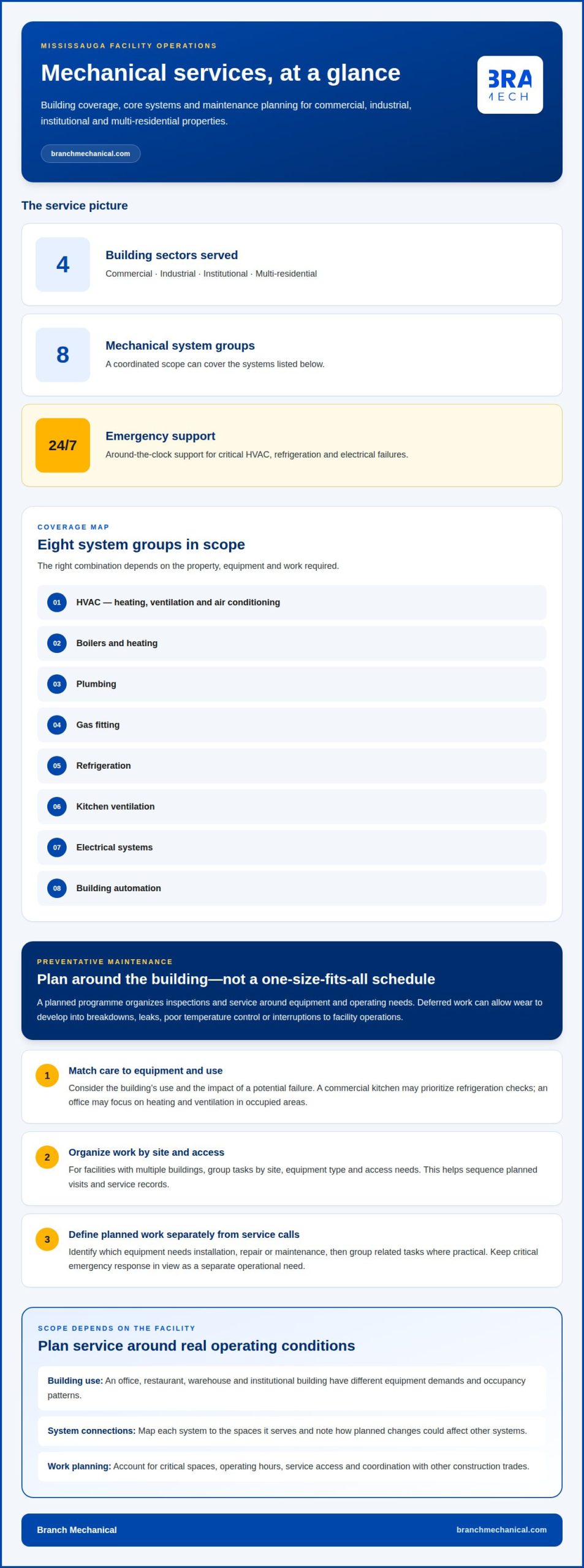
A mechanical problem rarely stays confined to one room. Facility management mechanical services in Mississauga support commercial, industrial, institutional and multi-residential buildings with HVAC, boilers and heating, plumbing and gas fitting, refrigeration, kitchen ventilation, electrical systems, and building automation. Service can include planned maintenance and emergency repairs, including 24/7 support for critical HVAC, refrigeration and electrical failures.
Keeping these systems maintained helps building teams plan work before a fault disrupts operations, while emergency service provides a path to address critical failures. This guide explains which building sectors these services support, what mechanical systems they cover, and how preventative maintenance and around-the-clock emergency response fit into building operations. You’ll also get a clear picture of when a mechanical contractor can help keep a facility functioning reliably.
Key Takeaways
- Match mechanical service planning to the needs of commercial, industrial, and institutional facilities.
- Understand how HVAC, heating, plumbing, refrigeration, electrical systems, and building automation contribute to building operations.
- Use preventative maintenance contracts to plan ongoing mechanical care around a facility’s systems and operating needs.
- Know how 24/7 emergency service can address critical mechanical failures, and where Branch Mechanical’s commercial HVAC services fit.
Facilities served across commercial, industrial, and institutional sectors
Facility management mechanical services in Mississauga can support commercial, industrial, institutional, and multi-residential buildings. Ontario requirements depend on the system and work scope; relevant building and safety rules, permits, and inspections may apply. Contractor qualifications should match the tasks, with relevant training and licences for HVACR, gas, plumbing, or electrical work.
Commercial Construction and Maintenance
Commercial facility construction in Ontario can include new spaces, additions, or renovations to occupied properties. A phased renovation, for example, can separate mechanical work from busy areas to limit disruption to daily operations. Planning should account for the building’s use, system connections, service access, and coordination with other construction trades.
Commercial facility maintenance should reflect how each property operates. An office, restaurant, warehouse, and institutional building have different equipment demands and occupancy patterns. Identify critical spaces, operating hours, and systems that affect daily use. These details help organize maintenance around the facility instead of treating every building as if it has identical requirements.
Mechanical Contracting and HVACR Services
Commercial and industrial mechanical contracting can cover work on heating, ventilation, air conditioning, refrigeration, plumbing, and related building systems. HVACR service may include installation, repair, and maintenance, with the work shaped by equipment type and facility use. A warehouse, for instance, may depend on heating and ventilation across large work areas, while a restaurant also relies on refrigeration and kitchen ventilation.
Assess the project scope and the contractor’s experience with similar systems. For an industrial facility, the review may include how equipment serves production areas and connects with existing systems. For an institutional building, occupied spaces and service access can shape work planning. Clear coordination helps keep construction, repairs, and maintenance aligned with building operations.
Companies responsible for several properties can organize requirements by building and system. List needs such as boiler service, refrigeration repair, or ventilation work, then use them to define the mechanical scope. This gives a contractor a practical basis for planning work across properties while accounting for each facility’s operating demands.
Mechanical and technical building services
Mechanical projects may use a tendered contract or a design-build approach. The appropriate scope depends on the building, its equipment, and the work required.
Building Systems and Equipment
Mechanical services can cover heating, ventilation, air conditioning, refrigeration, plumbing, gas fitting, electrical systems, and building automation. A restaurant, for example, may need refrigeration and kitchen ventilation considered alongside heating and cooling. In a warehouse, equipment needs can vary between office areas and operational spaces.
Map each system to the spaces it serves before defining the project work. In an existing building, note equipment connections and how planned changes could affect other systems. This creates a clearer scope for renovations, replacements, and ongoing service.
Tendered projects invite contractors to price a defined scope, while design-build combines design and construction in one project approach. Public buildings and private facilities may use different procurement processes. In either case, document equipment requirements, project boundaries, and coordination responsibilities clearly.
Choosing and Contracting a Provider
Choose a provider whose mechanical expertise matches the building’s systems and project scope. A business planning a boiler replacement, for example, needs a proposal that identifies the equipment and related work. For tendered projects, compare responses against the same scope rather than relying on headline price alone.
Before contracting, define the work areas, operating constraints, and expected deliverables. A design-build agreement should clarify who coordinates design decisions and construction activities. These details help a Mississauga business establish responsibilities and a practical process for managing changes.
Facility Management Mechanical Services
Facility management companies may coordinate work across systems such as HVAC, boilers, plumbing, gas fitting, refrigeration, electrical services, and building automation. The right combination depends on the property. An institutional building, for example, may have different equipment priorities from a commercial kitchen.
Separate planned work from service calls in the scope. Identify which equipment needs installation, repair, or maintenance, then group related tasks where practical. A defined service scope makes it easier to coordinate building access and communicate priorities. For integrated mechanical project planning, review mechanical service options as part of the process.
Preventive maintenance programs
A planned maintenance program organizes inspections and service around a building’s equipment and operating needs. Deferred work can allow wear to develop into breakdowns, leaks, poor temperature control, or interruptions to facility operations.
Custom Maintenance Solutions
Build the maintenance schedule around the equipment, building use, and impact of a potential failure. A commercial kitchen may prioritize refrigeration checks, while an office may focus on heating and ventilation in occupied areas. For a Mississauga facility with multiple buildings, group tasks by site, equipment type, and access needs. This creates a workable sequence for planned visits and service records.
Include the systems that matter to the operation, such as boilers, HVAC equipment, refrigeration, or plumbing. Distinguish routine inspections from repairs, and identify how findings will be recorded. For portfolios across Mississauga and Etobicoke, organizing records by building helps teams track recurring issues and coordinate maintenance without treating every property alike.
Maintenance Within Budget
Set maintenance priorities, then match scheduled work to available resources. Start with equipment whose failure could disrupt essential operations, such as a restaurant’s refrigeration or a building’s heating system. Then consider the condition of other equipment and the access needed to service it. This allows facility teams to phase work instead of scheduling every task at once.
A clear scope also supports budget planning. Separate planned inspections from corrective repairs and identify the systems covered by the agreement. A facility may, for example, prioritize boiler and HVAC maintenance while scheduling other work around operational demands. Review service records and recurring repair needs when adjusting the plan so decisions reflect actual building conditions.
For commercial facility maintenance, connect the schedule to day-to-day operations. Note equipment access restrictions, occupied areas, and suitable service times. A maintenance provider can then organize visits, record findings, and identify issues that need follow-up. This process helps facility managers make informed decisions before a minor equipment concern affects other building systems.
24/7 Plumbing, mechanical, and HVAC/R service
A failed system can disrupt a building after regular business hours. For a restaurant, refrigeration loss threatens food storage; a warehouse may lose heating or ventilation. Emergency mechanical service provides a route to respond to critical failures, including HVAC, refrigeration, and electrical problems.
Round-the-clock response means help can be requested at any hour, including overnight or on weekends. It doesn’t mean every fault has the same urgency. A contractor first needs to understand the affected system, the building’s use, and the operational impact. A heating failure in an occupied facility, for example, differs from a minor comfort concern in an unused area.
Useful incident details include:
- The affected equipment, such as a boiler, rooftop unit, or refrigeration system.
- The location and symptoms, such as a leak, loss of cooling, or unusual equipment shutdown.
- Whether the issue affects one room, a work area, or the wider facility.
These details help the mechanical team assess the call and identify the system involved. For a plumbing concern, the location and visible impact help distinguish an isolated fixture issue from a problem affecting building operations. For HVAC or refrigeration, details about temperature changes or equipment shutdown describe the disruption more clearly.
Emergency repairs address critical failures in HVAC, refrigeration, and electrical systems, supporting business continuity. The next steps depend on the fault and equipment: a technician assesses the issue, identifies the required repair, and explains any follow-up work. Clear communication helps facility staff coordinate access and share relevant operating information.
A trusted emergency provider should make the service scope clear and communicate findings in practical terms. For urgent building-system failures, request 24/7 emergency mechanical service.
Branch Mechanical: Commercial HVAC Installation & Service
Branch Mechanical supports building teams with commercial HVAC installation, service, and ongoing mechanical care. Its commercial and multi-residential mechanical contracting can coordinate work across building systems, while Building Automation & Energy Management Systems support building controls and energy management.
Turn to Branch Mechanical when a facility needs HVAC work, planned maintenance, or mechanical contracting for a commercial or multi-residential property in Mississauga or Etobicoke. Preventative maintenance contracts can organize service around the equipment and building operations. The right scope depends on the systems involved and the facility’s requirements.
Share the building type, affected equipment, project scope, and operating constraints to help define the work. To discuss commercial HVAC installation, service, or planned mechanical maintenance for your facility, contact Branch Mechanical.
Set a clear plan for your building
The next step is to turn your facility’s mechanical needs into a defined scope of work. Bring together the building’s priorities, equipment concerns, access requirements, and preferred maintenance approach. This gives the conversation a practical starting point, whether you’re planning a project or addressing ongoing service needs.
For facility management mechanical services in Mississauga, Branch Mechanical offers Commercial & Multi-Residential Mechanical Contracting, Commercial HVAC Installation & Service, and Preventative Maintenance Contracts. These services help building teams plan mechanical work around their property and operations.
Share the requirements that matter most to your facility and discuss a suitable next step. Contact Branch Mechanical today to talk through your building’s mechanical needs.
Frequently Asked Questions
Which Mississauga facility management companies specialize in HVAC, plumbing, and mechanical systems?
Branch Mechanical provides commercial and multi-residential mechanical contracting for Mississauga properties. Its work includes commercial HVAC, plumbing and gas fitting, electrical services, refrigeration, and heating systems. The company proudly serves Mississauga and Etobicoke. Property managers can match the contractor’s service scope to their building’s equipment, such as a commercial boiler, rooftop unit, or refrigeration system.
What mechanical maintenance services are available for commercial buildings in Mississauga?
Commercial maintenance can cover HVAC equipment, boilers, plumbing, refrigeration, and electrical systems. Branch Mechanical offers preventative maintenance contracts for commercial properties in Mississauga and Etobicoke. A building team, for example, can include rooftop HVAC equipment in planned service and address a separate plumbing concern through the appropriate mechanical work. A defined scope clarifies which equipment is covered and how maintenance relates to repairs.
How much does commercial HVAC maintenance cost in Mississauga?
Commercial HVAC maintenance pricing depends on the equipment and work required. Relevant factors include equipment type and condition, the number of systems, site access, and the maintenance scope. Branch Mechanical provides free, no-obligation quotes for properties throughout Mississauga and Etobicoke. A facility manager can describe the building and HVAC equipment so the quote reflects the service requirements.
What are typical response times for emergency mechanical services in Mississauga?
Branch Mechanical offers 24/7 emergency mechanical services throughout Mississauga and Etobicoke, but availability does not establish a specific arrival-time estimate. Response timing depends on factors such as the reported failure, affected equipment, and service requirements. For example, a facility team reporting a refrigeration failure should identify the equipment and operational impact. This information helps communicate the urgency and nature of the call clearly.
How often should commercial HVAC and plumbing systems be inspected and maintained?
Set inspection and maintenance timing according to the equipment, its condition, and how the building operates. A commercial kitchen’s refrigeration and ventilation needs in a Mississauga property differ from an office’s HVAC and plumbing demands. Review service findings and recurring issues when adjusting the schedule. For instance, repeated concerns with one piece of equipment may call for closer attention than systems operating without reported problems.