
Commercial boiler troubleshooting starts with recognizing the common warning signs: unexpected shutoffs, a pilot light that repeatedly goes out, leaks, poor heating and unusual noises. Boilers should receive professional inspection and service at least once every 12 months, and a yellow or flickering pilot flame needs professional attention. These problems can interrupt building operations, but their symptoms can help point to what needs investigation.
It’s understandable to want to know whether a boiler problem is routine or needs prompt attention. A commercial boiler may shut down because of a control or circulation issue, while rumbling, whistling or gurgling can point to scale, pressure or airflow concerns.
This guide covers common commercial boiler issues, what staff can safely observe, and when repairs require a qualified professional. You’ll also learn what preventative maintenance involves and how regular checks can help identify developing problems before an unexpected shutdown.
Key Takeaways
- Repeated shutdowns can point to a blocked heat exchanger, control fault or circulation problem; note when they occur to help narrow down the cause.
- Rumbling, whistling or gurgling can signal scale, trapped air or pressure issues, so pay attention to how the sound changes during operation.
- Pressure that keeps dropping may indicate a leak or a faulty pressure relief valve, not just a setting that needs adjustment.
- Routine inspections, attention to water quality and timely professional diagnosis can help address developing faults before they disrupt building heat.
2. Automatic shutoffs and pilot light problems
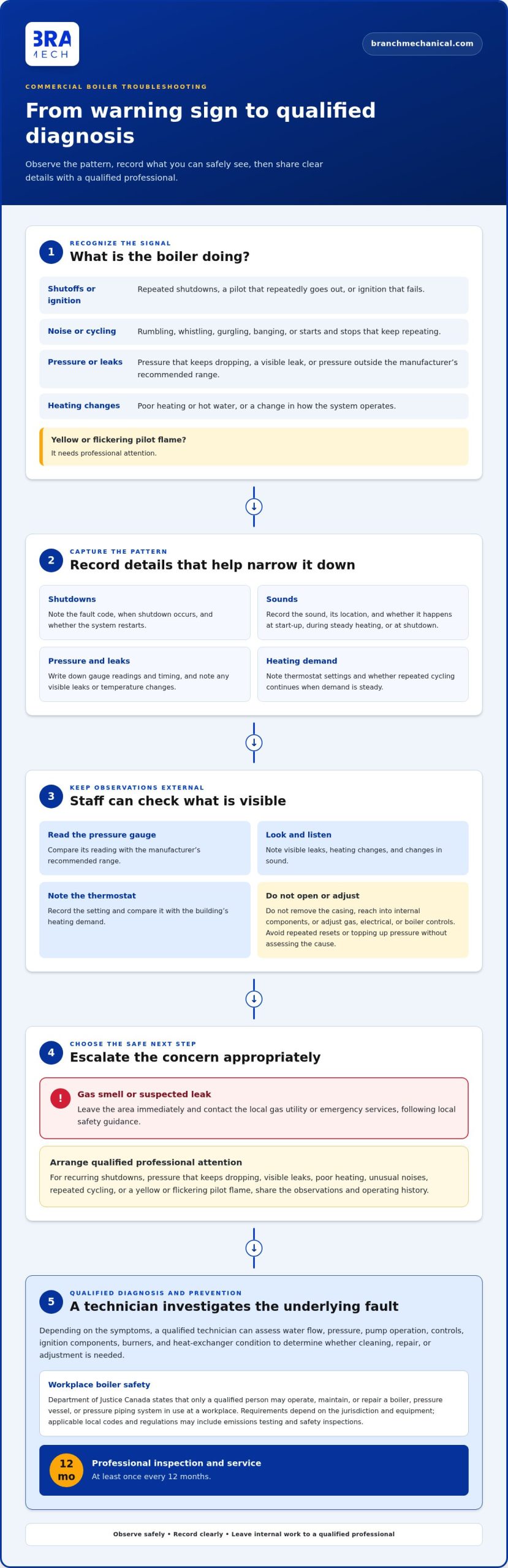
A commercial boiler that shuts off repeatedly may be responding to overheating, low pressure or another detected fault. A blocked or dirty heat exchanger can restrict heat transfer, raise operating temperatures and trigger a shutdown. A faulty thermostat, pressure loss, damaged pump or blockage can also interrupt heating. Record the fault code, when the shutdown occurs and whether the system restarts. These details can help identify a recurring pattern without opening the boiler.
Pilot-light and ignition problems need careful attention. A pilot that repeatedly goes out may indicate a thermocouple issue, draught, deposits or faulty control valve. A yellow or flickering pilot flame needs professional attention. If ignition fails, avoid repeated resets: the fault may involve the ignition system or controls, not just the settings. If anyone smells gas or suspects a leak, leave the area immediately and contact the local gas utility or emergency services, following local safety guidance.
Burner condition affects both reliable heat production and safety. Dirt on commercial boiler burners can obstruct heating, while trapped dust and debris can pose a fire hazard. Burner cleaning belongs in professional maintenance. Don’t remove the boiler casing or reach into internal components. A qualified technician can inspect the burner, ignition components and heat exchanger together, then determine whether cleaning, repair or a control adjustment is needed.
Fuses and electrical supply may also be involved when ignition or a connected pump stops working. A blown fuse, tripped breaker or faulty wiring can interrupt equipment, but repeated fuse failures need diagnosis, not just replacement. Department of Justice Canada states that only a qualified person may operate, maintain or repair a boiler, pressure vessel or pressure piping system in use at a workplace. Leave electrical, gas and internal repairs to a qualified professional, and share the fault code and shutdown history.
3. Boiler noises, including kettling and rattling
A new rumble or whistle can point to restricted water flow or heat transfer. Sediment or scale on a boiler’s heat exchanger can cause kettling, often described as rumbling or whistling. In hard-water conditions, calcium carbonate scale can build up, limiting flow and making heat transfer less efficient. Sludge can also obstruct the water supply and contribute to overheating. Note whether the sound occurs during start-up, steady heating or shutdown. That timing gives a technician useful diagnostic context.
Gurgling and banging can have different causes. Air in the system or low water pressure can create these sounds as heated water circulates. Pressure problems, a faulty pump, and limescale or sludge buildup can also be associated with banging, whistling or gurgling. For example, a gurgle from one heating zone shows where circulation sounds are most noticeable, but doesn’t prove the fault is in that zone. Record the sound, location and operating conditions instead of opening the boiler.
Frequent cycling needs attention, even without loud noises. A boiler that starts and stops repeatedly may be incorrectly sized for the building, responding to a malfunctioning thermostat, or affected by faulty internal controls. Repeated cycling can increase component wear and reduce efficiency. Compare the thermostat setting with the building’s heating demand, and note whether cycling continues when demand is steady. These observations can help distinguish control-related problems from changes in heating load.
Keep staff away from internal components. Don’t remove the casing or adjust gas, electrical or boiler controls. Share the operating pattern, thermostat settings and any changes in sound with a qualified technician. If unusual noise occurs alongside a leak, loss of heat or recurring cycling, arrange a professional assessment rather than relying on repeated resets. A technician can assess water flow, pressure, pump operation and heat-exchanger condition to identify the cause before it creates further disruption.
4. What Are Some Common Issues Commercial Boilers Have?
Low boiler pressure can reduce heat circulation, leaving parts of a building without adequate heating or hot water. A leak, steam loss or failing pressure relief valve may cause pressure to drop; a faulty expansion tank can also contribute to system leaks. Check the pressure gauge and compare its reading with the manufacturer’s recommended range. If pressure drops again after being restored, the underlying cause needs assessment, not repeated topping up.
Kettling and scale buildup can be linked to pressure and flow problems. Limescale or sludge may restrict water movement through the heat exchanger, impair heat transfer and contribute to overheating. Hard water can leave calcium carbonate deposits. Low pressure may also be associated with a leak or failing relief valve, while high pressure can result from excess water or air in the system. Record gauge readings alongside temperature changes, unusual sounds and any pilot-light or ignition faults.
Canadian inspection and repair requirements depend on the jurisdiction and equipment. Commercial heating-system service should account for applicable local codes and regulations, including emissions testing and safety inspections. Department of Justice Canada states that only a qualified person may operate, maintain or repair a boiler, pressure vessel or pressure piping system in use at a workplace.
Building staff can safely make external observations: read the pressure gauge, note thermostat settings, look for visible leaks, and record changes in heating or noise. Don’t remove the casing, adjust gas components or attempt internal repairs. If pressure keeps dropping, share the readings and timing with a qualified technician. They can assess the relief valve, expansion tank, pipework and heat exchanger, then determine whether repair or replacement is appropriate. Tracking these details can help distinguish pressure issues from control or circulation problems.
4. How do you diagnose low boiler pressure, poor heating, or no hot water?
Start with observations, not internal adjustments. Note the boiler’s pressure-gauge reading, displayed fault code, thermostat setting and which areas lack heat or hot water. Compare the gauge with the manufacturer’s recommended range: commercial systems don’t all have the same correct pressure target. Record whether the reading changes during operation, and look for visible water around accessible pipes or equipment.
Next, check external controls. Confirm that the thermostat or building controller is set to heating, and note whether its temperature setting matches the building’s demand. Check whether the boiler has power and whether an error message appears when it shuts down. If the manufacturer provides a reset procedure and staff are authorized to use it, follow the instructions once. If the fault returns, arrange professional diagnosis instead of repeatedly resetting the boiler.
Low pressure can result from a leak or faulty pressure relief valve. Steam loss can also reduce system pressure. If pressure drops again after reaching the manufacturer’s recommended level, log the readings and timing, then arrange an assessment. Don’t keep adding water without finding the cause. A qualified technician can inspect the relief valve, expansion tank, pipework and circulation components.
Poor heating in one area may reflect air in the system, circulation trouble, incorrect pressure or a zone-control issue. If a radiator has cold spots, trapped air may be involved; bleeding should follow the building’s procedures and be handled by authorized personnel. Little or no heat can also stem from a faulty thermostat, ignition problem, failed pump or zone valve. These components need professional attention.
Building staff should stop at external checks. Don’t remove the boiler casing or work on gas, electrical or internal parts. If gas is suspected, leave the area and contact the local gas utility or emergency services according to local safety guidance. For persistent pressure loss, poor heating or no hot water, request commercial boiler service to identify the fault and determine the appropriate repair.
Branch Mechanical: Commercial & Multi-Residential Mechanical Contracting
Branch Mechanical provides commercial boiler and heating-system services for buildings with recurring pressure loss, unreliable heat or equipment faults that need professional diagnosis. Its Commercial & Multi-Residential Mechanical Contracting includes work on commercial boilers and heating systems, helping building operators address faults that go beyond safe visual checks in Mississauga and Etobicoke.
Turn to Branch Mechanical when a boiler keeps shutting down, pressure repeatedly drops or heating problems persist after basic control checks. Preventative Maintenance Contracts support planned servicing, while Commercial HVAC Installation & Service addresses broader building heating needs. The right next step depends on the symptoms, system condition and building requirements.
Contact Branch Mechanical to discuss a commercial boiler or maintenance need, or visit branchmechanical.com.
Make the next boiler decision with confidence
Turn recurring boiler symptoms into a clear service plan. Before arranging work, gather the fault history, control readings and notes on when the problem occurs. This record gives a technician a useful starting point and helps connect symptoms to the building’s operating needs. A consistent maintenance plan can also help facility teams track developing concerns and plan service around their equipment.
Branch Mechanical provides Commercial & Multi-Residential Mechanical Contracting, Commercial HVAC Installation & Service, and Preventative Maintenance Contracts. These services give building operators a practical path from diagnosing a persistent boiler issue to planning ongoing mechanical care. Commercial boiler troubleshooting is most useful when observations lead to a focused assessment, rather than repeated resets or adjustments.
For a boiler concern or maintenance discussion, contact Branch Mechanical about boiler help. A clear next step can help your team move forward with confidence.
Frequently Asked Questions
What Are Some Common Issues Commercial Boilers Have?
Common issues include leaks, pressure changes, ignition faults, uneven heating and unexpected shutdowns. For example, one building zone staying cold while other areas heat normally may point to a zone valve or circulation issue rather than a whole-boiler failure. Track which areas are affected and whether the problem changes with heating demand. That record can help distinguish a local distribution fault from a boiler-wide problem.
What kind of maintenance does a boiler need?
Commercial boilers need professional inspection and service at least once every 12 months. Maintenance can include inspecting boiler components, checking water quality, clearing air vents and calibrating the thermostat. Seasonal testing before a change in heating demand can also help reveal performance issues. The work should reflect the boiler’s fuel type, heat-exchanger material, heating range and operating conditions, rather than relying on a one-size-fits-all checklist.
When Do I Call a Professional To Fix My Commercial Boiler or Pump?
Call a qualified professional for gas concerns, water leaks, complex electrical faults, or repairs involving disassembly and component replacement. A pump that keeps failing, vibrates excessively or leaks around a seal also needs expert assessment. Stop troubleshooting if the problem returns after a basic check or reset. For workplace boilers and pressure systems, Department of Justice Canada says only a qualified person may operate, maintain or repair them.
Why is my boiler not kicking on?
A boiler may not start because its thermostat or controller isn’t calling for heat, or because an ignition fault, failed pump or safety switch is preventing operation. Check that the controller is set to heating and note any displayed fault message. If the setting is correct but the boiler remains inactive, don’t open the casing. A technician can safely assess the controls and ignition system.
What are the most common commercial boiler problems and symptoms?
Common symptoms include cold areas, reduced heat, water around equipment, recurring shutdowns and changes in system pressure. A pump problem may show up as poor circulation, unusual vibration or a leak near a seal. A thermostat issue can make the building temperature differ from its control setting. Record where and when each symptom appears, since the pattern can help narrow down the affected component.
How do you troubleshoot a commercial boiler that won’t start or keeps shutting down?
Use a structured commercial boiler troubleshooting check: confirm the heating schedule and thermostat setting, inspect the display for an error message, and note any visible leaks or unusual sounds. Follow the manufacturer’s instructions for an available reset, but don’t repeatedly restart a boiler that shuts down again. Record the fault message and operating conditions, then arrange professional diagnosis for recurring shutdowns or any gas, electrical or internal fault.