

A gas-fitting project can be technically sound and still disrupt a building if it isn’t planned around how the facility operates. Finding commercial gas fitting contractors GTA businesses can rely on means looking beyond the pipework: tenants, staff, customers, access and connected mechanical systems all affect the plan. Coordination matters whether the work is a repair, an upgrade or part of a larger facility project.
If you know what needs attention but aren’t sure how to define the scope or schedule work around daily operations, start with the equipment, affected areas and access requirements. This guide explains how to prepare a project brief, compare approaches to commercial work and plan communication and follow-up. It also shows how gas fitting can connect with heating, HVAC, plumbing and building operations. Branch Mechanical provides commercial and multi-residential gas fitting and mechanical services across the GTA, including Mississauga and Etobicoke.
Key Takeaways
- Identify the equipment and areas affected, from commercial kitchens to boilers and multi-residential systems.
- Consider how the project scope, equipment and site conditions relate to Ontario requirements and other building systems.
- Compare commercial gas fitting contractors GTA facilities may consider by looking at scope clarity, system coordination and ongoing support.
- Prepare for planning by documenting affected areas, operating hours and access constraints.
- Branch Mechanical provides commercial gas fitting alongside plumbing, boiler, heating and HVAC services.
Commercial Gas Fitting Services for GTA Facilities
Commercial gas fitting involves connecting, maintaining or modifying gas piping and gas-fired equipment in commercial or multi-residential buildings. The scope depends on the equipment, property and work required. A restaurant’s cooking equipment, an office building’s heating system and a multi-unit property’s boiler plant each have different site and operating needs.
Commercial projects often affect more than one room or system. Work may involve shared areas, multiple suites, a kitchen in operation or equipment that supports building heating. Residential service generally centres on a home and its individual appliances. In a commercial setting, the facility context matters: the gas work needs to be planned in relation to the building and the equipment it serves. The Gasfitter Wikipedia entry provides a general overview of the trade, while commercial work must be scoped for the specific property and equipment.
For property owners in Mississauga and Etobicoke, start by identifying what the gas work needs to support. A warehouse, restaurant and condominium can have different equipment, access conditions and operational priorities, so a clear scope should be based on the actual site rather than assumptions about the building type.
Which commercial facilities need gas-fitting work?
Gas-fitting work can be needed in restaurants, offices, warehouses and multi-unit properties. A restaurant may use gas-fired commercial kitchen equipment; an office or warehouse may rely on gas-fired heating; and a multi-residential building may have shared boilers or other central heating equipment. These are examples, not a standard package. The equipment on site and the work required define the project.
- Restaurants: Identify the kitchen equipment involved and how work could affect food-preparation areas.
- Offices and warehouses: Note the heating equipment involved and which spaces it serves.
- Multi-unit properties: Clarify whether the work concerns shared equipment, particular suites or other building areas.
How gas fitting fits into a building’s mechanical systems
Gas work may be part of a broader commercial plumbing, HVAC or heating project. A heating-system upgrade, for example, can involve both gas-fired equipment and HVAC components. Work in a commercial kitchen may bring gas fitting, plumbing and ventilation into the same project plan. These systems are distinct, but the plan should account for their interfaces when they are related to the work.
Before setting the scope, record which equipment is involved, where it is located and which areas or operations depend on it. This gives the project team a practical basis for coordinating gas fitting with related mechanical tasks instead of treating it as an isolated change. For facilities comparing commercial gas fitting contractors GTA-wide, an integrated mechanical perspective can help make project boundaries and dependencies clearer.
How Commercial Gas-Fitting Projects Connect to Ontario Requirements and Building Systems
Commercial gas-fitting work needs to be considered in its specific setting. Applicable Ontario requirements can depend on the work, the equipment and site conditions. A change to one appliance may have a different scope from work on a boiler plant or a broader mechanical upgrade. Treating every job as identical can leave important project questions unresolved.
Coordinating gas work with the equipment it serves helps facility teams define the scope and build a workable project plan. Identify affected systems and spaces early, then account for how the work relates to building operations and other trades. The Technical Standards and Safety Authority (TSSA) is an important Ontario reference for gaseous-fuels safety. Check applicable requirements against current Ontario sources and the details of the project.
What GTA facility managers should know about Ontario requirements
General information can help frame a project, but it doesn’t replace a project-specific review. Before planning, clarify which equipment and piping are involved, what will change and where the work will take place. These details help establish which requirements and processes may apply.
Use current information from TSSA and relevant Ontario authorities when reviewing responsibilities or requirements. Don’t assume that the same rule, code edition, permit or inspection process applies to every job. Relevance depends on the work and site. This section offers planning guidance, not an interpretation of regulations for a particular facility.
Why gas work may need mechanical-system coordination
Gas-fired equipment often forms part of a wider mechanical system. A boiler project, for example, may intersect with heating distribution and HVAC equipment. Work involving commercial kitchen equipment may also need to be planned alongside ventilation and plumbing tasks. These connections can affect access, sequencing and the parts of the facility involved.
Coordination is practical as well as technical. Facility teams may need to schedule access around business activity, identify dependencies between trades and communicate which areas are part of the work. A clear scope describes the gas-fitting task and relevant interfaces without assuming every system needs to change. For related work on water and drainage systems, the commercial plumbing contractor guide can help clarify how plumbing scope fits into a commercial project.
For facility managers comparing commercial gas fitting contractors GTA businesses can work with, system coordination is a useful way to assess whether a proposed scope reflects the building’s needs. Branch Mechanical provides commercial gas fitting alongside plumbing, boiler, heating and HVAC services. Its commercial mechanical services support a connected view of facility work, including projects in Mississauga and Etobicoke.
How to Compare Commercial Gas Fitting Contractors Across the GTA
The right approach depends on the building, equipment and effect of the work on daily operations. A focused gas-fitting scope may suit a project with clear boundaries. If the work overlaps with boilers, heating, HVAC or plumbing, integrated mechanical coordination can bring related needs into one project plan. The choice should reflect the facility’s actual requirements.
Use these criteria to compare approaches for your site:
| Comparison point | What to look for in the project approach |
|---|---|
| Commercial experience | Work suited to commercial or multi-residential buildings, with attention to the equipment and facility type involved. |
| Scope clarity | A clear description of the gas-fitting work, related equipment, affected areas and boundaries between trades. |
| System coordination | Planning that accounts for relevant boilers, heating, HVAC, plumbing or kitchen systems instead of treating connected work as unrelated. |
| Ongoing support | Maintenance and service options that fit the facility’s longer-term needs, including arrangements for urgent mechanical issues. |
What contractor experience matters for commercial sites?
Commercial and multi-residential experience matters because equipment, access and operating conditions can differ from those in a home. A restaurant, office and apartment building each have distinct requirements. A useful scope identifies the work and its boundaries, relevant system interfaces, and how communication and sequencing will be handled. This gives your team a practical basis for planning around staff, tenants and customers.
How to assess service continuity and ongoing support
Consider the immediate project as well as the facility’s needs after the work is complete. Preventative maintenance contracts support planned mechanical upkeep, while clear service arrangements help facility teams plan for urgent issues. Branch Mechanical provides preventative maintenance contracts and 24/7 emergency mechanical services. These are ongoing support options to include in facility planning.
Manage disruption through clear planning. Before work begins, establish the sequence of tasks, affected areas, access arrangements and who will share updates with building stakeholders. A standalone gas scope can keep responsibilities focused. Integrated coordination can help when related systems or trades need to align. Compare approaches against the facility’s actual dependencies.
Branch Mechanical’s commercial and multi-residential mechanical capabilities include gas fitting alongside plumbing, boilers, heating and HVAC. For a broader view of how these services fit together across the region, see the guide to commercial mechanical contractors in Mississauga and the GTA. If you’re planning connected gas and mechanical work, explore commercial gas fitting support from Branch Mechanical.
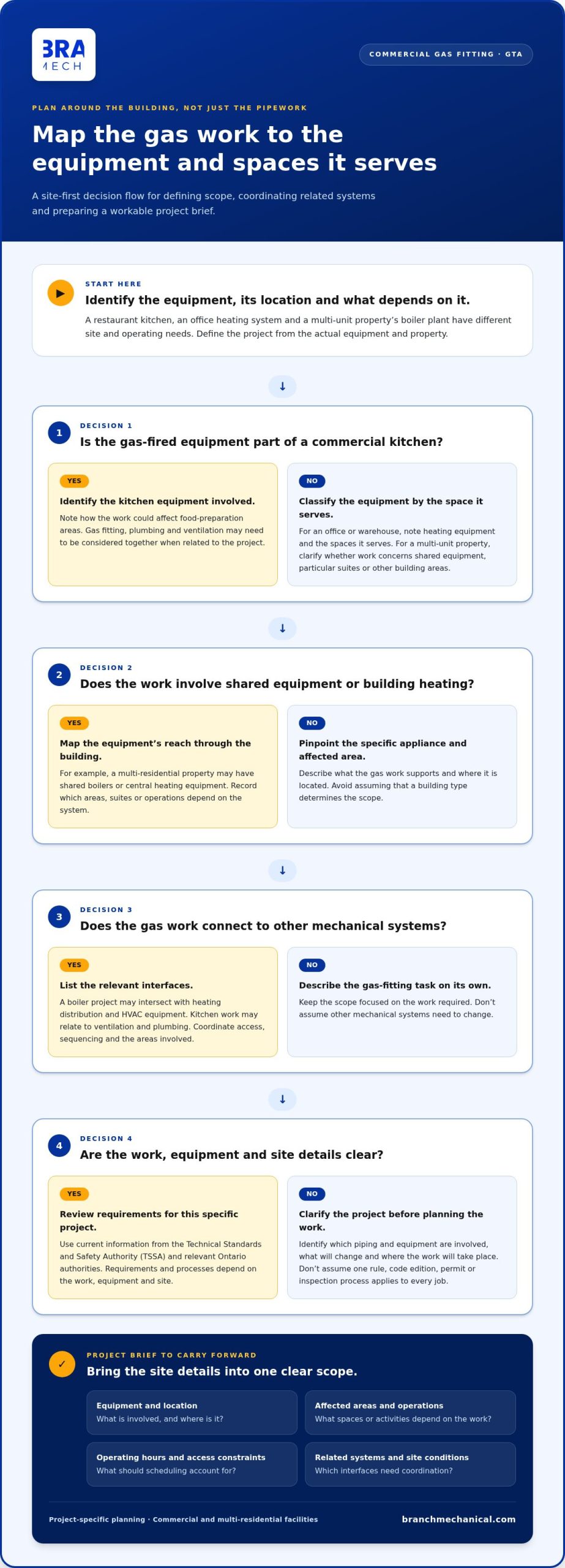
A Practical Planning Checklist for Commercial Gas Fitting in Mississauga and Etobicoke
Good planning starts with the facility, not a generic work schedule. In Mississauga and Etobicoke, occupied commercial and multi-residential properties may need to balance access, business hours and the needs of tenants, staff or customers. Use this sequence to prepare a clear project brief for commercial gas fitting contractors GTA facilities engage.
- Define the need. Describe the issue or objective in plain language. Note symptoms, planned equipment changes or the operational need the work should address.
- Identify the equipment and systems. Record the gas-fired equipment involved, such as a boiler, heating unit or commercial appliance. Note connected systems, including HVAC, ventilation or plumbing, without assuming they are part of the work.
- Map the work areas. Identify equipment locations, affected rooms and shared spaces. Include access constraints such as controlled entrances, busy loading areas or spaces occupied by tenants, staff or customers.
- Set out operating requirements. Record business hours, important operating periods and times when access may be easier or disruption would be especially difficult. Identify who can coordinate access and communicate with occupants.
- Clarify scope and sequencing. Discuss work boundaries, related trades and the order of activities. If heating-system work is involved, review how it connects to the wider HVAC scope using the GTA commercial HVAC installation guide as related planning context.
- Plan communication and follow-up. Decide who will share project updates, which facility contacts need them and how schedule or access changes will be communicated. After completion, record the agreed scope, work completed, outstanding items and any maintenance considerations discussed.
Check requirements against the actual project
Requirements can depend on the work, equipment and site. For a project in Ontario, use current information from the Technical Standards and Safety Authority (TSSA) and relevant provincial or municipal authorities to review applicable requirements. A general checklist is not project-specific regulatory advice. Keep decisions about code, permits, inspections and safety tied to current authoritative sources and the details of the work.
Plan around people and facility operations
In an occupied building, clear sequencing helps everyone understand which areas may be affected and when. A facility contact can coordinate access and share relevant updates with tenants, staff or customers. If other mechanical work is connected, align its sequence with those tasks so the project plan reflects the building’s operational needs. Site conditions may require adjustments, so keep communication clear as work progresses.
Branch Mechanical provides commercial gas fitting alongside plumbing, boiler, heating and HVAC services for commercial and multi-residential properties. For a coordinated project plan in Mississauga or Etobicoke, discuss your facility’s gas-fitting needs with Branch Mechanical.
Commercial Gas Fitting Support from Branch Mechanical Across the GTA
Branch Mechanical is a Canadian-owned and operated commercial and multi-residential mechanical contractor founded in 2012. The company serves facilities across the GTA, including Mississauga and Etobicoke, and provides commercial gas fitting as part of its wider mechanical work. This connected capability is useful when a project involves more than one system or needs to be planned around an occupied building.
Every facility has its own equipment, access needs and operating priorities. Discussing the building and the work helps define the scope, identify related systems and plan communication. For owners and facility managers comparing commercial gas fitting contractors GTA businesses, an integrated approach considers gas fitting alongside relevant mechanical needs rather than viewing each task in isolation.
An integrated mechanical approach for commercial properties
Gas-fitting work can connect with commercial plumbing, boilers, heating and HVAC. Branch Mechanical provides these services for commercial and multi-residential properties, so related mechanical needs can be considered together during project planning. If gas fitting is associated with boiler or heating work, for example, accounting for the connected systems can help clarify scope, sequencing and affected areas. The plan depends on the building and the work required.
This broader perspective can be useful across property types, from commercial spaces to multi-unit buildings. It doesn’t mean every project needs a combined scope. It means relevant system interfaces can be considered as the work is planned, giving facility teams a clearer view of the project and its relationship to building operations.
Discuss your GTA facility’s gas-fitting requirements
Share the details that shape the work: equipment, facility type, affected areas, operating schedules and access constraints. Include any related plumbing, boiler, heating or HVAC work. This gives the project team a practical starting point for discussing scope and coordination.
Support can extend beyond a single project. Branch Mechanical offers preventative maintenance contracts for ongoing mechanical upkeep and 24/7 emergency mechanical services for urgent mechanical needs. Facility owners can consider these services as part of wider maintenance and service planning.
- For a defined project: Describe the equipment, work area and operational priorities.
- For connected work: Note related plumbing, boiler, heating or HVAC requirements.
- For ongoing planning: Consider how preventative maintenance and emergency mechanical services fit the facility’s needs.
For commercial gas fitting support across the GTA, discuss your facility’s requirements with Branch Mechanical. Discuss your commercial gas-fitting project and share the scope, equipment and operating considerations that matter to your property.
Make Your Next Project Step Count
Before settling on a schedule, prepare a short brief your project team can use. Note the work objective, equipment involved, affected areas, operating constraints and connected mechanical work. Identify who needs to approve access, coordinate with occupants and receive updates. This gives everyone a shared starting point grounded in the realities of the building.
The right commercial gas fitting contractors GTA partner should be part of a considered facility plan, not just a single task. A clear scope makes it easier to align the work with operational priorities and plan follow-up.
Branch Mechanical supports commercial and multi-residential mechanical needs, including preventative maintenance and emergency service. Share your project outline and facility considerations to take the next step. Share your commercial gas-fitting project with Branch Mechanical.
A clear brief and practical plan help your team move forward with confidence.
Frequently Asked Questions
Who can carry out commercial gas-fitting work in Ontario?
Commercial gas-fitting work in Ontario must be carried out by a gas technician with the appropriate TSSA certification for the work. The certification level and permitted scope depend on the equipment and task, so don’t assume every technician is authorized for every system. For a project in Mississauga or Etobicoke, use current Technical Standards and Safety Authority guidance to understand the applicable requirements for the specific work.
What does a commercial gas-fitting contractor do?
A commercial gas-fitting contractor works on gas piping and gas-fired equipment in commercial or multi-residential settings. The project might involve a restaurant appliance, a building’s heating equipment or a shared system in a multi-unit property. The scope depends on the facility and the work required. Before planning, identify the equipment and reason for the work, such as an upgrade, a change in use or an operational concern.
Can commercial gas-fitting work be completed while a business is operating?
It may be possible, depending on the work, site conditions, affected areas and operating requirements. A restaurant may need to plan around kitchen activity, while an office may need to manage access to occupied spaces. Discuss how work areas and access could affect staff, customers or tenants. The project plan should set expectations for sequencing and communication without assuming operations can continue unchanged.
What should I include in a commercial gas-fitting project scope?
Include the facility type, equipment involved, reason for the work and areas that may be affected. Add known access restrictions, operating schedules and any related work already planned. If available, gather equipment details or building records that explain the existing setup. Identify the facility contact who can make decisions and coordinate access. A well-prepared brief helps the project team clarify what is included and what needs further review.
Does commercial gas-fitting work need to be coordinated with HVAC or plumbing?
Consider HVAC or plumbing coordination when those systems connect to the project’s equipment or work areas. A boiler change may affect heating-system planning, while commercial kitchen work could overlap with ventilation or plumbing tasks. Coordination helps identify dependencies and prevents each trade from being planned in isolation. The project scope should still distinguish which systems are included rather than assuming every nearby system needs work.
How can a GTA business plan commercial gas-fitting work?
Document the objective, affected equipment, building areas, operating hours and access constraints. Identify internal contacts and connected mechanical work that may affect sequencing. Businesses searching for commercial gas fitting contractors GTA can use these details to make project discussions specific and plan communication for tenants, staff or customers. For Mississauga and Etobicoke sites, include property-specific access and operating considerations in the brief.
Can a commercial mechanical contractor support gas work after installation?
Yes. Ongoing support can include preventative maintenance planning and future mechanical service. Branch Mechanical offers preventative maintenance contracts and 24/7 emergency mechanical services. Keeping a record of the equipment, work completed and follow-up discussions can help facility teams plan future maintenance. The appropriate support depends on the building’s systems and operating priorities, so include those needs in the facility’s mechanical planning.