
Yes, a commercial HVAC service contract in Mississauga can provide scheduled preventative maintenance for a building’s heating and cooling equipment. The right schedule and scope depend on the equipment, how the building operates, and its site conditions.
Maintaining commercial HVAC equipment is an important part of planning for reliable building operations. A contract can specify what gets inspected, how often service visits take place, and which equipment is covered, so expectations are clear.
This article explains what commercial maintenance contracts can cover, how equipment and operating needs shape the plan, and what to look for in a proposal. It also outlines how service in Mississauga and the Greater Toronto Area can support commercial and multi-residential buildings, from routine maintenance planning to ongoing mechanical service.
Key Takeaways
- Preventative maintenance contracts can give plazas and restaurants a planned approach to HVAC service, with visit schedules shaped by equipment and building use.
- Clear coverage across Mississauga starts with understanding which systems and building areas need ongoing service.
- An equipment inventory helps define contract scope, including which assets, maintenance tasks and reporting expectations belong in the agreement.
- Service planning across the GTA can support buildings with different mechanical needs; the article explains how location fits into that picture.
Do you offer maintenance contracts for commercial buildings?
Commercial maintenance contracts are available for Mississauga buildings. The schedule and scope should reflect each HVAC system, how it is used, and site conditions.
Preventive Maintenance for Commercial Properties
Plazas and restaurants may have rooftop units, ventilation equipment, and heating systems to include in a maintenance plan. Daycares, dental offices, and light-industrial properties also need scopes suited to their equipment and operating hours. Commercial and industrial HVAC maintenance differs from residential service because a single building may contain several systems serving separate spaces. A clear asset list connects each system to defined maintenance tasks.
Maintenance Programs and Visit Schedules
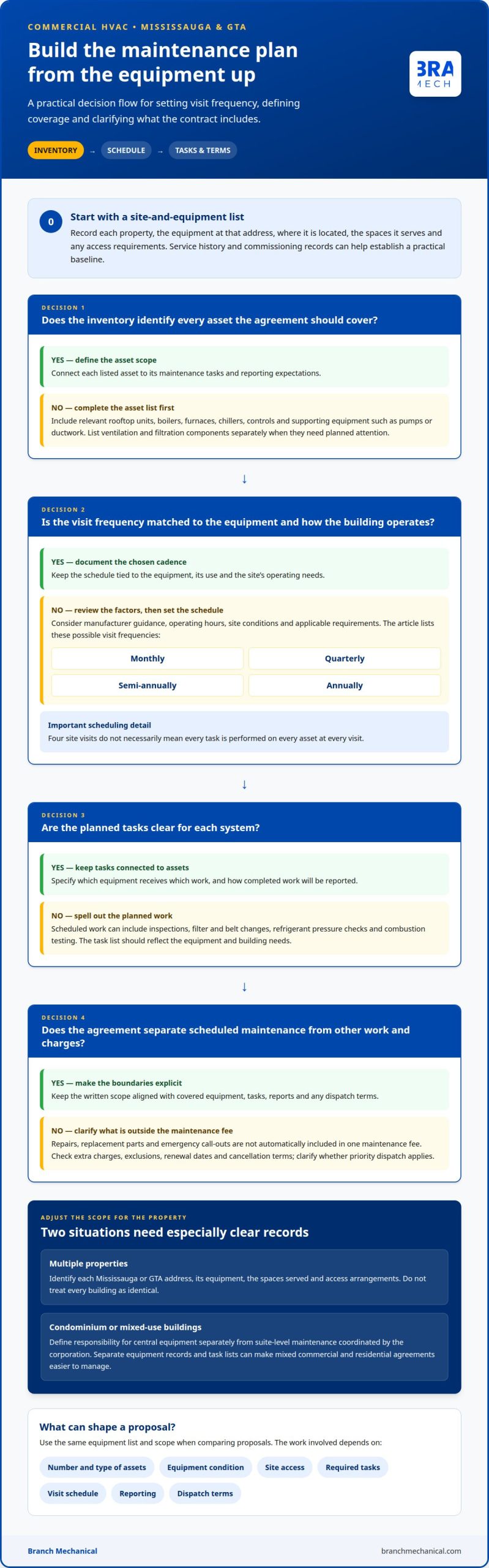
Programs may schedule visits monthly, quarterly, semi-annually, or annually. The right frequency depends on the equipment, its use, manufacturer guidance, operating hours, site conditions, and applicable requirements. Scheduled work can include inspections, filter and belt changes, refrigerant pressure checks, and combustion testing. For example, rooftop equipment at a Mississauga plaza may need a different service plan from equipment at a light-industrial property elsewhere in the GTA. Four site visits don’t necessarily mean every task is performed on every asset at each visit.
Reducing HVAC Operating Costs
How can a professional contract help reduce operating costs? Scheduled inspections can identify minor issues before they grow into expensive problems or sudden service calls. Maintenance tasks can help keep equipment operating as intended, while planned visits make service needs easier to manage. The contract should distinguish preventative work from repairs, replacement parts, and emergency call-outs, since those costs aren’t automatically included in one maintenance fee.
Condominium agreements should define responsibility for central equipment separately from suite-level maintenance coordinated by the corporation. This distinction clarifies which equipment receives scheduled service and which work falls outside the central plant scope. For mixed commercial and residential properties, separate equipment records and task lists can make the agreement easier to manage.
Commercial HVAC coverage across Mississauga
Branch Mechanical provides commercial HVAC service in Mississauga and across the Greater Toronto Area. A commercial HVAC service contract in Mississauga can define which building equipment receives planned service and how site-specific needs are handled.
Plan coverage around the property address, equipment inventory, and access requirements. A plaza near Square One, for example, may have rooftop units serving separate tenant spaces. An Etobicoke facility may have a different layout and operating schedule. The location helps organize service, while the equipment and building use shape the work. Clear site records also help technicians distinguish one property’s service history from another’s.
For a multi-site business, identify each Mississauga property in the service scope. Record the equipment at each address, the spaces it serves, and any access arrangements. This makes it easier to plan work across locations without treating every building as identical. It also clarifies which site needs attention when an operating issue arises.
Coverage can involve more than routine HVAC visits. Commercial service may address heating and cooling equipment, while separate mechanical needs can include commercial refrigeration or kitchen ventilation. Refrigerant-related work belongs within qualified service procedures. Emergency service is also relevant when a critical mechanical failure disrupts operations; planned maintenance and emergency response are distinct needs.
Before work begins, align the site list with the contract scope. Note whether the agreement covers one Mississauga address or several GTA properties, and identify the systems included at each. For a business with locations across the region, this approach gives the maintenance plan a practical geographic structure. Explore commercial HVAC service options when defining coverage for your building.
Equipment inventories and contract scope
A useful agreement connects each listed asset to specific maintenance tasks. In Ontario, an inventory helps define what the contractor will handle, how often, and what reports document completed work.
Start with the building’s heating and cooling equipment: rooftop units, boilers, furnaces, chillers, and associated controls. Add supporting equipment, such as pumps and ductwork, when it forms part of the system. For each asset, record its location, type, and the areas it serves. Commissioning records and service history can help establish a practical baseline for the scope.
Include indoor air quality equipment in the inventory when it needs planned attention. For example, identify ventilation equipment and filtration components separately from the heating or cooling unit. This distinction clarifies which inspections or maintenance tasks apply to each system. A commercial building with several units and extensive ductwork needs a more detailed asset list than a site with one rooftop unit.
What affects commercial HVAC contract pricing in Ontario? The main factors are the number and type of assets, their condition, site access, required tasks, visit schedule, reporting, and any dispatch terms. These details determine the work involved, so proposals are meaningful when they use the same equipment list and scope.
What exclusions, fees, and renewal terms should businesses check? Read the agreement for covered equipment, maintenance tasks, reports, extra charges, exclusions, renewal dates, and cancellation terms. It should separate scheduled maintenance from repairs, replacement parts, and emergency call-outs, which aren’t automatically included in one maintenance fee. Clarify whether priority dispatch applies and whether it describes response or repair completion.
Before signing, match every asset to its maintenance task and reporting requirement. This makes gaps visible: a listed boiler may have inspection tasks, while a separate ventilation system may need its own scope. Keep the final inventory with the agreement so future service visits follow the same documented plan.
Service area across the Greater Toronto Area
GTA coverage matters when one property manager oversees buildings in several municipalities. A portfolio might include a Mississauga plaza and a Toronto commercial property, each with different mechanical equipment and operating needs. A regional maintenance plan can organize both addresses while keeping their service records distinct. The key is to define a scope for every property.
For multiple sites, the agreement should identify each building and the equipment included there. A Mississauga rooftop unit and Toronto boiler plant may need different visits, access arrangements, and maintenance tasks. Separate site records help technicians document work at the correct address. They also give property managers a clearer view of recurring needs across the portfolio without treating each building as interchangeable.
Regional planning can also help coordinate related mechanical work. For example, a ventilation issue at one property may call for a different assessment than an equipment upgrade at another. Recording the site, affected system, and work completed keeps those activities connected to the right building. For a portfolio spanning Mississauga and Toronto, this detail helps distinguish routine maintenance from project work.
Service-area planning should connect geography with response expectations, not imply that every visit or repair follows the same timeline. The agreement can identify covered addresses, scheduled work, reporting, and emergency dispatch terms for each location. It should also distinguish technician response from repair completion. That distinction gives property managers a practical basis for planning around mechanical interruptions at separate sites.
When a GTA portfolio expands, its service scope should reflect the added properties and equipment. A new Mississauga address, for instance, needs its own asset record and clearly defined coverage. Keeping the site list current helps align maintenance, ventilation work, and upgrades with each building’s needs. For managers coordinating properties across the region, the next step is a location-by-location service plan.
Branch Mechanical: Commercial & Multi-Residential Mechanical Contracting
Branch Mechanical helps property owners and managers plan commercial HVAC service around each building’s equipment and needs. Its preventative maintenance contracts suit businesses seeking scheduled care, while commercial HVAC installation and service can address work beyond routine maintenance.
For multi-residential properties, Branch Mechanical’s commercial and multi-residential mechanical contracting can coordinate building-wide needs. Commercial boilers and heating systems are also part of its service offering, making Branch Mechanical a practical next step when a property needs ongoing HVAC attention or heating-system work.
Contact Branch Mechanical to discuss commercial HVAC maintenance or service for your building.
Set up your next maintenance cycle
Use the agreement as a working plan, not just a document to file away. Before the next service cycle, decide who coordinates building access, receives service reports, and tracks follow-up work. For multi-site properties, assign a contact for each address so updates reach the right person. This gives your team a consistent process for handling maintenance findings and planning future mechanical work.
A commercial HVAC service contract in Mississauga can support that process when its scope reflects your building’s equipment and operating priorities. Branch Mechanical provides commercial and multi-residential mechanical contracting, commercial HVAC installation and service, and preventative maintenance contracts. If you’re ready to discuss a plan for your property, contact Branch Mechanical about service. A clear conversation about your building’s needs is a practical next step toward organized maintenance.
Frequently Asked Questions
How quickly can you respond to a commercial HVAC emergency?
Branch Mechanical provides 24/7 emergency mechanical services for critical HVAC failures. Emergency service is available around the clock, but this does not set a fixed arrival time. For a Mississauga call, describe the affected system, site address, and operating impact to support clear triage. Technician response and repair completion are separate stages and may involve different timing expectations.
Are repairs and emergency calls included in preventive maintenance?
No. Preventative maintenance, repair labour, replacement parts, and emergency call-outs aren’t automatically included in one maintenance fee. The agreement should distinguish scheduled inspections from corrective repairs and explain which charges apply to each. For example, a technician may identify a fault during a planned visit, while the repair itself falls outside the maintenance tasks. Emergency mechanical service is a separate need.
Can you handle multi-unit residential or multi-tower portfolios?
Yes. Branch Mechanical provides commercial and multi-residential mechanical contracting for building owners and property managers. For a Mississauga portfolio, keep each tower’s mechanical records tied to its address and equipment. This helps distinguish a shared central plant issue from a concern affecting one building. Separate site records also make service history easier to review across the portfolio.
What does a commercial HVAC service contract in Mississauga typically include?
A commercial HVAC service contract in Mississauga typically identifies covered equipment, scheduled maintenance tasks, visit timing, reports, charges, and exclusions. Tasks may include inspections, filter and belt changes, refrigerant pressure checks, and combustion testing, depending on the equipment. A rooftop unit and a boiler plant need different maintenance records. The agreement should make clear which assets receive each task.
How often should commercial HVAC systems be serviced in Mississauga?
Service frequency depends on the equipment, building use, operating hours, manufacturer guidance, site conditions, and applicable requirements. Programs may schedule visits monthly, quarterly, semi-annually, or annually. For instance, a restaurant’s ventilation and rooftop equipment may need different service from a quieter office building. The maintenance plan should connect visit timing to each asset’s operating demands and required tasks.
What Ontario regulations and safety requirements apply to commercial HVAC maintenance?
Applicable requirements depend on the equipment and work performed. Electrical work should be handled by qualified professionals and planned according to the requirements that apply to the system. Its technicians are fully licensed, trained, and insured, and safety-certified. Maintenance planning should also account for manufacturer guidance and requirements that apply to the specific system. These details help property managers define a clear scope for each building.