
A newer HVAC unit isn’t automatically more efficient. To assess energy efficient HVAC for businesses, review equipment ratings, operating patterns and controls, then consider ENERGY STAR® certification. An ENERGY STAR®-certified HVAC unit can cost up to six per cent less to run than other current models.
It’s reasonable to seek lower energy bills without compromising workplace comfort. But efficiency depends on more than equipment: maintenance, building use and heating and cooling controls all play a part.
This guide explains how to assess system efficiency, reduce workplace energy use and estimate potential savings from your own energy patterns. You’ll also learn how zone control works, what ENERGY STAR certification indicates and which practical changes can help a commercial HVAC system use energy more effectively.
Key Takeaways
- Compare efficiency ratings and equipment performance, and consider whether the system suits your building’s heating and cooling needs.
- Plan energy-saving improvements around how your workplace is used, then support them with consistent HVAC maintenance.
- Use energy records to understand where heating and cooling costs come from and estimate how operational changes could affect consumption.
- Zone controls can direct heating or cooling to areas that need it, rather than treating every space the same way.
- ENERGY STAR® certification offers a useful efficiency signal: certified HVAC units can cost up to six per cent less to run than other current models.
HOW TO TELL IF A SYSTEM IS ENERGY-EFFICIENT?
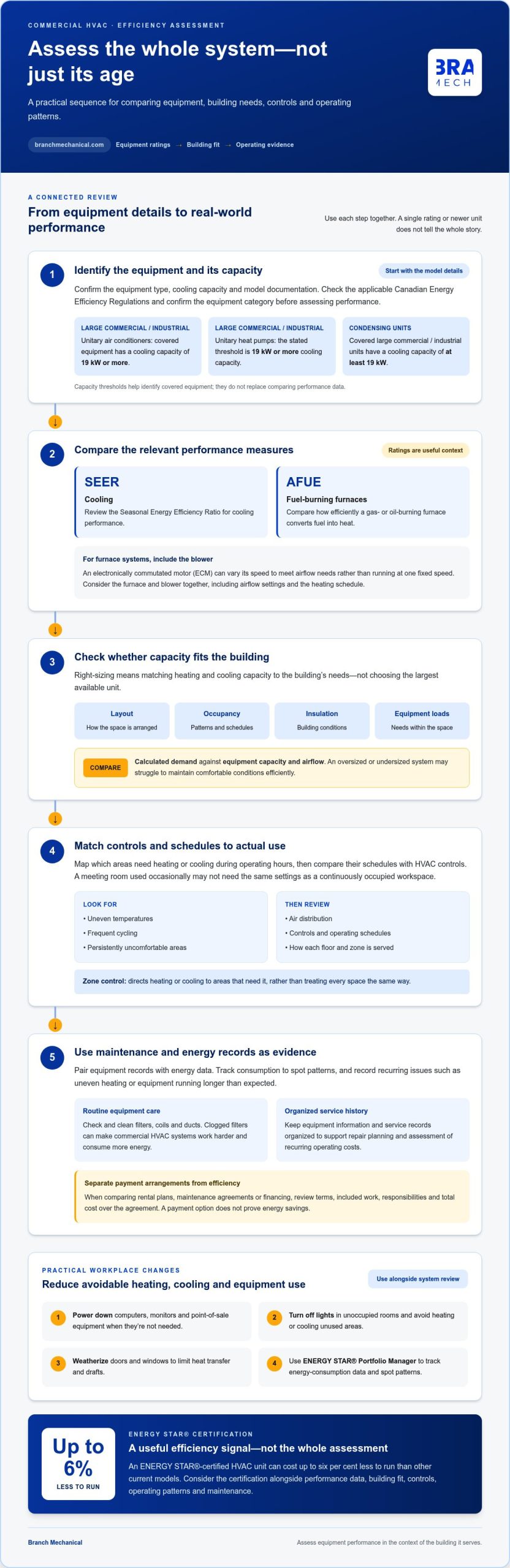
Assess efficiency by considering equipment ratings, operating conditions and the building’s actual heating and cooling demands. In Canada, check the applicable Energy Efficiency Regulations and performance measures such as SEER for cooling and AFUE for fuel-burning furnaces.
Regulatory coverage depends partly on equipment type and cooling capacity. According to Department of Justice Canada, large commercial or industrial unitary air conditioners covered by the Energy Efficiency Regulations have a cooling capacity of 19 kW or more. The same threshold applies to covered large commercial or industrial unitary heat pumps: a cooling capacity of 19 kW or more.
Condensing units have a related threshold. According to Department of Justice Canada, large commercial or industrial condensing units covered by the Energy Efficiency Regulations have a cooling capacity of at least 19 kW. These capacity thresholds help identify covered equipment, but they don’t replace comparing performance data. Review the model’s documentation and confirm its equipment category before assessing its efficiency.
For commercial air conditioning in a large or multi-storey space, assess how the system serves each floor and zone. A central unit may face different cooling demands across offices, meeting rooms and busy public areas. Compare its rated performance with the operating schedule, building use and comfort needs. Note uneven temperatures, frequent cycling or persistently uncomfortable areas, then review air distribution and controls.
High-Efficiency Furnaces and ECM Blowers
For commercial heating, compare furnace AFUE ratings, which describe how efficiently a gas- or oil-burning furnace converts fuel into heat. Review the blower motor, too. An electronically commutated motor (ECM) can vary its speed to meet airflow needs, rather than running at one fixed speed. Consider how the furnace and blower operate together, including airflow settings and the building’s heating schedule. A high-efficiency label alone doesn’t describe the whole system.
Right-Sizing Heating and Cooling Systems
Right-sizing means matching heating and cooling capacity to the building’s needs, not choosing the largest available unit. Consider the layout, occupancy patterns, insulation and equipment loads. For example, a multi-storey workplace with different schedules may need a different distribution approach from a single open space. Compare calculated demand with equipment capacity and airflow. An oversized or undersized system may struggle to maintain comfortable conditions efficiently.
Follow a consistent assessment process before comparing replacement options: identify equipment type and capacity, review SEER or AFUE where relevant, and assess controls and operating patterns. Then compare proposed systems with the building’s heating and cooling requirements. This makes energy savings a practical performance question, not a decision based only on equipment age or a single rating. A higher rating is useful context, but the system’s fit matters, too.
What are some energy-saving ideas in the workplace?
Start with a plan that connects building use, equipment condition and energy records. Map the areas that need heating or cooling during operating hours, then compare their schedules with HVAC controls. An occasionally used meeting room may not need the same settings as a continuously occupied workspace. This review helps target operational changes that can reduce unnecessary energy use.
Build a maintenance routine around the equipment and the building’s operating conditions. Check and clean filters, coils and ducts: clogged filters can make commercial HVAC systems work harder and consume more energy. Record recurring issues, such as rooms that heat unevenly or equipment that runs longer than expected. These observations can point to maintenance or control adjustments that may improve performance.
A consistent service plan makes maintenance tasks easier to track. A preventative maintenance contract can organize planned inspections and routine equipment care. For businesses managing several systems, clear maintenance records also help staff prioritize repairs and assess recurring operating costs. Keeping equipment information and service history organized can support continuity.
When reviewing service arrangements, compare what each plan covers rather than focusing only on the payment structure. Rental plans, maintenance agreements and financing are different arrangements, so review their terms, included work, responsibilities and total cost over the agreement. Consider how the arrangement fits the equipment’s expected use and the organization’s budget. A payment option doesn’t prove energy savings: efficiency depends on system performance, operation and upkeep.
A clear comparison also helps with repair decisions. Document the fault, its effect on heating or cooling, and any history of repeat repairs. Then assess whether restoring the existing equipment will address the underlying issue or whether a system review is more appropriate. The decision depends on equipment condition, energy use, the space served and how reliably the system meets workplace needs. This keeps repair planning grounded in performance rather than guesswork.
- Power down computers, monitors and point-of-sale equipment when they’re not needed.
- Turn off lights in unoccupied rooms and avoid heating or cooling unused areas.
- Weatherize doors and windows to limit heat transfer and drafts.
- Use ENERGY STAR® Portfolio Manager to track energy-consumption data and spot patterns.
For a commercial heat pump, include its operating schedule and condition in the same review. Pair equipment records with energy data, then prioritize maintenance or control changes that address observed waste. A planned approach to commercial HVAC maintenance can help keep routine tasks and system findings organized.
Energy costs and potential savings
Heating and cooling can account for up to 60% of a commercial property’s energy bill. To estimate savings, compare energy consumption and bills before and after changes, while noting occupancy and weather conditions.
Energy and Operating-Cost Savings
Energy-efficient HVAC systems can reduce energy use in commercial buildings by up to 30%. Treat this as a potential reduction, not a guaranteed bill decrease: energy rates, equipment use, building conditions and operating hours all affect the result. Compare consumption over similar periods, then separate HVAC use from other loads where your records allow. This helps show whether lower energy use translates into meaningful operating-cost savings.
Climate and energy rates across Canadian provinces influence HVAC choices through heating demand and the relative cost of electricity and gas. Colder conditions increase the importance of heating performance, while local energy rates affect the cost comparison between electric heat pumps and gas-fired systems. Consider both the building’s climate needs and its utility bills before choosing equipment.
Use a straightforward baseline to assess potential savings:
- Gather energy bills and consumption records for comparable operating periods.
- Note changes in occupancy, schedules and weather that could affect energy use.
- Track HVAC adjustments, such as thermostat settings or control upgrades.
- Compare consumption and costs after changes, accounting for those conditions.
ENERGY STAR® Portfolio Manager can help businesses track energy-consumption data and spot opportunities to improve performance. Because a building’s energy bill covers more than HVAC, review operating schedules and other major equipment before attributing every change to heating or cooling.
Workplace Energy-Saving Measures
Start with actions staff can apply consistently. Heat or cool occupied rooms, power down equipment that isn’t needed, and turn off lights in empty spaces. Set thermostats to match workplace schedules instead of maintaining the same temperature in unused areas. These steps can reduce avoidable energy use while keeping occupied spaces comfortable.
Smart controls can achieve energy savings of 20-50 per cent while maintaining occupant comfort. They can adjust temperature settings based on occupancy, weather conditions and time of day. Review schedules and settings against actual use, especially in spaces with changing occupancy. Advanced controls work best when programmed around the building’s operations, not simply installed and left unchanged.
Building conditions matter, too. Weatherize doors and windows to limit heat transfer, and use adequate insulation to support consistent indoor temperatures. In a workplace with frequent drafts, improving the building envelope can reduce the heating or cooling load before equipment has to compensate. Combine these measures with regular HVAC maintenance to help the system operate as intended.
Track results over time. ENERGY STAR® Portfolio Manager can help reveal energy-use patterns, while utility bills show the financial effect of changes. Comparing similar operating periods makes it easier to assess savings and decide which workplace measures warrant continued attention.
Variable refrigerant flow and zone control
Commercial HVAC systems can use less energy when maintenance keeps airflow clear and controls reflect actual occupancy. Zone settings, smart controls and demand-controlled ventilation can adjust heating, cooling and fresh-air delivery to suit building conditions.
Variable refrigerant flow (VRF) systems connect indoor units to a shared system that adjusts refrigerant flow as zone demand changes. In commercial spaces, this lets separate areas receive heating or cooling according to their needs. Some VRF systems can heat and cool different zones simultaneously, which can help when sunlit offices warm up while shaded rooms remain cool.
Zone control divides a building into areas with independent temperature settings. A business can set separate schedules for offices, meeting rooms and reception areas instead of conditioning every space identically. The benefit comes from directing energy where and when it’s needed. Review zone boundaries, occupancy patterns and operating schedules before installation so the controls reflect how people use the space.
Smart HVAC controls can adjust temperature settings in response to occupancy, weather and time of day. For example, a programmed schedule can reduce conditioning in an unoccupied area, then restore the desired settings for its next scheduled use. Smart thermostats can also learn from user behaviour and track data. Before integrating a thermostat or controls, confirm they’re compatible with the HVAC system.
VRF equipment and smart controls work as a coordinated system. In a multi-use building, for example, controls can respond to a meeting room’s changing schedule while maintaining different settings in continuously occupied offices. Assess the building layout, heating and cooling patterns, ventilation needs and control strategy together. This helps determine whether the equipment and controls suit the site, rather than treating an upgrade as a single-unit replacement.
Demand-controlled ventilation adjusts ventilation rates as occupancy changes, using CO2 sensors to inform airflow. A meeting room with changing attendance, for instance, can receive ventilation based on its occupancy rather than a fixed rate throughout the day. Proper coordination matters: ventilation controls should respond to indoor conditions while supporting the building’s air-delivery requirements.
Pair controls with routine equipment care. Keep filters, coils and ducts clean, and review control schedules when workplace use changes. A practical review can follow these steps:
- Map zones against actual room use and occupancy schedules.
- Compare thermostat settings with the heating and cooling needs of each area.
- Review sensor readings and control responses during occupied and unoccupied periods.
- Track HVAC consumption after adjustments to understand how operation changes.
These checks connect equipment performance with day-to-day operation. If the system runs longer than expected, review zone schedules, sensor inputs, ventilation settings and maintenance condition before changing temperatures throughout the building.
ENERGY STAR-certified HVAC efficiency
ENERGY STAR® certification gives commercial property owners a useful efficiency signal when comparing HVAC models. The programme was launched by the U.S. Environmental Protection Agency. In Canada, consider certification alongside system capacity, building needs, operating schedules and utility consumption when assessing equipment.
An ENERGY STAR®-certified HVAC unit can cost up to six per cent less to run than other current models. This makes certification useful when assessing potential operating savings, but it can’t predict a particular building’s energy bills. Actual use also depends on climate, occupancy, controls, maintenance and how the system serves the space.
Check the exact model and equipment category instead of relying on a general product description. A commercial property may use different equipment for heating, cooling and ventilation, and certification information applies to the specific product identified. Record the model number and compare its published information with the existing equipment. This gives you a clearer basis for evaluating replacement options.
Certification is most useful as part of a broader comparison. Review the equipment’s capacity and efficiency information, then consider the building’s operating profile. For example, a warehouse with long operating hours has different demands from an office used during set business hours. Certification can help narrow the options, but suitability depends on how the model’s performance aligns with the site’s heating and cooling requirements.
Consider equipment and controls together. An efficient cooling system may still waste energy if it conditions empty spaces or follows an unsuitable schedule. Pair model comparisons with a review of thermostats, occupancy patterns and zone operation. For buildings with different needs across floors or departments, confirm that the proposed system can serve those areas appropriately.
Use this practical sequence when evaluating ENERGY STAR® models:
- Identify the existing equipment type and the spaces it serves.
- Compare the exact model’s certification and performance details.
- Review operating schedules, controls and maintenance conditions.
- Compare energy consumption and bills across similar operating periods after changes.
These steps help distinguish a useful efficiency improvement from a label considered on its own. They also give facility teams a consistent way to compare models, document decisions and review performance after installation. For commercial HVAC installation and service that supports an informed equipment decision, discuss your HVAC project.
Branch Mechanical: Commercial & Multi-Residential Mechanical Contracting
Branch Mechanical helps businesses assess, maintain and upgrade the mechanical systems that support building comfort and energy use. Its commercial HVAC installation and service can address equipment performance, while preventative maintenance contracts help organize ongoing system care.
Consider a professional review when energy records show persistently high consumption, equipment struggles to maintain comfortable temperatures or you’re planning a replacement. For a facility that relies on fuel-fired heating, commercial boilers and heating systems are also part of the efficiency picture. The right next step depends on the building, existing equipment and how each space is used.
Share your building’s needs and operating concerns with Branch Mechanical to discuss commercial mechanical support.
Make your next HVAC decision with confidence
Turn your findings into a practical next step. Gather recent utility records, note comfort or equipment concerns, and identify the spaces or operating periods that need attention. This gives your team a useful starting point for deciding whether to focus on controls, maintenance or a larger system change. Choosing energy efficient HVAC for businesses is an ongoing process, guided by how the building operates and what occupants need.
Branch Mechanical provides Commercial HVAC Installation & Service, Preventative Maintenance Contracts, and Commercial & Multi-Residential Mechanical Contracting. These services can support businesses planning an upgrade or seeking a structured approach to ongoing system care. Share your building’s priorities with Branch Mechanical to discuss a suitable next step.
Contact Branch Mechanical for HVAC help and move forward with a clear plan for your workplace.
Frequently Asked Questions
How can businesses reduce energy consumption?
A practical plan for energy efficient HVAC for businesses starts by comparing system run times with the building’s operating calendar. Check whether evening events, cleaning shifts or weekend work leave equipment running longer than needed. Review control overrides and sensor readings, then adjust schedules that don’t match how staff use each space. In Mississauga and Etobicoke, logs of operating changes and comfort issues can help facility teams identify useful adjustments.
How does energy efficiency save money?
Efficient equipment uses less energy to provide the heating or cooling a building needs, which can lower consumption-related utility charges. Savings depend on equipment operation and the way the utility bill is structured. For a clearer comparison, separate electricity and gas use, note changes in operating hours, and compare similar billing periods. This helps distinguish HVAC-related changes from shifts caused by production, occupancy or other building equipment.
What does an ENERGY STAR® certification mean?
ENERGY STAR® certification identifies products that meet the programme’s energy-efficiency criteria. The programme was launched by the U.S. Environmental Protection Agency. For a commercial purchase, match the certification to the exact model and equipment type under consideration. Then assess whether its capacity and features suit the building’s needs. Certification helps compare models, but doesn’t replace a review of operating conditions, controls or space use.
Will a new HVAC system save money?
A new system can lower energy costs if it replaces equipment that uses more energy than the building needs. Compare the existing system’s condition and actual energy use, its operating schedule, and the proposed model’s performance. A replacement that’s poorly matched to the space may not deliver its savings potential. For a Mississauga office, compare usage across similar seasons and account for occupancy changes before assessing results.
What energy-efficient HVAC systems are best for Canadian businesses?
The best system for energy efficient HVAC for businesses depends on climate, available energy sources, occupancy and heating or cooling requirements. A heat pump may suit a facility seeking electric heating and cooling, while a commercial boiler may fit a building designed around hydronic heat. Offices with varied room schedules may benefit from zoned controls. In Etobicoke, compare options with the property’s actual loads and utility costs instead of choosing by equipment type alone.
How much can businesses save by upgrading to high-efficiency HVAC?
Energy-efficient HVAC systems can reduce commercial building energy use by up to 30%. That figure describes potential energy-use reduction, not a guaranteed reduction in a particular business’s utility bill. Bill results depend on the system’s starting condition, operating hours, local energy rates and how the building is used. Track consumption before and after an upgrade, while recording changes that could affect the comparison.
What are the most energy-efficient commercial HVAC technologies and their pros and cons?
VRF systems can serve separate zones and, in some configurations, heat and cool simultaneously, but require careful design. Heat pumps provide heating and cooling, though performance and operating costs depend on climate and energy rates. Energy recovery ventilation can use energy from exhaust air to precondition incoming fresh air, but its value depends on ventilation needs and system integration. Compare each technology with the building’s layout and operating profile.
What HVAC efficiency ratings should Canadian businesses compare, such as SEER2, EER2 and COP?
Compare ratings only within the same equipment category and test basis. SEER2 indicates seasonal cooling efficiency, while EER2 compares cooling output with electrical input under specified test conditions. COP expresses useful heating or cooling output relative to energy input. For furnaces, AFUE describes fuel-burning efficiency. Review the manufacturer’s documentation for the exact model, and avoid comparing different rating methods as if they were interchangeable.