

A facility’s mechanical systems aren’t just background equipment; they are the circulatory and nervous systems that determine whether a commercial property thrives or drains its owner’s budget. In the Greater Toronto Area, where seasonal temperature swings are increasingly volatile, these systems face unique pressures that often lead to frequent breakdowns and skyrocketing energy bills. We recognize the difficulty of coordinating multiple contractors while trying to maintain 24/7 reliability for your tenants.
Managing a modern facility requires a proactive approach to ensure long-term stability. This guide will help you discover the core mechanical systems that drive building efficiency and show you how to manage them for long-term reliability. We’ll preview essential components ranging from the latest 2026 HVAC standards to integrated building automation, providing you with a clear roadmap to reduced operating costs. By the end of this reference, you’ll have the expertise needed to stabilize your facility’s performance and protect your investment in the Ontario market.
Key Takeaways
- Identify the “Big Three” infrastructure components, HVAC, plumbing, and electrical, that form the backbone of any habitable and efficient commercial building.
- Discover how viewing your mechanical systems as an integrated ecosystem rather than isolated parts can significantly lower your long-term operating costs.
- Explore the vital role of specialized systems like commercial refrigeration and Building Automation (BAS) in maintaining 24/7 reliability for your tenants.
- Learn the critical criteria for selecting a GTA contractor, focusing on the necessity of multi-trade expertise and specific Ontario-based insurance requirements.
- Understand why proactive maintenance contracts are the most effective way to protect your facility against the frequent system failures caused by Ontario’s extreme weather shifts.
What Are Mechanical Systems in a Commercial Facility?
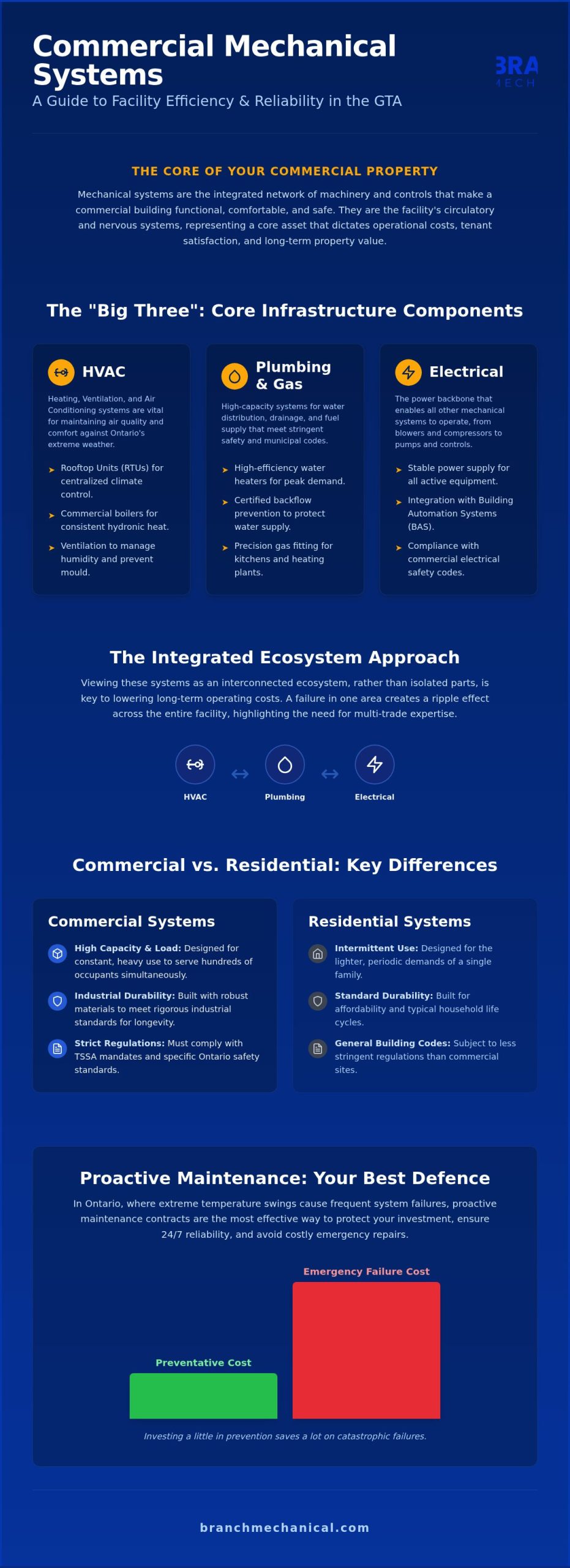
Mechanical systems are the integrated network of machinery and controls that allow a commercial building to function safely and comfortably. While the architectural shell provides the structure, it is the functional infrastructure that transforms a space into a habitable environment. Most industry professionals categorize these essential services as Mechanical, electrical, and plumbing (MEP) systems. These “Big Three” components work in unison to provide air, water, and power. In the Greater Toronto Area, the reliability of these systems is a matter of safety. With Ontario’s dramatic temperature swings, a failure in your facility’s heating or ventilation can lead to immediate tenant distress and potential property damage.
The Role of Mechanical Systems in Building Life Cycles
A facility’s mechanical infrastructure accounts for a significant portion of the building’s total market value. It isn’t just an operational cost; it’s a core asset. The operational health of your mechanical systems determines your property’s resale potential and your ability to retain high-quality tenants. Modern facilities in Mississauga and Etobicoke require far more sophisticated integration than the legacy buildings of previous decades. Today’s commercial spaces rely on interconnected sensors and high-efficiency equipment to meet modern environmental standards and occupant expectations. If these systems aren’t maintained, the building’s value depreciates rapidly.
Commercial vs. Residential Mechanical Needs
Scaling for load is the primary differentiator between residential and commercial mechanical needs. Commercial systems are designed for higher durability and must meet rigorous industrial standards. For instance, commercial gas fitting requires specialized licensing to handle the high-pressure demands of large-scale heating and kitchen equipment. The equipment used in these settings is built to withstand constant use, unlike residential models that only run intermittently.
The regulatory environment in Ontario adds another layer of complexity. Commercial sites must comply with TSSA (Technical Standards and Safety Authority) mandates and specific Ontario safety standards that don’t apply to single-family homes. Multi-residential plumbing and heating systems also face unique challenges, such as maintaining consistent water pressure across twelve floors or managing central boiler plants. These environments demand a level of technical precision and multi-trade expertise that ensures 24/7 operation for hundreds of occupants simultaneously. Reliability isn’t a luxury in this sector; it’s a legal and operational requirement.
Core Infrastructure: HVAC, Plumbing, and Electrical
Essential mechanical systems function as a unified loop where every component relies on the next to maintain building stability. A failure in one area creates a ripple effect across the entire facility. For instance, your HVAC equipment depends on a steady electrical supply to power blowers and compressors, while your heating systems require precise gas fitting to function safely. Managing these high-capacity systems requires a contractor who understands this interdependency and can navigate the complexities of large-scale infrastructure.
Commercial Heating and Cooling (HVAC)
GTA winters demand robust solutions like rooftop units (RTUs) and commercial boilers. RTUs are the workhorses of many Mississauga retail spaces, providing centralized climate control in a compact footprint. In contrast, multi-residential towers often rely on commercial boilers to provide consistent hydronic heat during extreme cold snaps. Ventilation is equally critical for air quality. During humid Ontario summers, your ventilation system must manage moisture levels to prevent mould growth and maintain tenant comfort. Investing in preventative maintenance contracts is the most effective way to extend the life cycle of these expensive assets and avoid emergency repairs during peak seasons.
Commercial Plumbing and Gas Fitting
Commercial plumbing involves much more than simple piping. It encompasses high-efficiency water heater installations designed to meet the massive peak demands of hotels or multi-residential complexes. These systems must also include certified backflow prevention to protect the municipal water supply, a mandatory requirement for Ontario commercial sites. Gas fitting is another high-stakes area. Whether you’re operating an industrial kitchen or a large-scale heating plant, precise gas line sizing and pressure regulation are vital for safety and efficiency. Common challenges in Mississauga warehouses often include maintaining water pressure across expansive footprints and ensuring all gas-fired equipment meets current TSSA safety codes.
Electrical systems act as the power source for every other mechanical component in the building. From the motors driving your pumps to the sensors monitoring your air quality, electricity is the lifeblood of the facility. Without a stable and properly distributed power supply, even the most advanced mechanical systems cannot perform their functions. Choosing a partner with multi-trade expertise ensures that your electrical, plumbing, and HVAC systems are synchronized for maximum reliability and 24/7 operation.
Specialized Systems: Refrigeration and Building Automation
Specialized mechanical systems often represent the highest risk for operational downtime in a commercial facility. While HVAC and plumbing provide the basic comfort, refrigeration and automation systems support the specific business functions that generate revenue. For GTA businesses in the food, hospitality, and logistics sectors, these systems are non-negotiable assets. They require a higher level of technical precision because their failure often leads to immediate financial loss. These specialized components rely heavily on electrical stability. Power surges or poor wiring can burn out expensive compressors, proving that these systems must be managed as part of a synchronized infrastructure.
Think of the Building Automation System (BAS) as the brain of your facility. It acts as the central hub that coordinates the “Big Three” systems discussed earlier. Modern BAS integration allows for 24/7 monitoring without the need for constant manual inspections by your staff. This proactivity is essential for catching a failing pump or a refrigerant leak before it triggers a total shutdown. Automation reduces the labour required for routine checks, allowing your team to focus on core operations while the software maintains the building’s equilibrium.
Commercial Refrigeration and Kitchen Ventilation
Industrial freezers and walk-in coolers require precise calibration to meet Ontario health and safety standards. Regular maintenance of these units is the only way to prevent catastrophic inventory loss. Beyond cooling, specialized kitchen ventilation is a critical fire safety component for GTA restaurants. It effectively removes grease-laden vapours that could otherwise ignite in the ductwork. You should watch for signs like excessive ice buildup, rising internal temperatures, or motors that cycle constantly. These symptoms indicate that your refrigeration system needs immediate emergency service to prevent a total mechanical failure.
Building Automation and Energy Management
BAS technology is the primary tool for controlling Ontario’s high electricity costs. By monitoring HVAC and lighting in real-time, these systems ensure energy isn’t wasted on empty zones or during off-peak hours. The transition from legacy pneumatic controls to integrated digital energy management is now a necessity for modern sites. According to current standards, buildings over 25,000 square feet benefit significantly from DDC (Direct Digital Control) systems that collect data at 15-minute intervals. Remote monitoring allows technicians to identify a mechanical failure before you even notice a temperature change. This shifts your strategy from reactive crisis management to planned, predictable maintenance.
The Integrated Ecosystem: Maintenance and Longevity
Mechanical systems perform best when treated as an interconnected ecosystem rather than a collection of isolated machines. In a modern GTA facility, the boundary between HVAC, plumbing, and electrical services is porous. A failure in one area rarely stays contained. For example, a minor electrical fault in a control panel can disable your Building Automation System, which in turn causes your rooftop units to cycle inefficiently or shut down entirely. This cascading effect can lead to tenant discomfort or even structural damage from frozen pipes during an Ontario winter. Consistent, professional service is the only reliable guarantee for uninterrupted business continuity in a high-demand commercial environment.
Shifting from a reactive mindset to a proactive strategy is the most effective way to manage long-term operating costs. Reactive repairs are inherently more expensive because they involve emergency labour rates, expedited shipping for parts, and the high cost of business downtime. By contrast, an integrated approach ensures that every component is synchronized for peak performance. You can secure this stability by partnering with a provider for Preventative Maintenance Contracts that cover your entire mechanical footprint.
The Value of Preventative Maintenance Contracts
A comprehensive mechanical audit is the foundation of any successful maintenance programme. These scheduled inspections go beyond a simple visual check. They involve testing electrical loads, verifying refrigerant levels, and inspecting boiler heat exchangers for signs of fatigue. By identifying minor wear and tear early, you can schedule repairs during off-peak hours rather than waiting for a system to fail during a July heatwave. This level of foresight provides property managers with the peace of mind that their facility is prepared for whatever the GTA climate delivers.
24/7 Emergency Services and Business Continuity
In the world of facility management, a “critical failure” is any event that threatens tenant safety, property integrity, or business operations. For Etobicoke warehouses or Mississauga multi-residential buildings, every hour without heat or refrigeration represents a tangible financial loss. This is why rapid response times are essential. A local partner who understands the specific layouts and common issues of GTA buildings can arrive on-site quickly to stabilize the situation. Emergency support isn’t just about fixing a leak; it’s about protecting your commercial assets and ensuring the safety of everyone inside the building at any hour of the day.
Choosing a Mechanical Contractor in Mississauga and Etobicoke
Selecting the right partner to manage your facility’s mechanical systems is a high-stakes decision that directly impacts your property’s bottom line. In Mississauga and Etobicoke, the technical requirements for commercial buildings are stringent. You need a contractor who doesn’t just fix isolated parts but understands the entire infrastructure as a single, functioning unit. Local expertise is vital because GTA-specific climate challenges, such as extreme humidity and rapid temperature drops, require specialized knowledge to keep equipment running efficiently. If you’ve been searching for mechanical contractors near me who offer a single point of contact for all your systems, understanding what separates a long-term partner from a quick-fix provider is essential.
A single-source contractor offers a distinct advantage by reducing communication errors between different trades. When one team handles your HVAC, plumbing, and electrical needs, the integration between these systems is seamless. This holistic approach prevents the coordination issues that often occur when multiple contractors are involved in a complex repair. By centralizing your maintenance, you ensure that every technician on-site has a complete picture of the building’s history and performance goals.
What to Look for in a Commercial Partner
Safety and compliance are the first hurdles. In Ontario, any business performing electrical work must be licensed by the Electrical Safety Authority (ESA) and carry at least C$2,000,000 in liability insurance. For heating systems, verify that your partner is TSSA certified to handle commercial boilers and gas fitting. Beyond paperwork, look for proven experience with large-scale multi-residential and commercial projects. A reliable partner must offer 24/7 emergency support and comprehensive maintenance plans to ensure your facility remains operational during peak seasons. They should also possess technical proficiency in modern building automation and energy management to help you manage the rising costs of utilities in Ontario.
The Branch Mechanical Advantage
Branch Mechanical serves as a methodical and conscientious expert for facility managers across the GTA. We provide a stabilizing presence, backed by a professional infrastructure that handles everything from kitchen ventilation to complex electrical services. Our team understands that your priority is a building that works without constant intervention. We take full responsibility for the results, offering integrated solutions across HVAC, plumbing, electrical, and refrigeration. This comprehensive coverage ensures your systems are synchronized for maximum reliability and longevity.
If you are looking for a partner who values predictability and precision, we are here to help. You can contact Branch Mechanical for your facility assessment to secure the long-term health of your building. We are committed to providing the professional, reliable service that Mississauga and Etobicoke business owners expect.
Securing Your Facility’s Operational Future
Building a reliable infrastructure requires more than just high-quality equipment; it demands a shift toward viewing your mechanical systems as a single, integrated ecosystem. By prioritizing preventative maintenance and modernizing your building automation, you protect your facility from the costly disruptions caused by Ontario’s volatile climate. We’ve explored how the synergy between HVAC, plumbing, and electrical services creates a foundation for long-term efficiency and tenant satisfaction.
Since 2012, we have served the Mississauga and Etobicoke communities as a full-service mechanical contractor across all trades. Our team provides the stability and technical expertise needed to manage complex commercial and multi-residential sites. Whether you require a routine audit or 24/7 emergency repair availability, we are the partner you can trust to maintain business continuity at any hour. Take the next step toward a more efficient, worry-free facility by choosing a partner who values precision and reliability.
Request a Consultation with Branch Mechanical and ensure your building operates at its peak performance for years to come. We look forward to helping you stabilize your property’s future.
Frequently Asked Questions
What are the most critical mechanical systems for a commercial building?
HVAC, plumbing, and electrical constitute the core infrastructure of any commercial property. These mechanical systems work together to provide a safe and comfortable environment for tenants. In specialized facilities like restaurants or warehouses, commercial refrigeration and kitchen ventilation also become critical components. Managing these as an integrated loop ensures that a failure in one area doesn’t compromise the stability of the entire building or lead to property damage.
How often should commercial HVAC systems undergo preventative maintenance?
Commercial HVAC equipment should be serviced at least twice per year, typically once before the heating season and once before the cooling season. In the GTA, the extreme shift from humid summers to freezing winters puts significant stress on rooftop units. High-demand facilities often benefit from quarterly preventative maintenance. This proactive schedule allows technicians to identify minor wear, such as frayed belts or clogged filters, before they cause a total system shutdown.
Is a building automation system (BAS) worth the investment for smaller facilities?
Modern Building Automation Systems provide a high return on investment even for smaller facilities by reducing manual oversight and energy waste. These systems act as a central hub, monitoring your facility’s performance 24/7. By automating temperature setbacks and lighting schedules, you can significantly lower Ontario electricity costs. A BAS also provides early warnings for potential equipment failures, allowing you to address issues during regular hours instead of paying for emergency service calls at night.
What are the TSSA requirements for commercial boiler inspections in Ontario?
In Ontario, the Technical Standards and Safety Authority (TSSA) mandates that most commercial boilers undergo an annual inspection by a licensed technician. This process ensures that pressure vessels, safety valves, and gas lines meet current safety codes. Maintaining a consistent inspection cycle is a legal requirement and a vital step in preventing catastrophic failures. Keeping detailed records of these inspections is essential for building compliance and maintaining your commercial insurance coverage.
What should I do if my commercial refrigeration system fails after hours?
If your refrigeration system fails after hours, you should immediately contact a provider that offers 24/7 emergency mechanical services. Avoid opening walk-in coolers or industrial freezers to maintain the internal temperature for as long as possible. Check your electrical panel for tripped breakers, but don’t attempt complex repairs yourself. Rapid response from a local Mississauga or Etobicoke contractor is the best way to prevent total inventory loss and protect your commercial assets.
How do mechanical systems impact a building’s energy efficiency rating?
Your facility’s mechanical systems are the primary drivers of its energy efficiency rating. HVAC, lighting, and water heating account for the majority of a commercial building’s utility consumption. Upgrading to high-efficiency boilers or installing variable frequency drives can drastically reduce your carbon footprint and operating expenses. An optimized system not only lowers monthly bills but also increases the overall market value of the property for future resale or attracting high-quality tenants.
Can one contractor handle HVAC, plumbing, and electrical services?
Hiring a single-source contractor to handle HVAC, plumbing, and electrical services is highly beneficial for facility managers. This approach ensures that all trades are synchronized and understand how the building’s systems interact. It eliminates the communication gaps that often occur when multiple contractors work on the same site. A multi-trade partner can provide a more holistic assessment of your building’s health, leading to more reliable 24/7 operations and simplified maintenance scheduling for your team.
How does the GTA climate affect the lifespan of rooftop HVAC units?
The Greater Toronto Area’s climate is particularly harsh on rooftop HVAC units (RTUs). The combination of heavy snow loads, rapid freezing and thawing cycles, and high summer humidity accelerates the corrosion and mechanical wear of external components. These fluctuations can shorten the equipment’s lifespan if it isn’t protected through a consistent maintenance programme. Regular cleaning of coils and ensuring proper drainage are essential steps to combat the local weather’s impact on your infrastructure.